
Feb 23, 2026 | Blog
Moving to the Baltics involves a inevitable collision with financial reality. Online statistics paint one picture; your first payslip paints another. While the government proudly announces rising averages, these figures often mask the deep divide between the capital’s tech sector and the rest of the economy. Rushing into a job offer without decoding “Gross” vs “Net” or understanding the “Winter Tax” (heating) creates budget deficits, not savings.
At De Civitate, we navigate legal and economic integration daily. We see expats land €3,000 roles and others struggle on €900. Whether you are checking latvian citizenship eligibility or relocating for work, your financial strategy must be based on net income, not recruitment brochures. This guide delivers the unfiltered truth about the average salary in Latvia and what you can actually expect to bank in 2026.
Average Salary in Latvia: The Numbers People Misread
Official statistics are dangerous if you read them superficially. In early 2026, the headline figure for the average wage in Latvia sits around €1,835 Gross (pre-tax). This number looks attractive compared to five years ago, but it is statistically skewed by high earners in Riga. The “median” salary—the number that splits the population exactly in half—is significantly lower, often trailing the average by €300–€400.
Most newcomers confuse “Gross” (Bruto) with “Net” (Neto). This is the costliest mistake you can make. Latvia’s tax wedge is substantial. A gross salary of €1,835 translates to roughly €1,360 in your pocket after taxes. When negotiating, always discuss “Neto” or have a calculator ready. Employers legally quote Gross; your landlord demands Net. Bridge that gap mentally before signing anything.
The concept of latvia average income also varies wildly by region. A “good” salary in Daugavpils is near-poverty in Riga due to rent differences. If you are comparing offers, ignore the national average. Focus entirely on the specific city and sector benchmarks.
Latvia Average Wage by Industry (Reality Check)
Salary ranges in Latvia are not a smooth curve; they are a series of cliffs. The gap between a senior developer and a retail manager is wider here than in many Western European countries. To give you a realistic baseline for 2026 negotiations, we have broken down the typical gross monthly offers across key sectors.
- IT & Tech. The undisputed king. Junior developers start at €1,600, but Seniors and Leads easily command €3,800–€5,000+. This is the only sector where Western salaries are matched or exceeded relative to the cost of living.
- Finance. Highly stratified. Compliance officers and AML specialists (high demand) earn €2,500–€3,500. Bank tellers or entry-level clerks hover closer to €1,200–€1,400.
- Sales & Customer Support. A common entry point for expats with languages. English-only support roles pay €1,300–€1,600. Adding German, Swedish, or Norwegian boosts this to €1,800–€2,200.
- Logistics. Supply chain managers see €1,800–€2,500. Warehouse operatives and drivers typically earn €1,100–€1,500, often supplemented by overtime.
- Construction. Skilled trades (electricians, welders) are in desperate deficit, pushing wages to €1,500–€2,000 (often with tax-exempt lunch allowances). Unskilled labor sits near the minimum wage.
- Hospitality. The lowest bracket. Waitstaff and hotel receptionists often earn €900–€1,100, heavily dependent on tips and summer season bonuses.
- Healthcare. Doctors vary wildly (€2,000–€4,000+), but nursing staff often struggle in the €1,200–€1,400 range, driving many to the private sector.
- Education. University lecturers earn decently, but school teachers average €1,200–€1,400, forcing many to take private tutoring gigs.
- Manufacturing. Factory floor roles average €1,000–€1,300. Engineering and plant management roles jump to €2,500+.
The Latvia average wage data reveals a clear “two-speed” economy. Technical skills or niche languages unlock the upper tier; general labor competes with a rising minimum wage (now €780 gross).
Riga vs Other Cities: Salary Differences That Matter
Riga is an economic island. The capital generates the vast majority of Latvia’s GDP, and salaries reflect this. The average gross wage in Riga hovers near €2,008, while the Latgale region struggles around €1,300. This 35% gap changes your entire financial model.
However, higher wages in Riga come with a “capital tax.” Rent for a one-bedroom apartment in the center costs €550–€700, whereas the same flat in Liepāja or Valmiera costs €250–€350. Transport costs and services are also higher.
Newcomers often find the “sweet spot” in satellite towns like Jelgava or Ogre. You earn a near-Riga salary (by commuting 40 minutes) but pay small-town rents. If you work remotely, moving to a regional hub like Cēsis allows you to leverage a high Riga salary against 50% lower living costs, significantly boosting your savings rate.
What Newcomers Can Realistically Earn (By Profile)
Your passport and language skills dictate your starting price. Without Latvian, your options are limited but well-paid. International Business Service Centers (BSCs) hire English speakers for IT support, KYC, and logistics, usually starting at €1,400–€1,600 gross. This is the standard “expat landing pad.”
Speakers of Russian find it easier to navigate daily logistics but typically do not get a salary premium unless the role specifically targets CIS markets. In fact, many high-paying corporate roles now strictly require English and Latvian, viewing Russian as a non-essential bonus.
EU vs Non-EU status impacts your bargaining power. EU citizens can switch jobs instantly, giving them leverage. Non-EU citizens tied to a specific employer via a visa often face “salary stagnation,” as employers know the administrative hassle of them leaving.
Remote workers employed by foreign entities but living in Latvia enjoy the best of both worlds. Earning a UK or German salary while paying Latvian taxes (especially if utilizing the micro-enterprise tax for freelancers) creates a massive purchasing power advantage.
Entry-Level vs Experienced: How Offers Are Actually Made
Standard contracts in Latvia include a 3-month probation period. During this time, it is legal to pay slightly less, though reputable companies usually pay the full rate. Be wary of “training wages” that drop below the minimum threshold.
Experience alone doesn’t always raise your wage; certifications do. In IT, an AWS or Azure cert is worth more than two years of generic experience. In finance, ACCA or CAMS qualifications instantly bump you to the senior bracket.
Negotiation in Latvia is direct. Do not expect a lowball offer that you are meant to counter by 20%. The first offer is usually close to the final budget. Asking for a 5-10% increase is normal; asking for 30% will likely end the interview process unless you have niche skills.
Take-Home Pay: Taxes and Deductions (Plain-English)
The gap between the average salary in Latvia and what hits your bank account is defined by three main deductions.
- Social Security (VSAOI). The employee pays 10.5%. This covers your pension, unemployment, and sick leave.
- Income Tax (IIN). Progressive in 2026. Roughly 25.5% for standard income levels (up to €105,300/year).
- Non-taxable Minimum. A portion of your salary (up to €550 depending on income) is tax-free.
Freelancers and self-employed individuals face a different beast. The “Self-Employed” status requires you to pay your own social tax (approx 31% on income over minimum wage). While the gross income might look higher, the lack of paid vacation and sick leave often makes employment financially safer for newcomers.
Red Flag: If an employer suggests paying the minimum wage officially and the rest in “cash” (envelope wages), run. You lose your pension contributions, your creditworthiness for mortgages, and your legal protection.
Can You Live Comfortably on the Latvia Average Wage?
Yes, but “comfortable” is relative. A net salary of €1,360 (the approximate average) supports a decent single life in Riga. The breakdown:
- Rent. €500 (decent 1-bedroom outside Old Town).
- Utilities. €150 (averaged year-round).
- Food. €350 (cooking mostly at home).
- Transport. €30 (monthly pass).
- Leftover. ~€330 for savings, fun, or clothes.
The “Winter Surprise” is the budget killer. In January/February, heating bills can spike by €200. If you have no savings buffer, the average wage feels tight during these months.
For families, a single average salary in Latvia is insufficient. Supporting a partner and child on €1,360 puts you near the poverty line after rent. A household income of €2,500+ net is the realistic baseline for a comfortable family life in the capital.
How to Increase Your Salary in Latvia (Fastest Levers)
Stagnation is common if you don’t actively manage your career. Switching employers remains the fastest way to jump tiers. Internal raises are typically capped at 5-10%, while moving to a competitor often yields 20%.
The Language Plan has the highest ROI. You don’t need to be a poet, but reaching B1 Latvian opens the door to 70% of the job market that is currently closed to you (including state sector and local management roles). It removes the “flight risk” label employers assign to expats.
Target International BSCs (Business Service Centers). Companies like Swedbank, SEB, Circle K, and various Scandinavian IT firms have large hubs in Riga. They standardize salaries based on regional benchmarks, meaning you get fair, transparent pay regardless of your negotiation skills.
Financial clarity is the foundation of a successful relocation. If you are navigating latvian citizenship eligibility or need legal support for your move, De Civitate helps you structure your life in the Baltics correctly. Check your eligibility today at https://latviancitizenship.eu/ today to ensure your paperwork supports your career goals.
FAQ
What is the average salary in Latvia right now?
As of early 2026, the gross average hovers around €1,835 per month.
What is the average wage in Latvia after tax?
For a gross salary of €1,835, the net (take-home) pay is approximately €1,360, depending on your non-taxable minimum and dependents.
Is the Latvia average income enough to live in Riga?
Yes, for a single person. You can rent a nice apartment and eat well. For a family, it is tight and usually requires a second income.
Which industries pay the most in Latvia?
IT, Finance, and specialized Engineering top the list. Senior roles in these sectors often pay double the national average.
Can I find a job in Latvia without Latvian?
Yes, primarily in IT, Customer Support (with other languages), and manual labor/construction. However, career growth without Latvian is limited.
Feb 21, 2026 | Blog
Choosing between Baltic and Central European passports is not about preferring mountains over beaches. It is about calculating your personal tolerance for specific types of bureaucratic pain. Latvia obsesses over historical timelines and geopolitical alliances, demanding absolute proof of pre-1940 existence. Czech Republic obsesses over continuous physical presence and economic independence, dissecting tax histories with surgical cruelty. Understanding these underlying mechanics prevents wasting years chasing incompatible legal pathways.
Overview of Latvian and Czech Citizenship Systems
Both nations rebuilt their legal codes entirely after Soviet bloc collapses. This means citizenship laws remain heavily influenced by repairing historical wrongs and protecting fragile national identities. They offer standard pathways through bloodline, long-term residence, and marriage to citizens. However, their administrative systems operate on entirely different frequencies. Latvian bureaucracy is highly digitized but incredibly rigid, whereas Czech bureaucracy relies heavily on physical paperwork, municipal stamps, and localized administrative decisions.
Latvian Citizenship Pathways
Navigating Baltic systems requires understanding that governments view citizenship as protective privileges, not tradable commodities. You cannot just buy your way in; anyone selling latvia citizenship by investment is lying to you, as only temporary residency by investment actually exists. Legitimate pathways to latvian citizenship require either proving historical bloodlines or surviving decades of linguistic and cultural testing. It is a marathon designed specifically to filter out uncommitted applicants. If you want to know how to get latvian citizenship in 2026, you must prepare for intense, unforgiving scrutiny.
Latvian Citizenship by Descent
Claiming heritage here is strictly tied to the interwar period. You must prove your ancestor was a citizen between February 16, 1918, and June 15, 1940. This is non-negotiable. If they left before 1918, you do not qualify for latvian citizenship by descent. Furthermore, retaining your current passport requires proving they fled or were exiled before March 11, 1990. Without hard archival evidence — like old military booklets or internal passports—your family stories mean nothing to migration officers.
Naturalization and Language Requirementsам
Naturalization is an endurance test lasting ten full years. You must hold a Temporary Residence Permit for five years, followed by a Permanent Residence Permit for another five years. There are no shortcuts. Once you hit the decade mark, you must pass language exams at the A2/B1 level. This is a Baltic language, completely unrelated to Slavic or Germanic tongues, making it notoriously difficult for foreigners. You must also sing the national anthem and pass exams on constitutional history, proving deep cultural assimilation.
Latvia Dual Citizenship Rules
This area catches many applicants off guard. Latvia dual citizenship is highly restricted and operates on a strict whitelist system. You can keep your second passport only if it belongs to an EU, EFTA, or NATO member state, or specific countries like Australia, Brazil, or New Zealand. If you are naturalizing from India, China, or South Africa, you must formally renounce your original nationality. The only exception applies to those claiming citizenship by descent as descendants of exiles, who are permitted to hold dual nationality regardless of their current country.
Czech Republic Citizenship Pathways
Central European approaches feel more traditional but come with intense financial scrutiny. The czech republic citizenship framework is built around integration, demanding applicants prove they are economically beneficial to the state. They do not care about your investment portfolio; they care about your tax history, local societal contributions, and health insurance continuity. Getting through this system means dealing with Ministry of Interior officials, who remain notoriously overwhelmed and slow. You must prove you are an asset, not a liability, before they even look at your language test scores.
Czech Citizenship by Descent
Central Europe redrew its borders constantly, making czech citizenship by descent legally complex. This pathway usually operates via declaration for those whose parents or grandparents were Czechoslovak citizens but lost their status due to emigration or specific historical treaties. You must navigate sections 31 and 32 of the Citizenship Act, which involve proving exactly when and how your ancestor lost their citizenship. If they were from Subcarpathian Rus or specific border regions, the claim might be entirely invalid.
Naturalization Requirements
Meeting czech citizenship requirements involves surviving five years on a Permanent Residence permit, which usually requires five preceding years on a temporary permit. Unlike Latvia, the language requirement here is a strict B1 level. Slavic speakers often pass easily, while others struggle for years. You must also pass the Life and Institutions exam, proving knowledge of Czech culture. Most importantly, you must demonstrate total financial independence, proving you never relied on state welfare and paid all social security taxes flawlessly.
Czech Citizenship Law Basics
The foundational update to czech citizenship law occurred in 2014, fundamentally modernizing how the state views its diaspora and immigrants. Before 2014, obtaining a Czech passport meant losing your original one. The updated law abolished this restriction entirely, embracing globalization. It also streamlined declaration processes for descendants, removing arbitrary generational limits that previously blocked grandchildren of emigrants from reclaiming their European rights.
Citizenship by Descent Compared
Bloodline claims look similar on paper but fail for completely different reasons in practice. Latvian archives are centralized, making proving cases a matter of finding correct pre-1940 ledgers in Riga. Czech claims often require navigating regional matrices and understanding complex Czechoslovak border shifts from twentieth-century conflicts. You must align your family tree perfectly with geopolitical maps of specific eras to succeed. Archival research in both countries requires professional translators, as local clerks will rarely answer emails written in English.
Eligibility and Generational Limits
Latvia imposes no generational limits on descent claims; if you are the great-great-grandchild of a 1920s citizen, you qualify, provided the documentation chain remains unbroken. Czech descent by declaration has specific limits depending on which exact legal section you use, often restricting claims to children or grandchildren of former citizens. Tracing lineage too far back in Czechia usually hits dead ends caused by Austro-Hungarian empire records.
Proof of Ancestry Documents
Both nations demand flawless vital records. You must provide birth and marriage certificates for every generation connecting you to your ancestor. These foreign documents must carry Apostille stamps and certified translations. In Latvia, name changes caused by transliteration are heavily scrutinized, requiring legal affidavits to prove “Jonas” and “John” are the same person. Czech authorities show similar pedantry regarding diacritics and surname endings.
Naturalization Compared
Earning passports through time spent on ground is an exhausting test of endurance in both nations. You are essentially volunteering for a decade of administrative audits and background checks. Latvian systems test cultural loyalty, forcing you to memorize national anthems and historical dates in difficult languages. Czech systems test economic loyalty, analyzing tax returns and employment histories ensuring you never touched public welfare funds. Neither country wants to naturalize someone who refuses to integrate deeply into local society.
Residence and Integration Rules
Latvian naturalization relies heavily on arbitrary integration metrics, like making you recite constitutional clauses aloud. Czech integration is mathematical; they calculate your exact days spent outside the country over ten years. If your absences exceed allowed limits, they reset your residency clock to zero. Czech B1 language tests are also significantly harder than Latvian A2 requirements, featuring complex grammar sections that fail thousands of applicants annually.
Dual Citizenship Comparison
This is where dreams of holding two passports usually live or die. Czech Republic is universally pragmatic, allowing you to hold multiple passports regardless of where you come from. Latvia remains highly protective, utilizing a strict whitelist of acceptable allied nations. If your home country is not on Latvian approved lists, you face brutal choices between heritage and current homes. You must analyze your specific geopolitical standing before submitting any permanent applications. Do not assume EU nations share identical dual nationality philosophies.
Processing Time and Document Burden
Speed is not a feature of either immigration department. You are entering pipelines that move at speeds of government funding, which always remains inadequate. Latvian digital infrastructure means files move cleanly between departments, but historical background checks drag on for twelve to eighteen months. Czech processing times are legendary for blowing past legal deadlines, often leaving applicants in limbo for over a year while regional offices shuffle paper. Do not plan international travel based on expected passport delivery dates.
Common Rejection Reasons
Rejections rarely happen because applicants are criminals; they happen due to tiny, arrogant administrative mistakes. In Latvia, failing to prove ancestors left before 1990 destroys descent claims instantly. In Czech Republic, having brief gaps in health insurance history from five years ago torpedoes naturalization applications. Bureaucrats in both capitals look for reasons to close files, not push them forward. You must audit your own life before giving them chances to do it.
Which Country Fits Different Applicants Better
Choosing battlefields depends entirely on starting resources and long-term goals. If you want streamlined, highly digitized processes and happen to be from NATO countries, Baltic routes are superior. If you are non-EU citizens who refuse renouncing original passports under any circumstances, Central European paths are your only viable options. Analyze your specific latvian citizenship eligibility and Czech constraints before committing decades of your life. Make sure you are fighting for passports you can actually keep. If the legal framework of the Baltic States matches your background, on the website https://latviancitizenship.eu/ you will find important recommendations for successfully overcoming these strict archival requirements.
Feb 2, 2026 | Blog
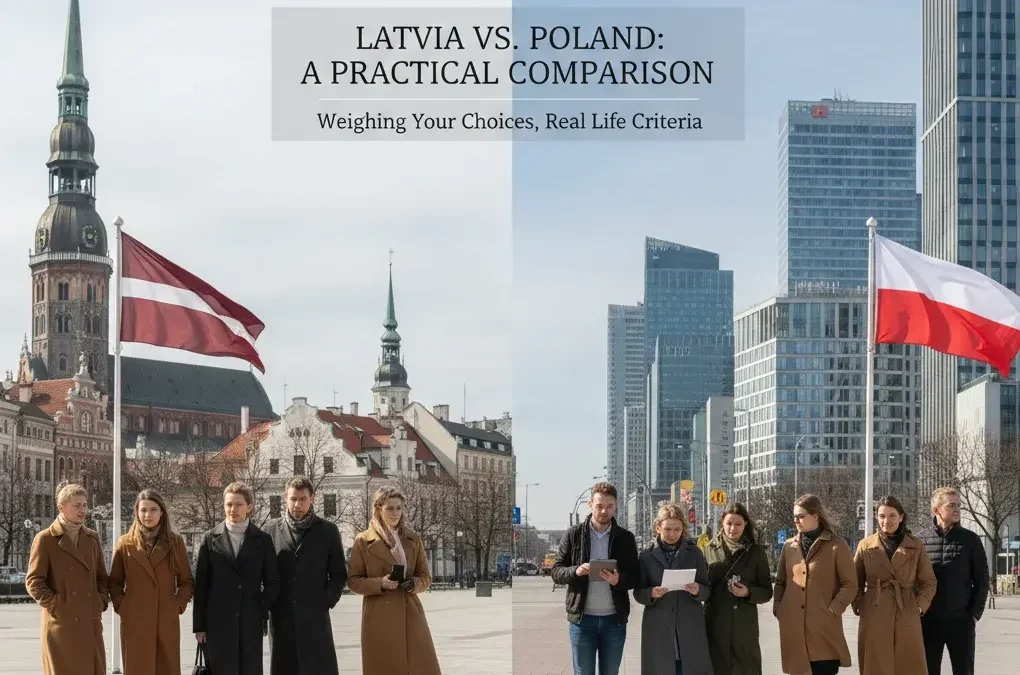
Choosing between Poland and Latvia is not just about picking a country; it is about choosing a pace of life. On one side, you have Poland—a massive, booming economic engine that feels like the “new Germany” of Central Europe. On the other, you have Latvia—a compact, digital, and serene Baltic state that values privacy and nature above the rat race.
For many potential expats, the choice is paralyzing. Both offer EU stability, NATO security, four distinct seasons. However, the day-to-day reality of living in Warsaw versus Riga is drastically different. At Latvian Citizenship, we help clients navigate legal relocation pathways, often seeing how initial expectations clash with reality. This guide strips away the marketing fluff to compare Latvia vs Poland on the metrics that actually impact your wallet, your mental health. If you have decided on Latvian citizenship eligibility, this article will help you better understand the intricacies of the issue.
Poland or Latvia—Who Should Choose What?
This decision usually splits candidates into two distinct camps based on their career stage and tolerance for chaos.
- Best for higher income + bigger job market. If your primary goal: aggressive career growth, networking, or maximizing a corporate salary, Poland is your winner. Warsaw, Kraków, Wrocław are genuine corporate hubs hosting giants like Google, JP Morgan, and endless shared service centers. The ceiling for earnings here is significantly higher, and the sheer volume of vacancies makes job hopping easier.
- Best for quieter lifestyle + smaller bureaucracy load. If you prioritize work-life balance, short commutes, digital efficiency, Latvia takes the crown. Riga offers big-city amenities without the crushing traffic or the frantic pace of Warsaw. Crucially, dealing with the Latvian migration office (PMLP) is generally faster and more predictable than navigating the notoriously overloaded Polish Voivodeship offices.
- Who will struggle. Non-tech workers without local language skills will face a hard ceiling in both countries, but the struggle is sharper in Latvia due to the smaller internal market. Families expecting Western European social benefits might also find the support systems in both countries “leaner” than expected, requiring two stable incomes to maintain a comfortable standard.
Cost of living Latvia vs Poland
A common myth: “Eastern Europe is cheap.” That era is ending. While both countries remain more affordable than Paris or London, inflation has reshaped the budget, particularly in major cities.
Rent: Riga vs Warsaw/Kraków/Gdańsk
Housing is where the divergence is most visible. Poland creates a high-pressure environment for renters. In Warsaw, a modern one-bedroom apartment often demands €800–€1,200 monthly, with frantic competition where tenants bid against each other. In contrast, Riga remains a renter’s market. A comparable renovated apartment in the center typically costs €550–€800. You get more square meters for your Euro in LT.
Utilities and Heating
Winter acts as the great equalizer. In PL, utility costs have risen but remain somewhat cushioned by government caps. In Latvia, the “winter shock” is a defining feature of the economy. Heating bills in older Riga buildings can be brutal, sometimes exceeding €300 in peak winter months. While Latvian rent is cheaper, the utility volatility is higher.
Food and Groceries
Poland—an agricultural superpower. Consequently, the grocery basket in Poland is noticeably cheaper—often by 15-20%—and offers wider variety. Latvia imports more consumer goods, leading to higher shelf prices for everything from dairy to vegetables.
Transport and Cars
Public transport is excellent in both, but owning a car is cheaper in Poland due to lower fuel costs and insurance rates. However, in Riga, you rarely need a car daily, whereas spreading out in Polish megalopolises often necessitates driving.
Healthcare and Kids
Private healthcare subscriptions (like LuxMed in Poland or various insurers in Latvia) are standard perks in corporate jobs. Out-of-pocket, private dentistry and specialists are roughly 10-20% cheaper in Poland. For families, private kindergartens in Warsaw are significantly more expensive (often €500-€800+) compared to Riga (often €300-€500), reflecting the higher demand in the Polish capital.
Salaries and Work Opportunities
The scale difference here is massive. PL is a nation of 38 million; LT has less than 2 million. This demographic reality dictates the job market.
Job Market Size and Sectors
Poland is the factory and back-office of Europe. It is easier to find work fast simply because there are more chairs to fill. Sectors like logistics, manufacturing, IT, finance are hungry for bodies. Latvia is boutique. The IT and fintech sectors are strong (think Printful, Twino), but outside of tech, the market for foreigners is narrow. You either fit a specific niche, or you struggle.
Salary-to-Expense Ratio
Who keeps more money at the end of the month?
- Junior/Mid-level. You might actually save more in Latvia because rent eats up less of your paycheck.
- Senior/Specialist. You will likely save more in Poland. The salary ceiling is higher, allowing you to out-earn the higher cost of living.
Remote
Work If you bring your own job (remote work), Latvia is often the superior base. The digital infrastructure is faster, the internet is among the best in the world, the lower density means you can afford a nicer home office than in crowded Warsaw.
Immigration and Legal Stay
This is where the user experience differs night and day.
Residence Permits
Getting a Temporary Residence Permit (TRP) in Poland is a legendary test of patience. The “Karta Pobytu” process can take anywhere from 6 to 18 months depending on the Voivodeship. You legally stay while waiting, but you are effectively grounded, unable to travel easily within Schengen.
Processing Times
Latvia functions with much stricter adherence to deadlines. A standard TRP application is processed in 30 days (or 5-10 working days if you pay extra). While the requirements are strict (they check every document thoroughly), the timeline is predictable. You are not left in limbo for a year.
Getting Banked and Registered
Bureaucracy in Latvia is highly digitized (e-signature is king). Once you have your ID card, you rarely visit an office. Poland is digitizing fast (mObywatel app), but physical visits to town halls for address registration (meldunek) and fighting banks for account opening as a foreigner remain frequent friction points.
Taxes and Paperwork
Nobody likes paying taxes, but the complexity of paying them matters.
Employees vs Freelancers
For standard employees, both countries use a “pay-as-you-earn” system handled by employers. The tax wedge is comparable (roughly 30-40% of total cost goes to the state). However, for freelancers and B2B contractors, Poland offers the famous “Ryczałt” (lump sum tax) system. For IT professionals, this can lower the effective tax rate to as low as 8.5% or 12% plus health insurance contributions. This makes PL a tax haven for high-earning developers.
Business Setup
LT offers a 0% corporate tax rate on reinvested profits (similar to Estonia). This is fantastic for startups that want to grow capital. You only pay tax when you take dividends. Poland’s system is more traditional and complex, requiring a good accountant to navigate VAT and ZUS (social security) labyrinths.
Hidden Bureaucracy
In Poland, the “hidden tax” is time. You spend time following up on permits, clarifying tax interpretations, or dealing with changing regulations. In Latvia, the rules are stable, but the scrutiny on “money laundering” (AML) is intense. Opening a business bank account as a foreigner in Latvia is harder than in Poland; banks are incredibly risk-averse.
Language and Integration
In Riga, you can live comfortably with English (and Russian, though its usage is politically sensitive). The younger generation speaks excellent English. In Warsaw or Kraków, English works in the city center, but dealing with plumbers, landlords, or older officials requires Polish.
Here is the hard truth: Polish is a Slavic language. If you speak Ukrainian or Russian, you will understand 40-60% quickly and speak decent conversational Polish within a year. Latvian is a Baltic language. It is distinct, archaic, difficult. Even for Slavic speakers, it requires serious, dedicated study. There is no “free” understanding.
Poles are generally more extroverted and chatty once the ice breaks. Latvians are more reserved, respecting privacy bordering on aloofness. Integration in Poland often happens through social gatherings; in Latvia, it happens through shared activities (choirs, sports, nature).
Safety and Stability
Both nations are NATO frontline states, meaning geopolitical awareness is high, but street-level reality is peaceful.
Street Safety
Both countries are incredibly safe by global standards. Walking alone at night in Riga or Warsaw is safer than in London or Paris. Violent crime is rare. Poland has a slightly higher incidence of road accidents (driving culture is aggressive). Latvia has issues with petty theft in tourist areas, but it is negligible.
Scams
Newcomers in PL face more rental scams simply because the market is hotter. Fake listings asking for deposits are common. In Latvia, the primary risk is usually employment scams targeting non-EU blue-collar workers promising visas that never materialize.
Healthcare
Public healthcare in both countries is underfunded and slow. Expect long queues. Private insurance is mandatory for a comfortable life. Poland’s private sector is larger and more competitive, meaning you can get an appointment faster than in Latvia’s private clinics, which are suffering from staff shortages.
Housing Market: Availability and Quality
We touched on price, but availability is the killer in Poland.
Rental Market Stress
In Warsaw, you might attend a “casting” for an apartment with ten other people. You need to decide instantly. In Riga, you can usually view a flat, think about it overnight, it will still be there. The stress levels are incomparable.
Housing Quality
Latvia has a lot of non-renovated wooden and Soviet housing stock. Drafts and mold can be issues in cheaper units. Poland has seen a massive construction boom. “New builds” (developerski standard) are everywhere, offering modern, warm, high-quality housing, albeit at a premium price.
Buying Property
Foreigners can buy apartments easily in both. However, buying a house with land in Poland requires a permit from the Ministry of Interior for non-EEA citizens, which takes months. Latvia restricts agricultural land but allows house purchases in cities more freely.
Lifestyle Fit: Cities, Pace, Travel, Nature
Warsaw feels like a metropolis—skyscrapers, subway, rush hour, anonymity. Riga feels like a large, cozy town. You run into people you know. Riga’s noticeably slower pace.
PL is a travel hub. With multiple major airports (WAW, KRK, GDN, WRO) and rail links to Berlin and Vienna, it is central. Latvia (RIX) serves as the Baltics’ hub with excellent air connections, while rail links to the rest of Europe remain under development (Rail Baltica approaches, but not yet complete).
LT is 50% forest. Nature is accessible immediately outside Riga. The coastline is public, sandy, and empty. Poland has mountains (Tatras) which Latvia lacks, but accessing nature from Warsaw requires a longer drive than accessing nature from Riga.
Choose Your Profile
To make this practical, identify yourself in these profiles:
- Single professional moving for work. Choose Poland. Better nightlife, more dating options, faster career ladder.
- Couple / family with kids. Choose Latvia. Safer pace, better work-life balance, accessible nature for weekends.
- Remote worker / digital nomad. Choose Latvia. Cheaper high-quality apartments, easy taxes, great internet.
- Entrepreneur / freelancer. Choose PL (for the B2B tax breaks) or LT (if building a startup to sell later due to 0% tax).
- Student. Choose Poland. More universities, vibrant student life, cheaper beer and food.
Which is better Latvia or Poland: how to decide on a choice?
The choice between PL and LT is rarely a tie. It trades off opportunity against livability.
Choose Poland if you are hungry—if you want to maximize earnings, don’t mind traffic jams, and thrive in a high-energy environment. This spot excels at building resumes.
Choose Latvia if you are seeking stability—if you want a European lifestyle where you can afford a nice apartment near the center, walk to work, and spend weekends in a pine forest. It is the best place to build a life.
For many of our clients at Latvian Citizenship, the deciding factor often comes down to the “hassle factor.” If you want a residency process that is strict but fast, Latvia wins. If you are willing to wait years for a passport but want a massive economy, Poland is the path. On our website https://latviancitizenship.eu/, we always honestly talk about all the intricacies of obtaining citizenship.
FAQ
Which is better Latvia or Poland for cost of living?
Latvia stands out for affordable renting. For food and daily consumer goods, Poland is cheaper. Overall, a single person spends slightly less in Latvia, while a family might spend less in Poland due to cheaper groceries and clothes.
Poland or Latvia: where are salaries higher vs expenses?
Salaries are higher in Poland. For specialists (IT, Engineering), the purchasing power is generally higher in Poland despite the higher rent.
Is it easier to integrate in Poland or Latvia?
If you speak a Slavic language, Poland is much easier. If you rely only on English, Latvia (Riga) is slightly more accessible socially, though deep integration requires the local language in both.
Which country is safer day-to-day?
Both are extremely safe. Latvia has fewer road accidents; Poland has less petty theft in the capital. The difference is statistically negligible for an expat.
Where is immigration smoother for most people?
Latvia. The process offers transparency and wraps up in just 1-2 months. Poland’s immigration offices chronically buckle under pressure, pushing delays past a year.
Jan 30, 2026 | Blog
Relocating to the Baltics often looks straightforward on paper. The region is compact, relatively affordable, and increasingly popular among professionals, entrepreneurs, and families seeking long-term stability inside the EU. Yet almost immediately after arrival, most newcomers hit the same quiet but persistent question: should you rent first, or is it smarter to buy property right away? Buy or rent latvia this question worries everyone who is planning to move to this country.
In much of Western Europe, this dilemma barely exists. Long-term renting is normal. Tenants are protected, socially respected, and rarely questioned about their “plans to buy.” Latvia works differently. Here, ownership still carries emotional and cultural weight that outsiders often underestimate.
For locals, property is not just square meters. It signals security, independence, and permanence. Paying rent is frequently perceived as helping someone else build wealth, while owning even a modest apartment represents personal grounding. This mindset seeps into conversations, advice, and expectations — sometimes gently, sometimes with pressure newcomers do not immediately recognize.
Cultural confidence, however, can be misleading. Expats who rush into buying often discover that certainty alone does not protect against practical risks. Seasonal utility spikes, aging Soviet-era infrastructure, and legal nuances like divided ownership structures can quietly transform what looked like a rational purchase into a restrictive and costly obligation. Capital becomes locked inside an illiquid asset precisely when flexibility matters most.
At De Civitate, relocation cases repeat a familiar pattern. Housing decisions and immigration status are rarely separate issues, even when people assume they are. Whether someone is checking Latvian citizenship eligibility by descent or relocating for work, housing strategy needs to match legal reality. This guide does not push one option over the other. Instead, it explains when renting protects you — and when buying Latvia real estate genuinely starts working in your favor.
The Timeline Rule Most People Ignore
Before comparing mortgage rates or scrolling endless listings, it helps to pause and simplify. In Latvia, housing decisions are driven less by math and more by time. Visa type, residency horizon, and personal flexibility outweigh most financial calculations.
Short stays: 3 to 12 months
For short horizons, renting is not just convenient — it is the only rational option. Transaction costs hit immediately when buying. Notary fees, state duties (usually around 1.5% for private individuals), valuations, and agency commissions wipe out any theoretical upside. Buying and reselling within a year almost guarantees a loss.
Liquidity matters more than many expect. Even in an active market, selling property in Latvia takes time. While waiting, owners continue paying utilities, building management fees, and sometimes mortgage interest. For newcomers whose job situation, neighborhood preferences, or visa status may change quickly, flexibility has real financial value. Mobility reduces risk while plans are still forming.
Medium stays: 1 to 3 years
This is where mistakes often happen. People feel “settled enough” to consider buying, but lack lived experience. The safest approach here is simple: rent first, decide later.
One winter in a rental teaches more than dozens of property descriptions. February utility bills expose insulation quality, window seals, and heating systems in ways summer viewings never reveal. A freshly renovated apartment can feel perfect in July and still generate €350–€400 monthly bills in January due to poor energy efficiency.
This period also builds geographic intuition. You learn which streets stay noisy late into the night, where traffic bottlenecks appear, how reliable public transport actually is, and whether nearby schools or kindergartens live up to their reputation. These insights cannot be Googled. They are earned by living through routines.
Long stays: 3 years and beyond
Once the horizon stretches past three years, buying often becomes strategically sound. Rent in Latvia continues to rise gradually due to inflation and limited new rental stock. Mortgage payments for comparable properties, by contrast, tend to remain relatively stable over time.
Property in Riga also acts as a partial hedge against inflation. Instead of paying rent indefinitely, owners convert monthly housing costs into equity. The logic is not emotional; it is structural. Temporary permit holders benefit from flexibility. Permanent residents can afford commitment.
Latvia Rent Prices: Why Listings Never Tell the Full Story
Online platforms like ss.com display what locals call “cold rent.” This number looks attractive — until reality arrives in monthly invoices. Experienced residents calculate housing costs using a blunt but accurate formula:
Base rent + utilities (komunālie) = real expense
Ignoring utilities is the most common budgeting error newcomers make.
Riga benchmarks
Riga sets the tone. Renovated one-bedroom apartments (around 45–55 m²) in Centrs or the Quiet Center usually fall between €550 and €800+. These districts offer walkability, architecture, and proximity to offices and culture. They also come with limited parking and fierce competition for quality units.
Sleeping districts
Move slightly outward to Purvciems, Imanta, Teika, or Pļavnieki, and pricing shifts. Similar apartments often cost €300–€450. These areas may lack postcard charm, but they compensate with practical layouts, green courtyards, large supermarkets, and strong public transport links. Families and budget-conscious professionals often prefer them.
Regional cities
Outside Riga, Latvia rent prices drop noticeably. Liepāja, Valmiera, or Daugavpils can be 30–50% cheaper. An apartment costing €500 in the capital might cost €250–€300 regionally. Smaller job markets and car dependency matter, but for remote workers, regional cities often deliver excellent value.
Houses
House rent in Latvia remains niche and expensive. The rental culture focuses on apartments. Suburban houses in Mārupe, Babīte, or Baltezers usually start around €1,200 and can exceed €2,500 for modern, energy-efficient homes. Supply is limited, and many properties circulate through corporate or diplomatic networks.
Utility costs vary dramatically. In modern A-class buildings, winter heating may stay around €40–€60. In non-renovated panel buildings, heating alone can exceed €250. Combined winter bills frequently pass €350. Always ask for the previous January invoice. Refusal is a warning sign.
Renting Pitfalls Newcomers Often Miss
Most leases run for twelve months, but the risks hide in details. Foreigners are sometimes targeted simply because they urgently need registered addresses to complete residence permits or open bank accounts.
The most critical clause concerns residence declaration (deklarēties). Contracts must explicitly allow it. Without declaration, PMLP may refuse to issue residence cards. Some landlords avoid declaration to reduce taxes or request extra payment. This is a red flag. An apartment without declaration rights is legally useless for immigration.
Furniture definitions matter too. “Partially furnished” may mean only a kitchen and fridge. Older apartments may include heavy furniture owners refuse to remove. Clarifying expectations early prevents frustration and hidden costs.
Scams exist, though they follow predictable patterns. Claims of being “abroad” paired with requests for Western Union, Revolut, or untraceable deposits are classic fraud signals. Legitimate landlords meet in person, provide keys, and show ownership documents. Licensed agents add security but usually charge one month’s rent.
Buying Property in Latvia: What the Process Actually Looks Like
Buying property in Latvia is relatively efficient compared to many EU markets. Foreigners can generally buy apartments and houses in cities without restrictions. Agricultural land and forests are the main exceptions, especially for non-EU citizens.
After choosing a property, buyers typically sign a preliminary agreement and place a 10–15% deposit. Legal due diligence follows. Lawyers or notaries review the Land Registry (Zemesgrāmata) for liens, debts, ownership limits, and unauthorized renovations — a common issue in older buildings.
Funds should always move through an escrow account (darījuma konts). Money is released only after ownership is officially registered. This system minimizes risk.
One Latvia-specific issue is divided ownership (dalītais īpašums). The apartment is owned, but the land beneath it is leased. Owners pay recurring land lease fees, which may increase. Properties with land owned outright consistently retain higher value.
Rent vs Buy: Removing Emotion From the Math
House rent in Latvia will be profitable if you follow a few simple tips. Looking at a five-year horizon clarifies decisions. Paying €600 monthly rent equals €36,000 spent with no asset created.
Mortgage payments, even with interest, gradually build equity. Owners of a €100,000 apartment may repay €15,000–€20,000 of principal within five years. Market appreciation can add upside.
Banks usually finance 70–85% for residents with stable local income. Non-residents often need 40–50% down payments. For stays beyond five years, buying property in Latvia often becomes financially superior — functioning as forced savings rather than pure expense.
Hidden Costs That Quietly Break Budgets
Many relocation budgets fail not because of prices, but because of secondary costs locals take for granted.
Insurance is one example. Banks require full property coverage for mortgages, and renters increasingly insure belongings and liability. Policies are affordable, but skipping them is risky. Water damage in older buildings is common and expensive.
Maintenance funds (uzkrājumu fonds) surprise new owners as well. Buildings collect reserves for roofs, insulation, or elevators. In older buildings, fees can be meaningful even when nothing appears broken.
Finally, many “renovated” properties are only cosmetically updated. Without inspections, buyers may inherit outdated wiring, ventilation problems, or plumbing issues that surface months later.
Final Thoughts
Choosing between renting and buying in Latvia is less about formulas and more about alignment. Renting preserves flexibility. Ownership offers stability and long-term protection against inflation — but demands commitment.
Legal status always comes first. Clean residency simplifies everything: banks trust residents, landlords trust residents. If you are exploring Latvian citizenship eligibility or residence permits, De Civitate handles the bureaucracy — so housing decisions can be made calmly, not under pressure. buy latvia property and start a new stage of your life with professional advice at https://latviancitizenship.eu/.
FAQ
What is the average rent in Latvia right now?
During 2026, expect €450–€600 regarding decent 50 m² apartments inside Riga, excluding utilities. Prices rise slowly but steadily due toward inflation plus limited new supply.
Are Latvia rent prices cheaper outside Riga?
Yes, significantly — often 30-50% lower. But commuting costs (fuel, train tickets) plus time require consideration. Working remotely allows cities like Cēsis alternatively Liepāja offering high quality life regarding much less money.
Is it easy to buy property in Latvia as a foreigner?
Legally, yes. Processes remain open. Main hurdles involve not purchases themselves but passing strict bank AML (Anti-Money Laundering) checks. Proving legal origins regarding every cent used regarding purchases stays mandatory.
What are the biggest risks when buying property in Latvia?
Two biggest risks involve divided ownership (owing rent regarding land) plus unapproved renovations (leading toward fines alternatively difficulties selling later).
House rent in Latvia: is it worth it vs apartment?
Families needing space plus privacy benefit. Be aware: winter heating regarding standalone houses can reach €400–€800/month if heating systems stay outdated (e.g., old gas boilers alternatively poor insulation). Modern heat pumps remain essential regarding keeping costs down.
Jan 28, 2026 | Blog
Look, moving to a new country is always going to be an adventure. It is exciting, fresh, and full of promise. But let’s be real for a second about what it actually means to stay there permanently. There is a massive, legally defined gap between being a temporary guest who just rents an apartment and becoming a permanent member of the national family. You might spend years enjoying the stunning Art Nouveau architecture in Riga or taking weekend trips to the quiet, sandy coastlines of the Baltic sea, but as long as you are holding a temporary permit, you are just an observer. In the eyes of the state, you don’t fully belong yet. Naturalization changes that reality completely. It is the legal process of finally declaring, “I am not going anywhere. I belong here.” It transforms a foreigner into a participant with full rights. The road toward this status is full of challenges — national identity matters deeply in this region due to a very complex history — but the reward for your hard work is holding one of the world’s most powerful travel documents.
For many of the clients we assist every single day, Latvia citizenship by naturalization signifies the finish line of an exhausting, decade-long marathon. It isn’t like citizenship by descent, where you just need to find a lucky ancestor in some dusty archive to get a passport. This specific path is strictly about proving your integration through personal effort. It is about grit. Success here demands patience, years of your time, and a genuine, provable adoption of the local culture and language. But don’t let the difficulty scare you off. If you have already made this Baltic nation your home, securing your future through formal status is the only logical step left to take. We exist to help you break down these bureaucratic bridges so you can cross them without getting lost in the paperwork.
Overview of Latvian Citizenship by Naturalization
We see newcomers get confused about this all the time. They often misunderstand naturalization, mixing it up with simple residency permits or those flashy “Golden Visa” investment schemes. But there are distinct differences that every applicant needs to understand before they even start. Think of residency as a revocable permission slip — it is a temporary allowance that can vanish into thin air if the laws change or if you lose your job. Nationality, by contrast, stands as an irrevocable right that belongs to you forever. Grasping this core concept is crucial before you even think about downloading an application form.
What citizenship by naturalization means
Plainly speaking, naturalization represents the act of a foreigner becoming a citizen through the passage of time combined with active, proven integration. You aren’t born with these rights; you have to earn them through merit and dedication. The unspoken deal with the government operates simply: if you live locally for long enough, master the local tongue, and respect the laws, then full rights will follow. Unlike descent paths that focus on bloodlines and family trees, Latvian citizenship by naturalization examines your behavior, your loyalty, and your commitment. The system operates on merit. You prove your worthiness, and the state grants you protection and identity in return.
Who is eligible
The net is cast wide, yet the mesh remains tight to ensure quality control. Generally, the path opens for foreign nationals who have resided legally for a specific duration — usually five years of holding permanent residence status. Expats building careers in Riga, spouses of locals, or long-term students fit this profile perfectly. However, tourists, digital nomads, or short-term contract workers need not apply, as their roots are just too shallow. Demonstrating that your life centers physically in Latvia matters immensely. Spending ten months annually in Spain while only popping over to Jurmala for summer breaks will disqualify you immediately.
Key benefits for foreigners
Why endure the stress of exams and mountains of paperwork? Security and absolute mobility provide the best answers. Permits can vanish if employment ends or immigration rules shift unexpectedly, but status lasts forever. Holding a passport places the full weight of the European Union behind you. Living, working, or retiring anywhere from Lisbon to Helsinki becomes possible without asking anyone for permission. Voting rights, running for office, and voicing opinions on laws governing daily life also emerge, transforming you from a subject into an active participant.
Eligibility Requirements
Authorities do not hand out passports as party favors in this region. The bar sits high, ensuring that only truly integrated individuals pass the test. There are several specific boxes that require ticking, and missing even one triggers an immediate rejection.
Residency duration and conditions
The hard rules dictate five years of permanent residence before an application can even be filed. But there is a catch that catches many people off guard. Acquiring permanent status usually necessitates living locally for five years on temporary permits first. Thus, most newcomers are actually facing a ten-year timeline from their arrival day to passport day. During this decade, your stay must remain continuous. Disappearing for years and expecting the clock to keep ticking will fail. The Office of Citizenship and Migration Affairs (PMLP) checks travel histories meticulously to ensure your center of life remained in Latvia.
Language and integration requirements
Language hurdles trip up most candidates, serving as the primary filter for applicants. Getting by with English or Russian stops working at this stage. Passing the Latvian language exam remains mandatory. Merely saying “hello” or “thank you” falls short; demonstrating conversational fluency—usually at an A2 or B1 level—is essential. But the requirements extend further than just grammar. Tests also cover the Basic Principles of the Constitution, the National Anthem, and History. The state demands that future citizens understand its origins, its struggles, and its values.
Criminal record and good conduct
Your record must remain squeaky clean. Society wants good neighbors, not liabilities. A criminal record involving serious crimes, whether local or from an origin country, kills an application instantly. Even accumulating small administrative fines or unpaid debts can raise red flags during the review. Authorities run background checks spanning international databases like Interpol and Europol. Those asking how to get citizenship in latvia must start by keeping their noses clean and paying any fines immediately.
Other legal conditions
Legal income sources require documented proof. The state ensures applicants won’t burden the social welfare system immediately after naturalizing. Renouncing previous nationalities generally becomes necessary unless candidates hail from EU/NATO nations or countries holding specific reciprocal agreements. This decision weighs heavily, as giving up a birth passport represents a significant emotional and practical step.
Application Process
Bureaucracy often feels daunting to the uninitiated. It looks like a mountain of paperwork that requires climbing in a specific order. Skipping steps or guessing requirements leads only to delays.
Step-by-step guide to applying
The process runs linearly but strictly, requiring milestone completion in a specific sequence. Jumping ahead results in files returning to the bottom of the pile. Preparing fully before starting the journey often necessitates consulting resources like https://latviancitizenship.eu/ to verify latvian citizenship eligibility and gather the correct forms. Once you are ready, follow this path to avoid getting lost:
- Preparation: Gather your documents and start studying for the exams immediately.
- Submission: Submit your initial latvian citizenship application files to the PMLP for review.
- Testing: Receive your exam dates regarding language and history, then pass them.
- Verification: Authorities perform background checks and verify your income sources.
- Renunciation: Prove the abandonment of old allegiances if required.
- Oath: Swear loyalty to the Republic publicly.
- Collection: Receive your passport and national ID card.
Rushing the timeline always fails. Government gears grind slowly, so patience acts as the only viable strategy. Harassing the clerks speeds nothing up.
Required documents
Building a legal case demands serious organization. Substantial paper piles will accumulate. Walking in with just a smile works poorly; hard evidence works best. A standard application package usually requires these items:
- Current valid travel documents plus your residence permits.
- Proof regarding legal income (tax returns or employment contracts).
- Documentary evidence showing residence duration over the past decade.
- Police clearance certificates from your home nation.
- Photos and forms signed before officials.
Documents not in Latvian require translation plus notarization. One missing stamp causes bounces, restarting the review clocks. Double-check every single page before submission.
Processing timeline
Patience constitutes a requirement here, not just a virtue. Submitting files does not yield answers next week. Review processes typically consume 6 to 12 months. Security checks, exam scheduling, and final administrative decisions eat up time. Background questions can drag timelines further. Plan your life accordingly — booking celebratory trips too early risks disappointment.
Common mistakes to avoid
Identical errors appear constantly in this line of work. Pain arises because prevention remains simple. Applicants trip over small hurdles, setting progress back by months. Watch out for these pitfalls:
- Underestimating language. Thinking “winging it” works on exams proves fatal.
- Residence gaps. Leaving borders too long breaks continuity unnoticed.
- Incomplete tax records. “Under the table” work fails to prove legal income.
- Ignoring dual rules. Applying without realizing old passports might vanish.
Avoid these errors, and the path smooths out. Clean files move through the systems faster than messy ones.
Rights and Benefits
Surviving the exams and waiting periods yields results. The status shift is profound. Outsiders become insiders.
Voting and civic participation
Passports provide voices. Voting in parliamentary (Saeima) and municipal elections becomes possible. Running for office opens up. Signing initiatives to change laws becomes a right. Policies affecting taxes, streets, and schools fall partially into citizens’ hands. Long-term residents find the shift from passive observation to active participation empowering.
EU mobility and work rights
Clients value this benefit massively. A local passport equals an EU passport. Freedom of Movement activates. Moving to Paris, Berlin, or Rome tomorrow with automatic work rights becomes reality. Permits no longer tether individuals to Riga. How to get latvian citizenship answers questions about opening doors to entire continents, not just one nation.
Social and economic benefits
Full safety nets open up. Consular protection activates if trouble strikes abroad — diplomats fight for nationals. Restricted jobs in government, military, or high-security sectors become available. Banks view citizens as lower-risk borrowers compared to temporary residents, granting easier access regarding loans and mortgages.
Dual citizenship rules
Tricky parts emerge here. Laws modernized in 2013, yet restrictions remain. Keeping existing nationalities works only if the countries belong to the EU, NATO, EFTA, Australia, Brazil, or New Zealand. Candidates from Russia, Belarus, or many non-Western aligned nations pursuing how to get citizenship in latvia generally must renounce their current status. The choice is binary. This step often proves the hardest for applicants from affected regions.
FAQ
How long does the process take?
From handing in papers to holding passports, budget approximately one year. Simpler cases move faster, yet bureaucratic wheels turn at distinct paces. Rushing proves impossible; using time for language perfection works best.
Can dual citizens apply?
Yes, but checking specific rules regarding your current passport comes first. Holding nationality from the USA, UK, or Germany offers safety; possessing both works. However, holders from Russia, India, or China almost certainly must renounce their origins. Knowing this beforehand prevents shock.
Is language proficiency mandatory?
Absolutely. No way around exists unless candidates exceed age 65 or possess specific medical disabilities. For everyone else, pathways start with textbooks. Speaking, reading, and writing at conversational levels remain mandatory. Society demands this admission price.
Where to find official guidance?
The ultimate authority rests with the Office of Citizenship and Migration Affairs (PMLP). However, navigating legal jargon frustrates non-native speakers. Consulting legal experts or specialized agencies ensures correct rule interpretation before file submission occurs.
Jan 6, 2026 | Blog
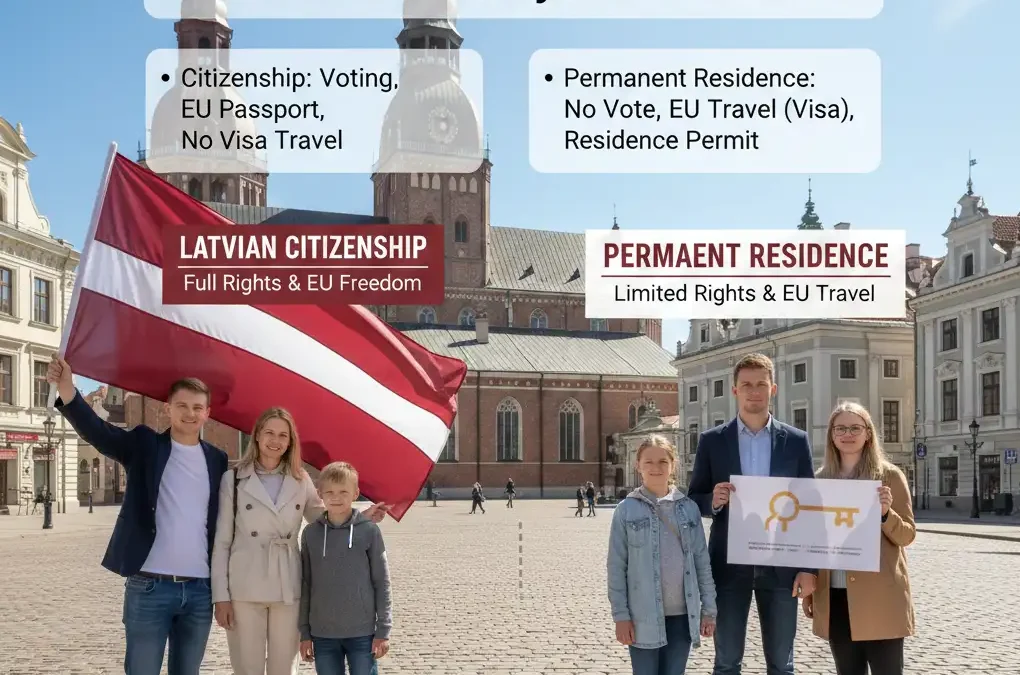
Relocating toward the Baltic region involves navigating complex legal ladders. For uninitiated individuals, lines between “allowed staying” versus “belonging” appear blurry. Living in Riga, paying bills, enjoying local culture—what constitutes the difference? Legally, massive gaps exist. One status treats holders as guests on renewable contracts; another hands over keys toward statehood itself.
Understanding distinctions involves more than paperwork; future security hangs in balance. Seeking temporary bases running businesses versus wanting safety nets provided by European passports revocable by no politician? Our guide breaks down raw realities regarding Latvia Citizenship vs Permanent Residence during 2026, stripping away legal jargon ensuring clarity on standing.
Overview: Legal Tiers
Consider immigration systems as tiered memberships. Starting with day passes, hopefully working up toward lifetime ownership.
Latvia Citizenship Explained
At absolute peaks lies Latvia citizenship. More than travel documents, such status represents total legal mergers between individuals plus the Republic. Voting, running for office, and—crucially—leaving for decades coming back remains possible. Irrevocable (barring fraud), flowing through bloodlines toward children.
Latvia Residency Explained
Lower rungs feature Latvia residency. Administrative permission slips. Privileges defined strictly by dates. Allows foreigners inhabiting territories regarding specific reasons—work, study, family. Unlike full national standing, permissions remain fragile. Breaking laws, losing jobs, spending excessive time within Spain causes vanishing overnight.
Resident of Latvia — Legal Meaning
Being a resident of Latvia simply implies existing on grids. Having registered addresses, personal codes (persona kods), eID cards. Do not confuse such with being “nationals.” Individuals remain citizens regarding home countries—USA, Ukraine, India—while acting as fiscal subjects regarding Baltic jurisdictions. Paying taxes locally, yet loyalty legally belongs elsewhere.
What Constitutes Temporary Permission?
Expat stories typically start here. The “probationary period.”
Temporary Residence Permit (TRP) Overview
Technically, what is temporary residence? Plastic cards possessing expiry dates, usually issued spanning one to five years. Purely conditional. Granted because valid excuses exist staying. Maybe investing in startups, marrying locals. Catches? If excuses disappear—startups fold, divorces happen—permits often expire simultaneously.
Who Qualifies?
Eligibility remains strict. Moving simply liking architecture fails. Grounds required:
Investors: Buying real estate (high thresholds apply) or interest-free government bonds.
Workforce: Employees possessing signed contracts, including high-skilled pros holding EU Blue Cards.
Students: Enrolled full-time within accredited programs.
Family: Spouses plus children regarding current residents.
Rights & Limitations
Holders receive famous Schengen perks—90 days visa-free travel every 180 days across Europe. Accessing local healthcare (often paid/insurance-based), putting kids in schools. Real limitations exist. Voting impossible. Moving toward Germany working requires obtaining new visas. Anxiety regarding renewal remains constant—every year or two, proving worthiness staying mandatory.
Defining Permanent Status
True game-changers. Shifts from “guest” toward “local.”
Indefinite Authorization Explained
Permanent Status (PR) represents indefinite authorization. Unlike TRP, standing itself never expires, though renewing physical cards every 5 years (like driver’s licenses) necessary. Signifies surviving probationary periods, effectively making Republics home bases.
Eligibility Criteria
Upgrading from temporary tiers typically requires clocking 5 years continuous life on ground. “Continuous” remains keyword. Absence cannot exceed 6 months consecutively or 10 months total over five-year spans. Taking gap years in Bali resets clocks. Plus, hurdles exist: state language exams (Level A2). Basic conversational skills, filtering those refusing integration.
Rights & Obligations
Indefinite status holders enjoy near-equality alongside nationals. Full access toward social benefits, state healthcare, labor markets. Crucially, “ground” requirements vanish. Quitting jobs, being unemployed, retiring possible without expulsion. Part regarding systems now. However, voting remains impossible, moving simply toward Paris working prohibited. Permanent residents locally, not elsewhere.
Acquiring Full Membership
Severing last ties being foreigners requires naturalization final steps.
Pathways Toward Status
Two main highways exist: restoration (diaspora) plus integration (settlers).
Citizenship by Naturalization
The marathon. Requires 10 years total legal stay (usually 5 years TRP + 5 years Indefinite Leave). Time insufficient. Proving “belonging” mandatory. Passing fluency exams (Level B1/B2), knowing history, constitution, national anthem. Proving legal income sources necessary. Merit-based filters designed ensuring only fully integrated obtain passports.
Citizenship by Descent
“Exile Category” represents shortcuts. Ancestors holding national standing before 1940 fleeing occupation means residency clocks apply not. Reclaiming standing from anywhere globally without speaking languages or living within Riga possible.
Key Requirements
Understanding how to obtain Latvian citizenship requires looking at records. Must remain spotless. No criminal history, unpaid taxes; documented loyalty proof mandatory. State security services (VSD) vet applicants ensuring constitutional order threats non-existent.
Citizenship vs Permanent Residence: Comparisons
Breakdowns regarding choosing options follow.
Legal Rights & Mobility
Indefinite status holders remain geographically stuck. Rights exist domestically. Wanting work within Berlin means starting square one, applying visas like third-country nationals. Citizens possess EU Freedom of Movement. Relocating toward 27 member states, working permit-free, retiring within Spain/Italy holding full rights possible. Mobility constitutes single biggest asset regarding passports.
Renewal Requirements
Indefinite Leave holders possess leashes. Physically living locally mandatory keeping standing. Leaving exceeding 12 months risks losing status. Citizens possess no leashes. Living within London, Tokyo, New York decades possible; passports remain valid. Burgundy booklets offer freedom from geography.
Political Voice
Only nationals shape futures. Voting within Saeima (Parliament), European Parliament elections possible. Permanent residents generally spectators regarding democratic processes, although some municipalities grant local voting rights.
Travel Benefits
Indefinite status holders travel using home country passports (Russian, American) plus local ID cards. Citizens travel using Latvian passports, opening doors visa-free toward USA (ESTA), Canada, Australia, UK. Weak current passports make such massive lifestyle upgrades.
Timeline Comparisons
Patience constitutes currency regarding migration.
Temporary Durations
TRP quick—usually processed within 1-3 months. Solves immediate problems “getting in.”
Permanent Durations
Indefinite Leave represents medium-term goals. Takes 5 years grinding through temporary renewals.
Full Status Timelines
Regarding naturalization, timelines achieving Latvian citizenship generally span 10 years (5 TRP + 5 Indefinite + processing). Regarding descent cases, lightning fast comparisons exist—often 6-12 months.
Selecting Better Options
Choices depend upon endgames.
Settled Residents
Built quiet lives within Riga, owning apartments, no desire working within France/Germany? Permanent Residence often suffices. Gives stability without stress regarding difficult language exams or emotional heavy lifting renouncing original nationalities (naturalization often requires).
Investors & Entrepreneurs
Business minds generally want passports regarding EU mobility. Registering companies within Dublin, opening branches within Milan without visa friction makes 10-year treks or ancestry searches worth every second.
Ancestral Applicants
Checking Latvian citizenship eligibility represents no-brainers. Offers passports immediately, protects dual allegiances (usually), requires zero residency. Ultimate heritage assets.
Seeking Clarity? Representing investors seeking permits or descendants looking restoring rights, professional guidance ensures avoiding wasting time wrong paths. Visit https://latviancitizenship.eu/ regarding expert assistance navigating Baltic legal landscapes.
FAQ
Living permanently without national standing?
Yes. Indefinite Leave designed exactly regarding such. Living entire lives locally as permanent residents without ever naturalizing possible.
Duration regarding processes?
Naturalization expects decades living locally. Descent cases much faster. Knowing how to get Latvian citizenship through ancestry saves ten years waiting.
Does Indefinite Leave lead toward full membership?
Yes, mandatory bridges. Jumping straight toward naturalization without holding Indefinite Leave first impossible.
Distinguishing TRP from Indefinite Leave?
TRP fragile; depends upon jobs/spouses, needs constant renewal. Indefinite Leave robust; depends only upon individuals living locally, offers safety nets similar toward locals.
Mandatory booklets regarding EU work?
No, simplifies everything. Working locally permits allow. Working freely across rest regarding blocs, passports represent master keys.
Page 12 of 14<...111213...>


 English [EN]
