
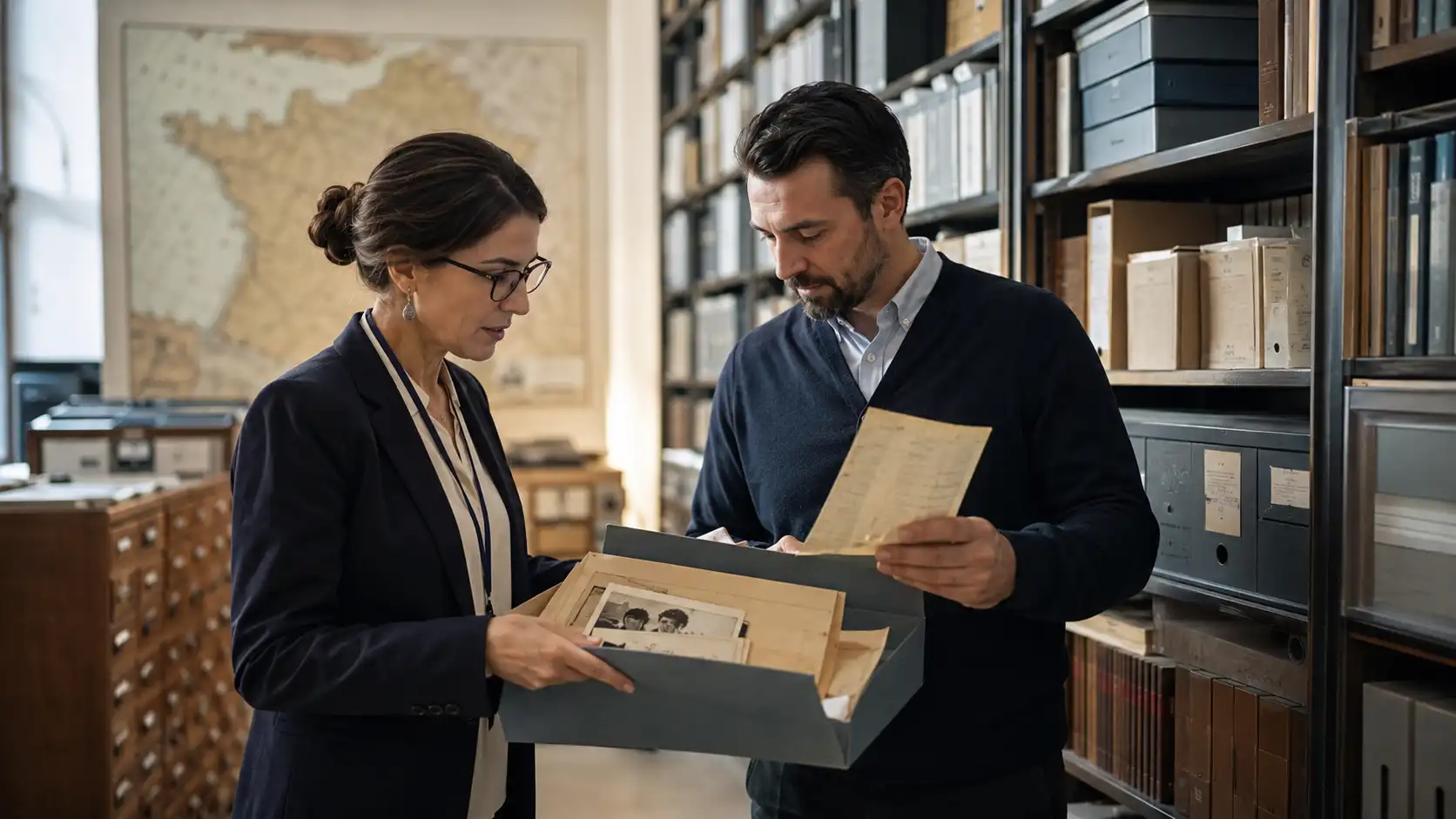
Latvian archive records can be essential when a family no longer has an ancestor’s original passport, birth certificate, residence document, or other evidence connecting that person to Latvia. They may help identify the ancestor, establish where the person lived, confirm family relationships, and document Latvian citizenship or membership in Latvia’s pre-war community of citizens.
However, finding an ancestor in a Latvian historical record and proving eligibility for Latvian citizenship by descent are not necessarily the same task. A birth entry may establish birthplace and parentage without proving citizenship. An internal passport file may provide stronger evidence of identity and residence, but its legal significance still depends on the applicant’s citizenship category and the complete documentary record.
This guide explains how to request Latvian archive records, what information to provide, which records may be relevant, and how to connect Latvian evidence with U.S. civil and naturalization documents.
Why Documents Matter in Latvian Citizenship by Descent Cases
Latvian citizenship by descent applications are usually assessed through documentary evidence. Family stories, photographs, online family trees, and DNA results may help with genealogical research, but they generally do not replace official records proving identity, family relationships, and the ancestor’s relevant legal connection to Latvia.
Depending on the applicant’s situation, the documents may need to establish several separate facts. The applicant may need to prove that the ancestor was the person identified in Latvian records, that the applicant descends from that person through a documented family line, and that the ancestor had the Latvian citizenship status required under the applicable legal pathway.
The records may also need to resolve inconsistencies. An ancestor’s Latvian name may have been transliterated into Russian, German, Polish, Yiddish, or English. A surname may have changed through marriage or been shortened after immigration to the United States. Dates and places of birth may differ among passenger lists, naturalization petitions, death certificates, and Latvian archive files.
For these reasons, a citizenship case is usually built from a consistent chain of evidence rather than from one isolated document.
What Latvian Archive Records May Help Prove
Latvian archive records for citizenship by descent may serve several different purposes. Some records establish ancestry, while others may provide evidence of residence, identity, citizenship, military service, property ownership, or participation in Latvian public life.
A Latvian birth or baptism record may identify the ancestor’s parents, birthplace, date of birth, religion, and parish. A marriage record may connect the ancestor to a spouse and explain later surname changes. Census, tax, residence, and passport records may show where the person lived and how the person was recorded by Latvian authorities.
For certain citizenship pathways, evidence connected to the period of Latvia’s independence before Soviet occupation can be especially important. Relevant records may include a pre-war Latvian passport, internal passport file, 1935 census information, tax administration records, military conscription files, citizenship documents, or other records produced by Latvian state institutions.
The legal value of a record depends on what it actually establishes. A document showing that an ancestor was born within the territory of present-day Latvia does not automatically prove that the person was a Latvian citizen. The authority may examine the document together with the ancestor’s residence, citizenship history, emigration, naturalization, and other available evidence.
Proof of Latvian Ancestry and Proof of Citizenship Are Different
People researching how to find Latvian citizenship records often begin by searching for a birth certificate. Although a birth record can be central to the family line, it may not answer the citizenship question by itself.
Proof of Latvian ancestry usually establishes that the applicant descends from a particular person connected to Latvia. Proof of citizenship addresses whether that ancestor belonged to the Latvian community of citizens at the legally relevant time.
The distinction is particularly important when searching for proof of Latvian citizenship before 1940. The phrase “before 1940” is commonly used in general discussions, but citizenship eligibility may depend on a specific historical date, legal category, and family history. Applicants should therefore avoid assuming that any pre-war Latvian document will be sufficient.
An archive request should identify both objectives. It may ask for records confirming the ancestor’s birth and parentage, as well as records that may demonstrate citizenship, residence, passport issuance, census registration, military conscription, or other official status.
Where Latvian Historical Records May Be Held
The correct institution depends on the type of document, the date of the event, the ancestor’s place of residence, and whether the applicant needs a historical archive copy or a current civil status certificate.
Latvian State Historical Archives
The Latvian State Historical Archives hold extensive collections covering historical institutions, churches, congregations, personal files, and the institutions of the Republic of Latvia during the interwar period. These collections may contain church registers, parish lists, census materials, passport files, tax records, military records, citizenship-related documents, and other historical sources.
The Latvian State Historical Archives are commonly relevant when an applicant is looking for Latvian citizenship records before 1940, internal passport files, historical birth and marriage entries, or records showing where an ancestor lived during the period of Latvian independence.
Not every record is indexed by name, and the archive may require sufficiently precise information before staff can identify the correct collection. A targeted request is usually more practical than asking the archive to research an entire family history without dates, locations, or record types.
Civil Registry Authorities
A Latvian civil registry authority may be the appropriate source for certain birth, marriage, or death certificates and official statements from civil status registers. The correct route can depend on when and where the event was registered and whether the person is living or deceased.
An applicant should distinguish between a historical copy of an original register entry and a newly issued civil status certificate or statement. Both may contain useful information, but they are different documents and may be obtained through different procedures.
Regional and Zonal Archives
Records created by local institutions may be held in a regional or zonal archive rather than in the main historical archive in Riga. This can be relevant for documents from cities and districts outside Riga, particularly when the records relate to local government, employment, education, property, or post-war administrative activity.
If the archive receiving the request does not hold the relevant collection, it may identify another division. Providing the historical place name and modern municipality can make that determination easier.
Latvian Genealogy Records Online
Online databases can help narrow the search before a formal archive request is submitted. Latvian genealogy records online may include digitized church books, civil registers, census materials, passport indexes, residence records, and databases prepared by genealogical organizations.
Raduraksti, FamilySearch, JewishGen, and other genealogy platforms may help identify a parish, year, household, record number, or archival reference. Some collections are indexed by name, while others require browsing images by location and date.
Online access should generally be treated as a research tool rather than an automatic substitute for an official archive document. An index entry may contain transcription errors or only part of the original information. Access restrictions and digitized collections may also change.
When an online database provides an archival reference, applicants should preserve it exactly. A reference identifying the archive, collection, inventory, file, page, or record number can significantly improve the accuracy of a later request.
Information to Gather Before Contacting the Archive
A productive archive request begins with a detailed profile of the ancestor. Even approximate information may be useful, but uncertainties should be identified rather than presented as established facts.
The request should include the ancestor’s full name and all known spelling variations. It should also provide the approximate date and place of birth, parents’ names, spouse’s name, religion or congregation if known, occupation, addresses in Latvia, and the approximate date of emigration.
For an ancestor from Riga, a street address or district may help distinguish between people with similar names. For an ancestor from a smaller town, the parish, congregation, estate, district, or historical county may be important.
Historical geography requires particular attention. A birthplace may appear under Latvian, Russian, German, Polish, or Yiddish names. The same town may have belonged to a different administrative district at the time the record was created. Providing both the historical and modern versions can help archive staff locate the correct collection.
U.S. records should be reviewed before sending the request. Naturalization petitions, passenger manifests, draft registrations, Social Security applications, marriage records, and death certificates may contain clues that are absent from family memory.
How to Request Latvian Archive Records
The most effective request clearly identifies the person, the record sought, and the purpose for which the document will be used.
Define the Purpose of the Request
State that the requested records are intended to support a Latvian citizenship by descent application or another official citizenship procedure. This helps distinguish a request for an archive statement or document copy from an open-ended genealogy project.
The request can explain that the applicant is seeking evidence of the ancestor’s birth, parentage, residence, citizenship, passport issuance, census registration, tax registration, or military status. It should not claim that the archive must confirm citizenship if the available records may establish only residence or identity.
Identify the Specific Records Sought
A broad request asking for “everything about my Latvian family” may be difficult to process. A more focused request could ask whether the archive holds a birth entry for a named person in a specified parish and year, a pre-war internal passport file, 1935 census information, a military conscription record, or documentation of Latvian citizenship.
When the exact record type is unknown, the request can describe the fact that needs to be established. For example, the applicant may ask whether the available collections contain records showing that the ancestor was registered as a Latvian citizen or resided at a specific address during the interwar period.
Provide Name Variations
Include every documented version of the ancestor’s name. Latvian surnames may use different masculine and feminine endings, while Russian-language or German-language records may use other spellings. U.S. records may omit diacritics, simplify consonants, translate a first name, or use an Americanized version.
Each variation should be connected to the source in which it appears. This makes it easier to understand whether the variations likely refer to the same person.
Request the Appropriate Form of Evidence
Applicants may need an official archive statement, a certified archival copy, a reproduction of the original record, or a combination of these documents. A plain transcription or informal email confirming that a record exists may be useful for research but may not be sufficient for an official application.
The request can ask the archive to explain what form of official document it can issue for citizenship purposes. It may also ask for copies of all relevant pages, attachments, photographs, address entries, or family annotations contained in a file.
An internal passport file, for example, may include more than the passport’s identity page. Associated pages may document addresses, marriage, children, prior documents, or the surrender of the passport.
Choose the Submission Method
The National Archives of Latvia provides procedures for requesting archive statements and copies. Requests may generally be submitted through the applicable online service, by regular mail, or in person. A formal email request may require a secure electronic signature, which many U.S.-based applicants do not possess.
An ordinary email may still be useful for asking which archive holds a collection or how a foreign applicant should submit a formal request. However, applicants should not assume that an unsigned email will be accepted as the official order.
The request normally needs the applicant’s identifying and contact details, including name, date of birth, postal address, telephone number, and email address. The archive may request additional information or an identity document depending on the record and applicable access restrictions.
Address Fees and Delivery
Archive searches, statements, document copies, certification, and delivery may involve separate fees. The amount can depend on the complexity of the search, the number of pages, the format requested, and the destination.
The archive may first assess the request and provide payment instructions. Applicants should follow the payment reference and banking instructions carefully, especially when paying from a U.S. account.
Processing time can vary. A well-defined request with a record reference may be easier to process than a request requiring staff to search multiple collections, parishes, years, or people with similar names.
How to Find Latvian Birth Records
Applicants asking how to find Latvian birth records should first determine whether the event was recorded in a church register, a civil status register, or both.
Older Latvian birth information is frequently found in church books. The correct record may depend on the ancestor’s religious affiliation and congregation, not only the nearest modern city. Lutheran, Roman Catholic, Orthodox, Jewish, Baptist, and other communities maintained separate records.
A birth or baptism entry may identify the child, parents, residence, occupation, witnesses, or godparents. These details can help connect the Latvian record to later U.S. documents. However, handwriting, language, calendar differences, and historical place names can complicate interpretation.
For later events, the applicant may need to request a certificate or statement from the relevant civil status authority. The issuing authority may limit access to records concerning living people or require proof of relationship.
If the exact birthplace is unknown, U.S. naturalization documents, passenger lists, military registrations, marriage licenses, obituaries, and Social Security records may help identify the Latvian town or parish.
Latvian Internal Passport Records
Latvian internal passport records can be particularly valuable for ancestors who lived in Latvia during the interwar period. These documents were used as domestic identity and residence records and may contain a photograph, date and place of birth, address history, family information, marital status, occupation, and annotations about other documents.
An internal passport can help connect a person across multiple records. It may show that the individual recorded in a Latvian birth entry later lived at a particular Riga address, married a named spouse, or used a specific Latvian spelling of the surname.
Internal passport records may also support an inquiry into the ancestor’s legal status during the relevant period. However, their significance should be assessed together with other citizenship evidence. The existence of an internal passport entry should not be treated as an automatic guarantee of citizenship eligibility.
Indexes may identify a file number or passport issuance entry without displaying the complete file. In that situation, the archive request should include the reference and ask for an official statement and copies of the underlying documents.
Documents Usually Needed for Latvian Citizenship by Descent
Archive evidence is only one part of a citizenship application. The complete file usually needs to connect the Latvian ancestor to the current applicant through each generation.
Birth certificates commonly establish parent-child relationships. Marriage certificates may explain surname changes and connect records issued under different names. Divorce decrees, adoption records, court orders, and legal name-change documents may also be required depending on the family history.
Death certificates can provide supporting evidence of identity, birthplace, parents, spouse, and residence. They may be especially useful when earlier records are missing, although information on a death certificate is often supplied by another person and may contain errors.
The applicant may also need a passport or identification document, evidence concerning current citizenship, and documents required for the particular Latvian citizenship category. The authority may request additional records if the submitted documents do not clearly establish lineage, identity, or the ancestor’s status.
Using U.S. Civil Records to Prove the Family Line
U.S. civil records for Latvian citizenship by descent usually provide the documentary bridge between the Latvian ancestor and later generations born in the United States.
For example, a Latvian archive record may identify the ancestor’s birth and parents. A U.S. marriage certificate may show the ancestor under an Americanized name. The ancestor’s child’s birth certificate may establish the next generation, followed by additional birth and marriage records leading to the applicant.
Each generation should be reviewed as part of one continuous chain. It is not enough to collect several documents containing the same surname if the records do not establish the legal parent-child relationships connecting the applicant to the Latvian ancestor.
Long-form or full certified copies are often more useful than short abstracts because they may include parents’ names, places of birth, prior surnames, ages, residences, and other identifying details.
Naturalization Records for Latvian Citizenship by Descent
Naturalization records for Latvian citizenship by descent can help establish when an ancestor became a U.S. citizen, what nationality the person previously claimed, and which name, birthplace, and immigration details were used during the process.
A U.S. naturalization certificate may confirm the date of naturalization, court, and certificate number. However, the certificate may contain less biographical information than the complete naturalization file.
Declarations of intention, petitions for naturalization, certificates of arrival, court orders, and related files may include the ancestor’s original name, date and place of birth, former nationality, spouse, children, address, occupation, arrival date, and vessel.
The correct source for the file can depend on the date and court involved. Records may be held by a federal court, state or local archive, the National Archives and Records Administration, or U.S. Citizenship and Immigration Services.
Applicants should avoid requesting only a replacement naturalization certificate without investigating whether the underlying petition and court file contain more useful evidence. The complete file can be particularly important when the ancestor’s name or place of birth differs from Latvian records.
Name Changes, Transliteration, and Americanization
Spelling differences are common in Latvian-American family records and do not necessarily mean that the documents refer to different people. Nevertheless, each significant difference should be explained with evidence.
A Latvian surname may appear without diacritics in U.S. records. Grammatical endings may have been removed, while first names may have been translated or shortened. A woman’s surname may change through marriage, and a family may adopt a new spelling after naturalization.
Documents proving name changes may include marriage certificates, divorce decrees, naturalization petitions, court orders, amended birth certificates, Social Security records, and other official records connecting the old and new names.
When no formal name-change document exists, identity may need to be established through a combination of consistent details. Matching dates of birth, parents, spouse, children, occupation, addresses, and immigration information may help show that two differently spelled names refer to the same person.
An applicant should not silently correct records or use only the preferred spelling. The archive request and citizenship file should disclose the variations and explain how the records connect.
What Happens If Records Are Missing
A missing birth certificate or passport does not necessarily end the research, but it may require a broader evidentiary approach.
If a birth register has not survived, another record may identify the same person and parents. Marriage records, parish member lists, internal passports, census records, military files, school records, tax records, residence files, immigration documents, and naturalization records may provide overlapping evidence.
The applicant can also ask the archive whether it can issue a statement confirming that a search was conducted and that the requested record was not located. Such a statement may help document the reason alternative evidence is being submitted, although it does not automatically establish the missing fact.
A negative archive response may result from insufficient details, an incorrect parish, a different spelling, an inaccurate date, or the record being held by another institution. It should therefore be reviewed carefully before concluding that the document does not exist.
The authority deciding the citizenship application may request additional evidence if the alternative records do not establish the relevant fact clearly enough.
Dealing With Inconsistent Records
Historical documents frequently contain inconsistent dates, names, and places. A U.S. death certificate may list a different birth year from the Latvian birth record. A naturalization petition may use the name of a major city rather than the ancestor’s actual village. A passenger manifest may identify the birthplace according to the empire or state that controlled the area at the time.
The goal is not necessarily to make every record identical. It is to demonstrate, through official evidence and a coherent explanation, that the records concern the same person.
The strongest explanation usually identifies the discrepancy, shows where each version appears, and provides records containing additional matching details. Material inconsistencies should not be ignored because the Latvian authority may ask for clarification or further documentation.
Certified Copies, Apostilles, and Latvian Translations
Documents used only to guide archive research do not always need to be certified. Documents submitted as part of the citizenship application may be subject to formal requirements.
U.S. birth, marriage, death, divorce, and name-change records may need to be issued as certified copies and authenticated with an apostille. The correct apostille authority depends on whether the document was issued by a state, county, court, or federal agency.
Federal records may follow a different authentication procedure from state civil records. Applicants should confirm the correct process before attaching an apostille or authentication to a naturalization or federal immigration document.
Foreign public documents generally need to be translated into Latvian for the citizenship procedure, subject to the applicable rules and any exceptions. The required format of the translation and translator’s certification should be verified before submission.
An archive statement issued in Latvia may not require the same treatment as a U.S.-issued document. However, the applicant should ensure that the archive provides an official document suitable for submission rather than an informal research note.
Common Mistakes When Requesting Latvian Archive Records
One common mistake is requesting a birth record without identifying the ancestor’s religion, parish, or historical residence. Another is searching only under the Americanized surname and omitting Latvian, Russian, German, Polish, or Yiddish variants.
Applicants also sometimes ask the archive to confirm citizenship without identifying the type of evidence sought. A clearer request may ask the archive to search for a pre-war passport, 1935 census entry, citizenship file, tax record, military conscription file, or another record showing the ancestor’s status.
Another mistake is treating an online index as the final official document. An index can identify a record, but the citizenship application may require an archive statement or certified copy of the original.
Some applicants collect the Latvian ancestor’s records without first mapping the complete family line. This can lead to archive research that proves the correct ancestor but leaves unresolved gaps between generations in the United States.
It is also important not to order apostilles and translations too early. If the wrong version of a certificate is obtained, the applicant may need to repeat the certification process after securing a long-form or amended copy.
What to Do After Receiving the Archive Response
The archive response should be compared with every document in the family line. Check the ancestor’s name, date and place of birth, parents, spouse, occupation, residence, citizenship references, and archival citations.
If the archive provides only a brief statement, determine whether copies of the original pages are also available. The underlying record may contain details that help resolve name changes or connect the Latvian person to U.S. records.
Any discrepancy should be identified before the citizenship application is assembled. Additional U.S. documents, another Latvian archive search, or a formal name-change record may be needed to close the gap.
Finally, the archive evidence should be evaluated according to the applicant’s actual citizenship category. A useful genealogy record may support the case without independently proving every legal requirement. The required documents may vary depending on the ancestor’s citizenship, date of departure, naturalization history, family line, and the basis on which Latvian citizenship is requested.
FAQ
Can I request Latvian archive records from the United States?
Yes. U.S.-based applicants may generally request archive statements or document copies without traveling to Latvia. The available submission methods may include an official online service, regular mail, or an in-person request through a representative. Formal email requests may require a secure electronic signature, so an ordinary email may be appropriate only for preliminary questions unless the archive confirms otherwise.
What information does the Latvian archive need to find my ancestor?
The archive usually needs the ancestor’s full name, spelling variations, approximate date and place of birth, parents, spouse, religion or congregation, residence in Latvia, and the type of record requested. A precise parish, address, year, or archival reference can substantially improve the search.
Can a Latvian birth record prove citizenship before 1940?
A birth record may prove birthplace, parentage, and identity, but it does not always prove Latvian citizenship. Proof of citizenship before the relevant 1940 date may require additional evidence, such as a pre-war passport, census information, citizenship file, tax record, military conscription record, or another document showing membership in Latvia’s community of citizens.
Are Latvian internal passport records useful for citizenship by descent?
They can be useful because they may contain identity details, photographs, addresses, family information, and official annotations from the interwar period. Their legal significance depends on the contents of the file and the citizenship pathway being used. The authority may assess the internal passport together with other Latvian and U.S. records.
Can I use Latvian genealogy records found online?
Online records and indexes can help locate an ancestor and identify an archival reference. For an official citizenship application, the applicant may still need an archive statement, certified copy, or another officially issued document. The requirements depend on the record and the purpose for which it is submitted.
What should I do if the archive cannot find the record?
Review the search details for incorrect dates, historical place names, parish boundaries, and alternative spellings. The record may be held by another archive, civil registry authority, congregation, or regional institution. A formal statement that the record was not found may also help explain why alternative evidence is being used, although additional documentation may still be required.
Do U.S. naturalization records help prove Latvian descent?
They may help confirm the ancestor’s original name, date and place of birth, nationality, immigration history, spouse, children, and date of naturalization. Naturalization records can connect the person in Latvian archive files to later U.S. civil records, but they may not replace direct Latvian evidence of citizenship in every case.
Do U.S. documents need an apostille and Latvian translation?
Certified U.S. civil documents submitted in a Latvian citizenship procedure may need an apostille and translation into Latvian. The correct authentication process depends on the issuing authority and document type. Federal documents may require a different procedure from state-issued birth or marriage certificates.
Can spelling differences cause an archive request to fail?
Yes. A search limited to one spelling may miss records created in another language or under a different surname form. Applicants should provide Latvian and Americanized spellings, transliterations, maiden names, married names, and any variations found in immigration, naturalization, or civil records.
How long does a Latvian archive records request take?
There is no single timeframe for every request. Processing may depend on the archive’s workload, the complexity of the search, the amount of information provided, and whether the applicant already has an archival reference. The archive may also request clarification or payment before completing the order.


 English [EN]