
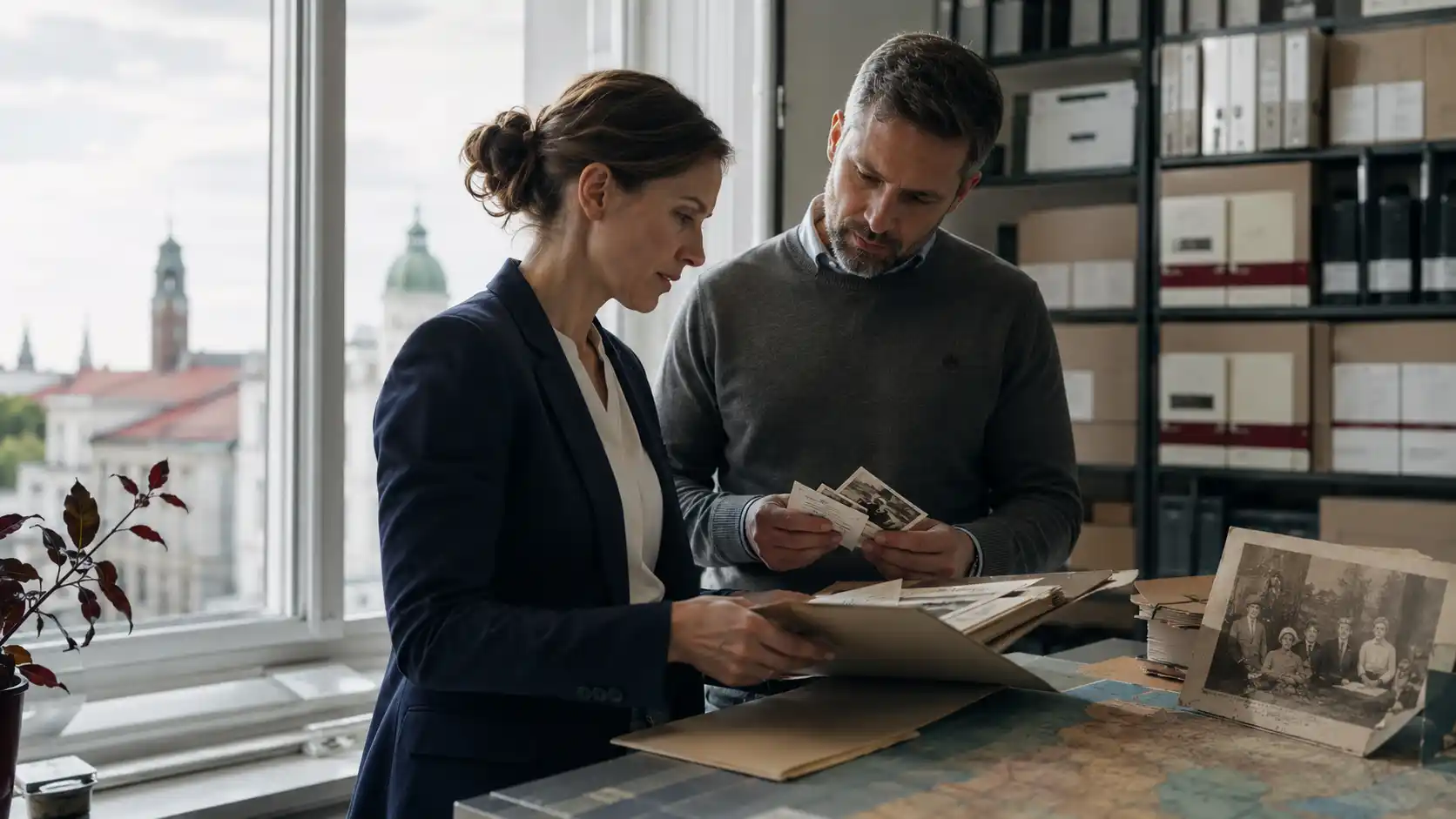
Many people begin researching Latvian citizenship by descent with only a family story, an old surname, a place of birth, or a reference to an ancestor who came from Latvia. In some families, the original Latvian passport, birth certificate, or pre-war civil record no longer exists at home. In others, the documents survived but contain spelling differences, incomplete dates, changed surnames, or place names that no longer match modern borders.
Missing documents do not always end a Latvian citizenship by descent case. However, they usually make the evidence analysis more important. The applicant may need to prove several separate facts: the ancestor’s connection to Latvia, the family line from that ancestor to the applicant, identity across generations, and, where relevant, the ancestor’s Latvian citizenship history before the occupation period.
This guide explains what Latvian citizenship by descent documents are usually important, what alternative evidence may help when records are missing, and how U.S. civil records, naturalization records, archive records, and name-change evidence can support a more complete file.
Why Documents Matter in Latvian Citizenship by Descent Cases
Latvian citizenship by descent is document-based. Family memory can be useful for research, but the application itself generally depends on official records that show who the ancestor was, how the applicant is related to that person, and why the ancestor may qualify under Latvian citizenship rules.
In many cases, the key issue is not simply proving that a family was “from Latvia.” The evidence may need to show a more specific legal or historical connection, such as the ancestor’s citizenship status, residence, civil registration, or membership in the Latvian community of citizens during the relevant period. The required documents may vary depending on the applicant’s family line, the ancestor’s place and date of birth, emigration history, citizenship history, and the legal category under which the application is assessed.
Documents also help resolve identity questions. A Latvian ancestor may appear under different names in Latvian, Russian, German, Yiddish, Polish, or English-language records. U.S. immigration and naturalization records may use a simplified or Americanized version of the name. Marriage may have changed a surname. A missing middle name, an altered date of birth, or a different spelling of a birthplace may require explanation through supporting documents.
For this reason, a strong case is usually built as a chain of evidence rather than a single document.
What Latvian Citizenship by Descent Documents Usually Need to Prove
The documents in a Latvian citizenship by descent case usually serve several functions. First, they identify the applicant. Second, they establish the applicant’s direct family line to the Latvian ancestor. Third, they support the ancestor’s connection to Latvia and, where required, the ancestor’s Latvian citizenship before the relevant historical cutoff. Fourth, they explain any changes in names, surnames, dates, or places that appear across the record set.
The applicant’s own documents usually include a valid identification document and a birth certificate. If the applicant’s name changed through marriage, divorce, court order, or another legal process, the relevant certificate or name-change document may also be needed. Where the claim passes through a parent, grandparent, or great-grandparent, birth and marriage certificates are commonly used to connect each generation.
The ancestor’s documents are often the most difficult part of the case. Ideally, there may be a pre-war Latvian passport, Latvian birth record, Latvian marriage record, archive certificate, census-related record, military record, tax record, or another official document showing the ancestor’s connection to Latvia and citizenship history. If the family does not have original Latvian records, archive research in Latvia may become necessary.
The authority may request additional evidence if the documents are incomplete, inconsistent, not properly certified, or do not clearly prove the required legal facts.
Documents Proving Latvian Ancestry and Pre-War Citizenship
A common search query is how to prove Latvian citizenship by descent when the family does not have an old Latvian passport. This is a practical concern for many U.S.-based applicants. Families that left Europe during war, occupation, displacement, or migration often lost original documents. Some records were destroyed, left behind, or never passed down to later generations.
A pre-war Latvian passport can be strong evidence, but it is not the only type of document that may matter. Documents proving Latvian citizenship before 1940 may include Latvian civil status records, archive records, census-related documents, military service documents, tax administration records, or other records issued by Latvian authorities during the relevant period. In some cases, a birth certificate or extract from a birth register may help establish the ancestor’s identity and place of origin, while other archive records may help clarify citizenship or residence.
The exact value of a document depends on what it proves. A birth record may prove that the ancestor was born in Latvia, but birth in Latvia alone may not always answer every citizenship question. A census or archive record may help place the ancestor in Latvia at a legally relevant time. A military or administrative record may provide additional identity and status details. A marriage record may link the ancestor to a spouse and confirm continuity of identity.
When direct Latvian documents are missing, the applicant may need to combine Latvian archive findings with U.S. records and family-line documents. The goal is to create a coherent evidence chain that allows the authority to understand who the ancestor was and how the applicant descends from that person.
Birth Certificates and the Family Line
Birth certificates are usually central to Latvian citizenship by descent proof of ancestry. They connect one generation to the next and help prove the direct family line from the Latvian ancestor to the applicant.
For a U.S.-based applicant, this often means obtaining a certified copy of the applicant’s birth certificate, the parent’s birth certificate, and the grandparent’s or great-grandparent’s birth certificate, depending on where the Latvian ancestor appears in the family tree. Each certificate should ideally show the names of the relevant parents, because the purpose is not only to prove that a person was born, but also to prove the legal relationship between generations.
If a certificate is short-form and does not list parents, it may be insufficient for lineage purposes. In that situation, a long-form or full certified birth certificate may be needed. If a birth certificate contains an abbreviated name, a misspelled surname, or a different place of birth, supporting records may be required to explain the discrepancy.
Birth certificates are especially important when the claim passes through maternal lines, changed surnames, or multiple jurisdictions. A clean chain of birth records can often prevent confusion later in the review process.
Marriage Certificates, Divorce Records, and Surname Changes
Marriage certificates often play a major role in Latvian citizenship by descent documents because they explain surname changes and connect family members across generations. This is especially important when a woman in the direct line changed her surname after marriage, or when a family used different spellings before and after immigration to the United States.
A marriage certificate may show the birth name, married name, spouse’s name, date of marriage, and sometimes the names of parents. Depending on the jurisdiction and period, older U.S. marriage records may contain limited information, while later records may be more detailed. If a marriage certificate does not clearly connect the person to the family line, it may need to be supported by birth records, census records, naturalization records, or other civil documents.
Divorce records can also matter if they explain a later name change or clarify identity. Court-ordered name-change records may be relevant where a person formally changed a first name or surname. If the change happened informally through Americanization or everyday use, the applicant may need to rely on a combination of records showing that the different name versions refer to the same person.
Death Certificates and Supporting Identity Evidence
Death certificates are not always the primary evidence in a Latvian citizenship by descent case, but they can be useful when other records are missing or incomplete. A death certificate may include a date and place of birth, parents’ names, spouse’s name, last residence, or burial information. These details can help confirm that the person in U.S. records is the same person as the Latvian ancestor found in European records.
However, death certificates must be used carefully. Information on a death certificate is often provided by an informant, such as a spouse, child, relative, or institution. That person may not have known the ancestor’s exact birthplace, original surname, or parents’ names. As a result, death certificates can support a case, but they may not be enough on their own when more direct records are needed.
In cases involving missing Latvian ancestor documents, a death certificate may help point research in the right direction. It may confirm a Latvian birthplace, reveal an alternate spelling of a surname, or identify a parent whose name later appears in Latvian archive records.
U.S. Civil Records for Latvian Citizenship by Descent
U.S. civil records can be important for applicants trying to prove Latvian descent with U.S. records. These records may not replace Latvian citizenship evidence in every case, but they can help establish identity, family relationships, and the continuity of the family line after immigration.
Useful U.S. civil records may include birth certificates, marriage certificates, death certificates, divorce records, court name-change orders, adoption records, probate records, and sometimes social security or local registration records. The value of each document depends on the details it contains and how it fits into the evidence chain.
For example, a U.S. birth certificate may prove that the applicant’s parent was the child of the Latvian-born ancestor. A marriage certificate may show why the surname changed. A death certificate may confirm the ancestor’s birthplace as Latvia or identify the ancestor’s parents. Probate or estate records may help connect family members when birth or marriage records are incomplete.
U.S. census records can also provide helpful supporting context. They may show household relationships, immigration year, language, place of birth, citizenship status, or family structure. Still, census records are usually secondary evidence because they were created for population enumeration rather than citizenship determination. They may help support a broader record set, but they should be treated cautiously when they conflict with civil certificates or official archive records.
Naturalization Records for Latvian Citizenship by Descent
Naturalization records are often highly relevant for U.S.-based applicants. A Latvian ancestor who immigrated to the United States may have filed a declaration of intention, petition for naturalization, certificate of naturalization, or related court and immigration records. These documents may contain the ancestor’s original name, date and place of birth, date of arrival, prior nationality, spouse, children, address, and sometimes a photograph or signature.
A U.S. naturalization certificate can be useful, but it may not contain all details needed for a Latvian citizenship by descent case. The petition for naturalization or declaration of intention may be more informative because these records often include biographical details and arrival information. In some cases, the certificate number can help locate the complete naturalization file.
Naturalization records may also help explain whether and when the ancestor became a U.S. citizen. Depending on the legal pathway and facts of the case, the timing of naturalization may be relevant. The effect of naturalization can depend on the ancestor’s citizenship status, the period involved, and the specific legal basis of the application. It should not be assessed through assumptions alone.
For missing Latvian ancestor documents, naturalization files can provide valuable clues. They may identify the ancestor’s birthplace, former nationality, port of arrival, vessel, or previous name. These details may help locate Latvian archive records or connect a U.S. identity to a Latvian record.
Name Changes, Spelling Differences, and Americanization
Name inconsistency is one of the most common issues in Latvian citizenship by descent cases. A surname may appear differently because of transliteration, language changes, clerical errors, marriage, shortened endings, or Americanization after immigration.
Latvian names may have endings or diacritics that were omitted in English-language records. A name recorded in Cyrillic, German, Yiddish, Polish, or another language may have been transliterated more than one way. U.S. immigration officers, census takers, court clerks, or local officials may have written names phonetically. Family members may also have adopted a simplified spelling after settling in the United States.
These differences do not automatically make a case impossible. The issue is whether the evidence can show that the records refer to the same person or the same family line. A marriage certificate may explain a surname change. A naturalization petition may show both an original and Anglicized name. A passenger record may connect the old spelling to a U.S. address. A birth certificate may confirm parents’ names. A death certificate may preserve the original birthplace.
When documents contain different name forms, the file should not leave the discrepancy unexplained. The stronger approach is to build a logical record trail showing how the name changed over time and why the different versions belong to the same person.
Latvian Archive Records for Citizenship by Descent
Latvian archive records for citizenship by descent can be especially important when family-held documents are missing. Many applicants do not have an original Latvian passport, birth certificate, or official civil document at home. In that situation, research in Latvian archives or civil registry sources may help locate records that were never preserved by the family.
Archive records may include civil registration documents, birth register extracts, marriage records, census-related records, tax records, military conscription files, residence records, school records, employment records, or other administrative materials. The availability of records depends on the ancestor’s place of birth, religion, time period, local record preservation, and the historical circumstances affecting that region.
A Latvian archive record may help confirm the ancestor’s identity, residence, family members, or connection to the Latvian state. In some cases, it may provide stronger evidence than later U.S. records because it was created closer to the relevant time and place. In other cases, archive records may be fragmentary and need to be interpreted together with U.S. civil and immigration documents.
Applicants should be cautious about assuming that one archive result will answer every question. A birth record may identify the ancestor but not fully prove citizenship status. A census-related record may help with residence or status but still need to be connected to the applicant through family-line documents. The strength of the file depends on how the records work together.
Alternative Evidence When Original Latvian Documents Are Missing
Latvian citizenship by descent alternative evidence may be relevant when the most direct document is unavailable. Alternative evidence does not mean informal family stories alone. It usually means other official or semi-official records that can help prove the same fact indirectly.
For example, if a pre-war Latvian passport is missing, other records may help show the ancestor’s identity and connection to Latvia. These may include Latvian civil records, archive extracts, 1935 census-related records, military or administrative records, U.S. naturalization records, immigration records, displaced persons records, refugee records, foreign passports, or other official documents that identify the ancestor’s birthplace, nationality, citizenship, residence, or family members.
Alternative evidence is most persuasive when it is consistent. A U.S. naturalization petition showing the ancestor’s Latvian birthplace, a passenger manifest showing arrival from Latvia, a marriage record naming the same parents, and a Latvian archive record with matching identity details may be more useful together than any one of those documents alone.
However, alternative evidence is not always accepted as a substitute for required documents. The authority may request additional evidence, clarification, certified copies, translations, or records from Latvia. The applicant’s situation, the legal pathway, and the quality of the evidence all matter.
How to Prove Latvian Descent With U.S. Records
U.S. records can help prove Latvian descent when they connect the applicant to the Latvian ancestor and clarify the ancestor’s identity. The practical task is to move from the applicant backward through each generation, using official records that prove parent-child relationships and name continuity.
A typical evidence chain may begin with the applicant’s birth certificate, then the parent’s birth certificate, then the grandparent’s birth certificate, and so on until the Latvian ancestor is reached. Marriage certificates may explain surname changes between generations. Death certificates, naturalization files, census records, and immigration records may support identity and help resolve missing details.
U.S. records are particularly useful when the Latvian ancestor used different names in different contexts. A naturalization petition may show the original name and the U.S. version. A marriage certificate may show a maiden name. A child’s birth certificate may show the parent’s Americanized name. A passenger record may show the older European spelling. Together, these records may help bridge the gap between the Latvian archive record and the U.S. family line.
Still, U.S. records usually need to be evaluated in relation to Latvian records. A U.S. document stating that someone was born in Latvia may be helpful, but it may not fully prove Latvian citizenship before 1940. The file may still need Latvian or European evidence showing the ancestor’s relevant legal or civil status.
What Happens If Documents Are Missing or Inconsistent
If documents are missing, the first step is usually to identify exactly which fact is not yet proven. The missing fact may be the ancestor’s Latvian citizenship, the ancestor’s birthplace, the parent-child relationship between two generations, a surname change, or the link between a U.S. identity and a Latvian archive record.
Once the gap is identified, the applicant can look for records that prove the same fact in another way. If a birth certificate is missing, a baptism record, delayed birth certificate, census record, marriage record, death certificate, or archive extract may provide supporting information. If a naturalization certificate is missing, the court petition, declaration of intention, certificate number, or immigration file may help. If a Latvian record is missing, archive searches may identify related civil, military, census, tax, or residence records.
Inconsistent documents require a different approach. If one record says the ancestor was born in Riga and another says Russia, Poland, or “Baltic States,” the inconsistency should be assessed historically and geographically. Older records often used political borders, imperial place names, provinces, or foreign-language versions of Latvian locations. The issue is whether the records can still be reconciled through dates, names, parents, spouse, immigration details, and other identifying information.
The authority may ask for additional documents if the evidence is incomplete or unclear. A careful file should anticipate likely questions rather than leaving obvious contradictions unresolved.
Certified Copies, Apostilles, Translations, and Legalization
Document format matters. In many Latvian citizenship by descent cases, foreign-issued documents may need to be provided as certified copies or originals, and they may require apostille authentication, legalization, and Latvian translation depending on the issuing country and the type of document.
For U.S.-issued records, this often means obtaining certified copies from the relevant state, county, court, or federal agency. In many cases, state-issued civil records such as birth, marriage, divorce, and death certificates may need apostille authentication from the appropriate Secretary of State. Federal records may follow a different authentication route. The exact requirement can depend on the document type and where it was issued.
Translations should be handled carefully. A translation should preserve names, dates, places, certificate numbers, and official terminology accurately. Name spellings should not be “corrected” casually, because differences between the original document and the translation can create new inconsistencies.
Applicants should not assume that a scan, photocopy, online genealogy image, or uncertified database record will be enough. Such materials may be useful for research, but formal submission often requires properly issued and authenticated documents.
Common Mistakes Applicants Should Avoid
One common mistake is starting with a conclusion instead of evidence. A family may know that an ancestor was Latvian, but the file still needs documents showing identity, lineage, and the relevant citizenship or historical connection.
Another mistake is relying only on online genealogy records. Online indexes can be helpful for locating records, but an index entry may contain transcription errors and may not be accepted as a formal document. The applicant usually needs the underlying record or an official certificate, extract, or archive response.
A third mistake is ignoring name variations. If the ancestor appears as Jānis in one record, John in another, and Ivan or Jan in another, the file should explain why these records refer to the same person. The same applies to surnames affected by Latvian endings, transliteration, marriage, or Americanization.
Applicants also sometimes collect documents without checking whether each document proves a necessary point. A large file is not automatically a strong file. The evidence should be organized around the legal and genealogical questions: who the ancestor was, how the applicant descends from that person, what the ancestor’s Latvian connection was, and why the records are consistent despite any differences.
Finally, applicants should avoid assuming that missing documents can always be replaced by any alternative evidence. Some gaps may be manageable, while others may require specific archive records or additional official documentation. The outcome depends on the applicant’s family line and the available evidence.
FAQ
Can I apply for Latvian citizenship by descent if I do not have my ancestor’s Latvian passport?
Possibly, depending on the rest of the evidence. A pre-war Latvian passport can be strong proof, but other documents may also support the case. Latvian civil records, archive records, census-related records, military or administrative records, and U.S. immigration or naturalization records may help establish the ancestor’s identity and Latvian connection. The authority may still request additional evidence if the file does not clearly prove the required facts.
What documents are usually needed to prove Latvian citizenship by descent?
The documents usually need to prove the applicant’s identity, the direct family line to the Latvian ancestor, the ancestor’s relevant Latvian citizenship or historical connection, and any name changes across generations. This often includes birth certificates, marriage certificates, name-change records, identification documents, Latvian archive records, and sometimes naturalization or immigration records. The exact document set depends on the applicant’s situation.
Can U.S. birth and marriage certificates prove Latvian ancestry?
U.S. birth and marriage certificates can help prove the family line from the applicant to the Latvian ancestor. They are often essential for showing parent-child relationships and explaining surname changes. However, they may not always be enough to prove the ancestor’s Latvian citizenship or status before the relevant historical period. Latvian or European records may also be needed.
Are U.S. naturalization records useful for Latvian citizenship by descent?
Yes, U.S. naturalization records can be useful supporting evidence. They may show the ancestor’s original name, date and place of birth, former nationality, arrival details, spouse, children, and address. These records can help connect U.S. documents to Latvian archive records and may clarify name changes or immigration history. Their legal importance depends on the facts of the case and the citizenship pathway involved.
What if my ancestor’s name is spelled differently in different records?
Different spellings are common in Latvian ancestry cases, especially after immigration to the United States. The file should show that the different versions refer to the same person. Marriage records, naturalization petitions, passenger records, birth certificates, death certificates, and archive records can help connect the name variants. The more consistent the surrounding details are, the easier it may be to explain the discrepancy.
Can a death certificate replace a missing birth certificate?
A death certificate may help support identity, birthplace, parents’ names, or family relationships, but it may not always replace a birth certificate. Death certificates can contain second-hand information, so they are usually stronger when supported by other records. Whether it is sufficient depends on what fact must be proven and what other evidence is available.
Do documents need to be translated into Latvian?
Foreign-issued documents may need Latvian translation, depending on the document type and submission requirements. In many cases, civil records and legal name-change documents issued outside Latvia must be translated properly. The translation should accurately reflect names, dates, places, and official details because translation errors can create problems in the review process.
Do U.S. documents need an apostille for Latvian citizenship by descent?
U.S.-issued documents may need apostille authentication, especially certified civil records such as birth, marriage, divorce, or death certificates. The required authentication route can depend on whether the document was issued by a state, county, court, or federal authority. Applicants should verify the requirement for each document rather than assuming that an ordinary photocopy is enough.
Can Latvian archive records help if my family has no original documents?
Yes, Latvian archive records may be very important when family-held documents are missing. Archive research may locate birth records, marriage records, census-related records, tax records, military records, residence records, or other administrative documents. The availability and usefulness of these records depend on the ancestor’s location, time period, and record preservation.
Is alternative evidence enough for Latvian citizenship by descent?
Alternative evidence may help, but it depends on what is missing and what the alternative records prove. A combination of consistent official records may support a case when direct documents are unavailable. However, alternative evidence is not automatically sufficient in every situation. The authority may request additional records, clearer proof of lineage, certified copies, translations, or Latvian archive documents.


 English [EN]