
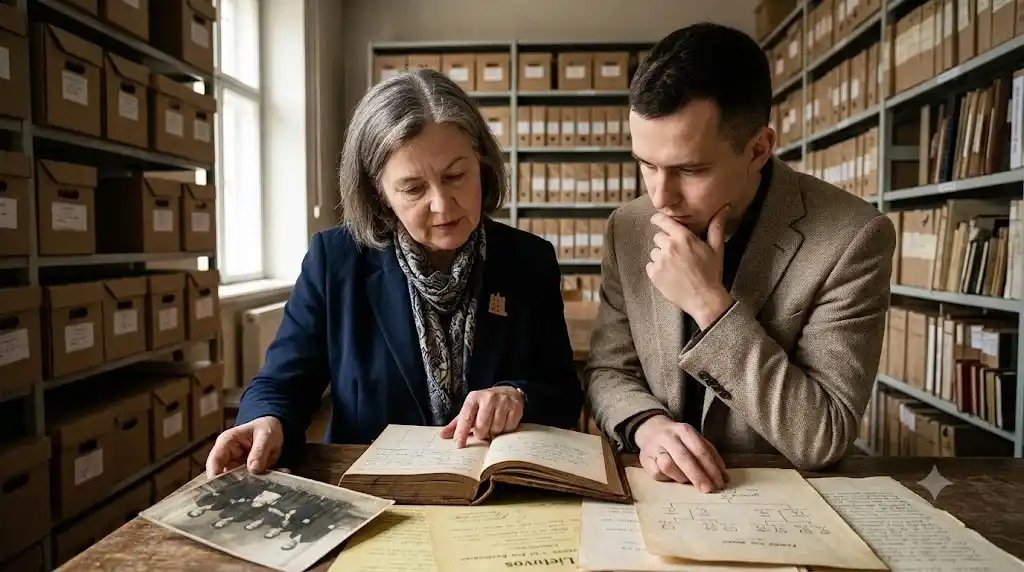
Latvian citizenship by descent applications are often document-driven. In many cases, the legal question is not only whether a person has Latvian ancestry, but whether the applicant can prove the required facts with records that the Latvian authority can accept and verify.
This is why Latvian citizenship by descent applications are refused or delayed in situations where the family history may appear clear to the applicant, but the documentary chain is incomplete, inconsistent, uncertified, poorly translated, or legally insufficient. A file may also be delayed if the authority needs additional evidence to confirm the ancestor’s citizenship status, the family line, a name change, or the applicant’s eligibility under the correct legal category.
For US-based applicants, the process can be especially complex because many relevant records may be spread across Latvia, the United States, immigration archives, state vital records offices, naturalization files, church registers, and family documents. A US birth certificate, marriage certificate, or naturalization record may be useful, but it usually has to be connected to Latvian records and to the applicant’s direct family line.
Why Documents Matter in Latvian Citizenship by Descent Cases
Documents matter because Latvian citizenship by descent is usually based on specific legal facts. The applicant may need to prove that an ancestor belonged to the relevant Latvian citizenry, that the applicant descends from that person, and that the application fits the legal basis being used.
Family stories, surname traditions, oral history, DNA results, or a general statement that a grandparent was “from Latvia” are usually not enough on their own. The authority normally reviews official documents that identify the ancestor, show dates and places of birth, confirm relationships between generations, and explain how the applicant is legally connected to the Latvian ancestor.
A delay can occur when a document raises a question but does not answer it. A refusal may occur if the evidence does not prove a required legal element, if the records appear to refer to different people, or if the applicant relies on documents that are not strong enough for the category of citizenship being claimed.
What Documents Are Usually Needed for Latvian Citizenship by Descent
The required documents may vary depending on the applicant’s situation, family line, country of residence, and legal category. However, most Latvian citizenship by descent files require several types of evidence.
The applicant usually needs identity documents, such as a valid passport, and civil status documents, such as birth certificates and marriage certificates. These records help prove the applicant’s identity and show the family line from the applicant back to the Latvian ancestor.
The file may also need Latvian records proving the ancestor’s connection to Latvia and, where relevant, the ancestor’s citizenship status on the legally relevant date. Depending on the case, this may include Latvian birth records, marriage records, registry extracts, archive statements, pre-war Latvian passports, census records, military records, tax records, or other official documents.
For US-based applicants, American civil records and naturalization records may also be important. They can help prove identity, migration history, residence, family relationships, name changes, and continuity between Latvian and US records.
Missing Proof of Latvian Ancestry
One of the most common reasons a Latvian citizenship by descent application is delayed or refused is weak proof of ancestry. A person may know that a parent, grandparent, or great-grandparent was Latvian, but the authority may still require documentary evidence showing that the ancestor legally fits the relevant citizenship or descent category.
A birth record from Latvia can be useful, but it may not always prove everything by itself. In some cases, the key issue is whether the ancestor was a Latvian citizen at the required historical point. In other cases, the issue may be whether the ancestor belonged to the Latvian or Liv community, whether the ancestor lived in the relevant territory, or whether the ancestor’s migration history supports the application category.
Documents proving Latvian ancestry may include civil registry records, archive confirmations, pre-war Latvian passports, census data, military conscription records, tax administration files, church records, school records, or other documents that identify the ancestor and connect that person to Latvia. The strength of the evidence depends on what the document says, who issued it, when it was issued, and whether it clearly relates to the same person in the applicant’s family line.
Incomplete Family Line from the Latvian Ancestor to the Applicant
A Latvian citizenship by descent application can be delayed or refused if the family line is not fully documented. It is usually not enough to prove that a Latvian ancestor existed. The applicant must also show a direct legal relationship from that ancestor to the applicant.
Birth certificates are often the main documents used to prove parent-child relationships. If the claim goes through a grandparent, great-grandparent, or more distant ancestor, the file may need birth certificates for each generation in the line. Marriage certificates may be needed to explain surname changes and to connect individuals across records. Death certificates may be relevant if they help confirm identity, dates, family relationships, or the continuity of the record chain.
Problems often arise when one generation is not documented clearly. For example, an applicant may have the ancestor’s Latvian archive record and their own birth certificate, but may be missing a parent’s or grandparent’s long-form birth certificate. In that situation, the authority may not be able to verify the direct relationship without additional evidence.
Problems with Birth Certificates
Birth certificates are central in many Latvian citizenship by descent cases because they usually establish parent-child relationships. A delay may occur if a birth certificate is missing, incomplete, short-form, amended, uncertified, or does not list the necessary parents.
US applicants should pay particular attention to whether a birth certificate is a full certified copy or a limited extract. Some short-form records may not include enough detail to prove the family line. In many cases, the record should show the person’s full name, date of birth, place of birth, and parents’ names.
A problem can also arise when the parent’s name on a birth certificate does not match the name used in earlier Latvian, immigration, or naturalization records. That does not automatically mean the application will fail, but the discrepancy may need to be explained with additional documents.
Problems with Marriage Certificates and Surname Changes
Marriage certificates are often necessary when the family line includes surname changes. This is especially common in applications passing through women in the family line, where a maiden name in one record may differ from a married surname in later records.
A Latvian citizenship by descent application may be delayed if the file does not show why a surname changed. For example, the ancestor may appear under a Latvian surname in a birth record, under an Americanized spelling in a passenger list, and under a married surname in a US civil record. If the application does not bridge those names, the authority may request additional evidence.
Marriage certificates, divorce records, court name-change orders, Social Security records, naturalization records, and amended civil records may help explain these differences. The key issue is whether the documents show that the different names refer to the same person or the same family line.
Latvian Citizenship by Descent Name Discrepancies
Name discrepancies are one of the most practical reasons Latvian citizenship by descent documents are questioned. Latvian, Russian, German, Polish, Yiddish, and English-language records may spell the same name differently. US records may also contain simplified spellings, phonetic versions, clerical errors, or Americanized surnames.
A minor spelling difference may be explainable, especially where the difference results from transliteration or the loss of Latvian diacritics. However, larger differences can create problems. If the ancestor’s first name, surname, date of birth, place of birth, or parents’ names differ across records, the file may need stronger evidence.
For example, Jānis may appear as Janis, John, Johann, or Ivan depending on the record language and historical context. A Latvian surname may lose diacritics or change endings in US records. A married surname may replace a maiden name. These variations can be manageable, but they should be documented rather than ignored.
US Civil Records for Latvian Citizenship by Descent
US civil records can be important supporting evidence in Latvian citizenship by descent cases. These records may include birth certificates, marriage certificates, divorce records, death certificates, court records, probate documents, and name-change documents.
US civil records can help prove the family line, especially when the applicant’s parent, grandparent, or great-grandparent was born, married, or died in the United States. They may also confirm dates, places, relationships, and surname changes that connect the US family line to the Latvian ancestor.
However, US civil records usually need to be evaluated carefully. A US death certificate may list a birthplace as “Russia,” “Latvia,” “Riga,” “Courland,” or another historical designation, but the informant may not have had complete knowledge. A US marriage certificate may contain a shortened or Americanized name. A US birth certificate may not include enough detail if it is not a long-form version. These records can be helpful, but they may not be conclusive on their own.
Naturalization Records for Latvian Citizenship by Descent
Naturalization records are often relevant for US-based applicants. A US naturalization certificate, declaration of intention, petition for naturalization, certificate of arrival, or related immigration file may identify the ancestor’s former nationality, birthplace, date of birth, arrival date, spouse, children, and name variants.
Naturalization records can help prove that a Latvian ancestor moved to the United States and may explain when and how the person acquired US citizenship. They can also be useful when a person used one name in Latvia and another name in the United States.
At the same time, a US naturalization certificate does not automatically prove eligibility for Latvian citizenship by descent. It may support identity and migration history, but the file may still need Latvian documents or archive evidence showing the ancestor’s relevant Latvian citizenship status, residence, or ethnic origin, depending on the legal basis of the application.
Missing or Rejected Latvian Citizenship by Descent Documents
Latvian citizenship by descent documents may be rejected or questioned if they are not official, not certified, not properly legalized, not translated when required, or not relevant to the legal issue being reviewed.
A family copy of an old document may be useful for research, but the authority may request an official certified copy or archival extract. A scanned image from a genealogy website may help locate a record, but it may not be enough as a formal submission. A translated document may still be questioned if the translation is incomplete or if the original document is not properly certified.
Missing documents do not always make a case impossible, but they usually change the evidence strategy. The applicant may need substitute records, archive research, civil registry searches, court records, or multiple supporting documents that collectively prove the missing link.
Problems with Apostilles, Legalization, and Translations
Many Latvian citizenship by descent applications are delayed because foreign documents are not prepared in the correct formal way. Depending on where a document was issued, it may need an apostille, legalization, certification, notarization, or translation into Latvian.
For US-issued documents, an apostille is often required when the document is intended for use in Latvia. The apostille normally must correspond to the issuing state or competent authority. A common mistake is apostilling the wrong document, notarizing a copy when the original certified record is needed, or submitting a document that is not eligible for apostille in its current form.
Translations can also create issues. Names, places, and historical terms should be translated or rendered consistently. If a translation introduces a new spelling or omits important details, the authority may request clarification. In many cases, the safest approach is to make sure the document, certification, apostille, and translation all correspond to the same official record.
Eligibility Problems and the Wrong Application Category
Another reason Latvian citizenship by descent applications are refused is that the applicant may be applying under the wrong legal category. Latvian citizenship law includes different routes that may apply to descendants of Latvian citizens, Latvian exiles and their descendants, persons of Latvian or Liv origin, and children of Latvian citizens.
These categories are not identical. The evidence required for one category may not be enough for another. For example, proving that an ancestor was born in Latvia may not be the same as proving that the ancestor was a Latvian citizen at the relevant time. Proving Latvian ethnic origin may involve different requirements from proving descent from a citizen of Latvia on a specific historical date.
Eligibility problems may also arise because of the ancestor’s emigration period, citizenship history, residence, naturalization, or the applicant’s own citizenship situation. The exact legal analysis depends on the family history and available records.
Inconsistent Dates, Places, and Historical Geography
Latvian citizenship by descent cases often involve records from different countries and historical periods. Latvia’s territory, administrative divisions, languages of recordkeeping, and political status changed over time. As a result, older records may refer to places using Russian, German, Polish, or historical regional names.
A US record may list the ancestor’s birthplace as Russia, the Russian Empire, Latvia, Riga, Courland, Livonia, Vitebsk, or another historical location. This does not automatically disprove Latvian ancestry, but it may require careful interpretation. The important question is whether the record can be connected to the relevant territory and to the same individual in the family line.
Dates can create similar problems. A birth date may differ by one day because of calendar differences, clerical mistakes, or later reporting errors. Larger inconsistencies may require additional evidence. If the authority cannot determine whether two records refer to the same person, the application may be delayed or refused.
What Happens If Documents Are Missing or Inconsistent
If documents are missing or inconsistent, the authority may request additional evidence, ask for clarification, or extend the review while the applicant supplements the file. In more serious cases, the application may be refused if the evidence does not prove the required legal facts.
A missing document may sometimes be replaced or supported by other official records. For example, if a birth certificate cannot be found, a baptism record, archive extract, census record, school record, military record, or court record may help establish identity or family connection. If a name discrepancy exists, a sequence of civil records may help show that the records refer to the same person.
The stronger the inconsistency, the more important it is to build a coherent evidentiary chain. The file should not simply contain many documents; it should show a clear legal and factual connection from the Latvian ancestor to the applicant.
Common Mistakes Applicants Should Avoid
A common mistake is assuming that Latvian ancestry alone is enough. In practice, the application usually depends on official records that prove specific legal facts. Another mistake is submitting documents without checking whether they contain inconsistent names, dates, places, or relationships.
Applicants also sometimes rely too heavily on US records without obtaining Latvian archive evidence. US documents may be useful, but they may not prove the ancestor’s Latvian citizenship status or the precise legal basis for the application. The opposite problem can also occur: an applicant may have a Latvian record for the ancestor but fail to prove each generation between the ancestor and the applicant.
Formal document errors are also common. These include missing apostilles, incorrect certifications, incomplete translations, uncertified copies, illegible scans, and documents issued in a form that is not acceptable for official use. Before submission, each document should be reviewed for both content and formal validity.
How to Reduce the Risk of Delay or Refusal
The best way to reduce the risk of delay or refusal is to treat the application as an evidence file, not just a collection of family records. Each document should serve a purpose. One document may prove identity, another may prove parentage, another may explain a surname change, and another may prove the ancestor’s connection to Latvia.
For US-based applicants, it is usually important to collect long-form civil records, naturalization records where relevant, and official Latvian archive or civil registry documents. The file should also account for name changes, transliteration, Americanized spellings, historical place names, and gaps between generations.
No document strategy can guarantee approval, because each case depends on the facts, the applicable legal basis, and the authority’s review. However, a well-organized file with certified, consistent, and legally relevant documents is less likely to face avoidable delays.
FAQ
Can a Latvian citizenship by descent application be denied because documents are missing?
Yes, a Latvian citizenship by descent application may be refused if missing documents prevent the authority from confirming a required legal fact. This may include proof of the ancestor’s Latvian citizenship status, proof of the family line, or proof that the applicant fits the relevant legal category. In some cases, missing documents can be replaced or supported by other official records, but this depends on the facts and the available evidence.
Is a US naturalization certificate enough for Latvian citizenship by descent?
Usually, no. A US naturalization certificate can be useful because it may show the ancestor’s name, former nationality, residence, date of naturalization, and sometimes name changes. However, it generally does not prove by itself that the ancestor met the Latvian citizenship requirement. The file may still need Latvian civil records, archive records, or other evidence connecting the ancestor to Latvia and to the applicant.
What if my Latvian ancestor’s name is spelled differently in US records?
Different spellings do not automatically mean the application will be refused. Name discrepancies are common in Latvian, US, immigration, and naturalization records. The issue is whether the documents can show that the different spellings refer to the same person. Marriage certificates, name-change records, naturalization records, Social Security records, and consistent family details may help explain the discrepancy.
Can US birth and marriage certificates prove Latvian descent?
US birth and marriage certificates can help prove the family line from the applicant to the Latvian ancestor. They are especially important when one or more generations were born or married in the United States. However, they usually need to be combined with Latvian records or archive evidence proving the ancestor’s relevant connection to Latvia.
Why are Latvian citizenship by descent documents rejected?
Documents may be rejected or questioned if they are not certified, not apostilled or legalized when required, not translated properly, incomplete, inconsistent, or not relevant to the legal issue. A document may also be insufficient if it proves only part of the case, such as birthplace, but not citizenship status or direct descent.
Do all foreign documents need apostilles for Latvian citizenship applications?
This depends on the country where the document was issued and the rules applicable to that document. US-issued public documents often need an apostille for use in Latvia. Some documents from certain countries may be treated differently depending on international agreements or applicable procedures. The applicant should verify the formal requirements before submitting records.
What happens if a birth certificate does not list both parents?
If a birth certificate does not list the parent needed to prove the family line, the authority may request additional evidence. A long-form birth certificate, amended record, court record, adoption record, acknowledgment of parentage, or other official document may be needed. The correct solution depends on the jurisdiction and the specific missing information.
Can Latvian citizenship restoration be refused because of eligibility problems?
Yes. Latvian citizenship restoration or citizenship by descent may be refused if the authority finds that the applicant does not meet the requirements of the category used in the application. This may involve the ancestor’s citizenship status, emigration history, ethnic origin, residence, naturalization, or the applicant’s own circumstances. Eligibility should be reviewed before filing, not only after documents are collected.


 English [EN]