
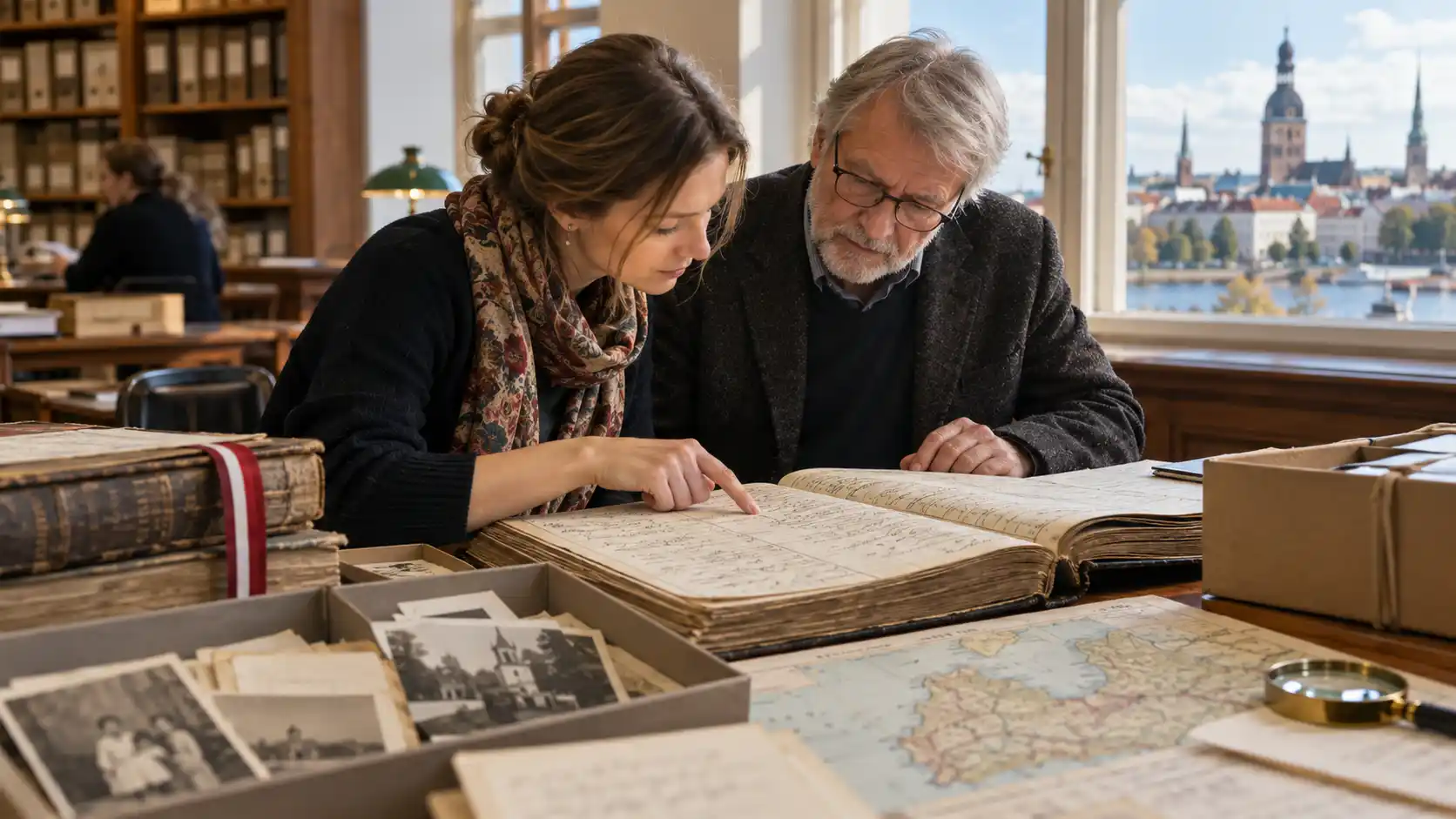
Latvian church records are among the most valuable historical sources for tracing family ancestry in Latvia. Long before modern civil registration systems became established, religious congregations documented births, baptisms, marriages, and deaths in parish registers. These historical documents can help descendants identify relatives, reconstruct family relationships, and discover where their ancestors lived.
For Americans researching Latvian family history, church registers can be particularly useful when an ancestor emigrated before World War II or when original civil records are missing. A baptismal entry may identify an ancestor’s parents, while a marriage record can reveal a previously unknown family surname or place of origin.
Many historical Latvia parish records are now available through digital archives, including the Latvian National Archives’ Raduraksti database. However, finding the correct entry often requires knowledge of historical parish boundaries, religious denominations, language differences, and changing surname spellings.
Understanding how these registers were organized and what information they contain is an important starting point for reliable Latvian genealogy research.
What Are Latvian Church Records?
Latvian church records are historical registers maintained by religious congregations to document important events in the lives of their members. They are sometimes called parish registers, church books, or ecclesiastical records.
For much of Latvia’s history, these registers served as essential sources of personal and family information. Many were maintained before the establishment of the independent Republic of Latvia in 1918, during periods when Latvian territories belonged to other political entities, including the Russian Empire.
The main categories include records of births and baptisms, marriages, deaths, and burials. Some congregations also maintained confirmation registers and lists of parish members.
The information recorded varied by denomination, location, historical period, and individual congregation.
A birth or baptism entry may identify a child’s parents, while a marriage entry might include the names of both spouses, their ages, occupations, religious affiliations, and parents.
For genealogy research, these records are especially useful because they can connect several generations of a family through independently recorded events.
Unlike modern birth certificates, historical parish entries were not always created according to standardized administrative requirements. Researchers should therefore examine the original document rather than relying exclusively on an indexed transcription.
What Information Can Be Found in Historical Latvian Parish Registers?
Historical parish registers contain several types of information that can help establish family relationships and reconstruct an ancestor’s life.
Birth and Baptism Records
Latvian baptism records are often the first source researchers examine when attempting to identify an ancestor’s parents or establish an approximate birth date.
Depending on the congregation and period, a baptismal entry may contain:
-
The child’s full name.
-
Date and place of birth.
-
Date and place of baptism.
-
Names of the parents.
-
Mother’s maiden name, when recorded.
-
Parents’ residence or occupation.
-
Names of godparents or witnesses.
-
Religious denomination of the family.
These details can help distinguish between individuals who shared the same name.
For example, two people named Jānis Bērziņš may have been born in neighboring villages during the same decade. Their parents’ names, residences, and baptism dates can help determine which person belongs to a particular family line.
Researchers should also distinguish the date of birth from the date of baptism. Although these events might have occurred close together, they are not interchangeable.
Marriage Records
Latvian marriage records genealogy research can reveal information that is difficult to establish from birth records alone.
Marriage entries may identify the bride and groom, their ages, previous marital status, occupations, residences, and religious affiliations.
Some registers also provide the names of the couple’s parents and the bride’s maiden surname.
This information is particularly important when researching maternal family lines. A woman’s surname may have changed after marriage, making it difficult to locate her earlier records without knowing her birth surname.
Marriage entries may also contain references to marriage banns, which were public announcements of an intended marriage.
In certain cases, the recorded residence of a bride or groom can point researchers toward another parish where earlier family records may survive.
Death and Burial Records
Although the main purpose of church registers was to document events within religious communities, death and burial entries can also contribute to family reconstruction.
Depending on the parish, these records may identify the deceased person’s name, approximate age, marital status, residence, date of death, burial date, and occasionally the cause of death.
A death record may also identify a surviving spouse or other relatives.
However, recorded ages were not always exact. When a person’s age at death conflicts with a baptismal record, researchers should compare additional evidence before deciding which date is more reliable.
Where to Find Latvian Church Records Online
Many historical Latvia parish registers online are accessible through digitized archival collections.
The most important starting point is Raduraksti, the virtual reading room maintained by the Latvian National Archives.
Other genealogy platforms can provide additional indexes, digitized images, and historical collections.
Raduraksti: The Latvian National Archives Database
Raduraksti church records include digitized registers from several religious denominations.
The collection contains historical documents concerning births, baptisms, marriages, deaths, and other parish activities.
The archive organizes church books primarily by religious denomination, congregation, chronological period, and type of register.
The denominations represented include Lutheran, Roman Catholic, Orthodox, Baptist, Reformed, Uniate, Old Believer, and Jewish communities.
Jewish vital records maintained by rabbinical authorities are also included within the broader church-book collection.
Raduraksti is particularly useful because researchers can examine digitized images of historical documents rather than relying entirely on searchable name indexes.
Not every surviving document has been digitized, and not every digitized page is searchable by an individual’s name.
In many cases, the researcher must identify the relevant parish and browse the images manually.
FamilySearch and Other Genealogy Databases
FamilySearch provides access to historical genealogical collections and catalog descriptions that may include Latvian parish registers and related documents.
Availability depends on the collection, and access restrictions may apply to individual images.
Other genealogy platforms, including Ancestry, contain Latvian birth, marriage, death, census, and resident-register collections.
Some collections overlap with records available through Latvian archival institutions.
When a searchable database produces a matching result, it is advisable to examine the underlying image whenever possible.
Indexes can contain transcription errors, particularly when historical documents were written in German, Russian, Latin, Polish, or older handwriting styles.
How to Find Latvian Church Records: Step-by-Step Research Guide
Learning how to find Latvian church records involves more than entering an ancestor’s surname into a genealogy website.
Historical church registers were generally organized around congregations rather than individual family names. Therefore, successful research usually begins by establishing where an ancestor lived and which religious community maintained the relevant records.
Step 1: Identify Your Ancestor’s Place of Origin
Start by collecting everything already known about the ancestor.
Useful information includes their name, approximate birth date, birthplace, parents’ names, religious affiliation, and emigration period.
For US-based researchers, American immigration documents may provide important clues.
Passenger lists, naturalization petitions, census records, and death certificates sometimes identify a Latvian ancestor’s birthplace or last residence.
However, these documents may describe the location using historical administrative names rather than modern Latvian place names.
A person born in present-day Latvia may have been recorded as coming from Russia, Livonia, Courland, or another historical jurisdiction.
Identifying the actual town, village, or parish is more useful than relying exclusively on the country recorded in an American document.
Step 2: Determine the Religious Denomination
Once the probable location is known, identify the family’s religious affiliation.
This matters because different religious communities maintained separate registers.
Lutheran congregations were historically prominent in many parts of Latvia, while Roman Catholic communities were especially significant in Latgale. Orthodox, Old Believer, Baptist, Jewish, and other communities also maintained records.
Religious affiliation should not be assumed solely from an ancestor’s surname or birthplace.
Family correspondence, marriage certificates, burial records, and immigration documents may provide useful evidence.
When the denomination remains unknown, examine the religious communities that historically operated near the family’s residence.
Step 3: Find the Relevant Parish in Raduraksti
The next step is to locate the appropriate congregation within the Raduraksti collection.
The archive uses Latvian terminology to organize its records.
Important terms include:
-
Baznīcu grāmatas — church books.
-
Dzimušie un kristītie — births and baptisms.
-
Laulātie — marriages.
-
Mirušie — deaths.
-
Draudze — parish or congregation.
Researchers can navigate to the church-book collection, select a denomination, identify the relevant parish, and examine registers for the appropriate years.
Historical parish boundaries do not always correspond to modern municipal boundaries. A village may have belonged to a congregation located outside its present-day administrative district.
It may therefore be necessary to investigate neighboring parishes.
Step 4: Search the Appropriate Register and Year
After locating the parish, identify the register corresponding to the event being researched.
For a baptism, begin with the ancestor’s approximate birth year.
If the exact year is uncertain, examine a reasonable range of years before and after the estimated date.
For marriage research, consider the birth dates of known children, since these may help establish an approximate marriage period.
Some registers contain alphabetical indexes, while others require page-by-page examination.
A useful approach is to record all plausible entries rather than immediately selecting the first matching surname.
This reduces the risk of confusing individuals from different families.
Step 5: Examine the Original Entry Carefully
When a possible match appears, review the entire register entry.
Do not focus only on the individual’s name.
Compare the recorded date, parents, residence, denomination, witnesses, and any additional notes.
Historical handwriting can be difficult to interpret, especially when names were written using German or Russian spelling conventions.
If a word is unclear, compare it with similar entries written by the same clerk or minister.
Repeated place names, occupations, and common phrases can help identify unfamiliar handwriting.
Step 6: Save the Archival Reference
Once a relevant entry has been identified, preserve the information needed to locate it again.
A useful research note should contain the archive or database name, religious denomination, parish, register type, year, page or image number, and the names appearing in the entry.
Save a readable image where permitted.
The archival reference becomes particularly important when another researcher, translator, or government authority needs to verify the original document.
An image without its source details may be considerably less useful than a properly documented archival finding.
How to Search Latvian Birth and Baptism Records When Names Differ
One of the most common challenges in Latvia birth records genealogy research is the variation in personal names.
Historical Latvian records were created under different political and linguistic systems. As a result, the same individual may appear under several spellings.
A Latvian name might have been recorded in German, Russian, Latin, or Polish, depending on the location and period.
For example, the Latvian given name Jānis may appear in historical sources as Johann, Johannes, or another equivalent form.
Surname variations can be more complicated.
Diacritical marks may be omitted, endings may change, and transliterations may differ between documents.
An immigrant’s surname may also have been shortened or Americanized after arrival in the United States.
These differences do not necessarily indicate that the documents concern different individuals.
Researchers should compare names together with other identifying details, including birth dates, parents, spouses, residences, and occupations.
A consistent combination of family relationships and biographical facts can provide stronger evidence than an exact surname match alone.
How Historical Parish Boundaries Affect Latvian Genealogy Research
Latvia’s historical administrative geography creates additional difficulties for genealogists.
Before independence, territories now forming Latvia belonged to different governorates and administrative divisions of the Russian Empire.
Historical sources may therefore refer to Livonia, Courland, or Vitebsk rather than modern Latvian regions.
The same settlement may also appear under Latvian, German, Russian, or Polish names.
A researcher who searches only for the modern settlement name may miss relevant records.
Historical maps, parish directories, and geographical reference materials can help establish which congregation served a particular settlement.
It is also important to remember that religious communities maintained their own administrative structures.
Two families living in the same town might appear in different registers because they belonged to different denominations.
When a search produces no results, neighboring congregations and alternative historical place names should be investigated before concluding that the records are missing.
What If Latvian Church Records Are Missing?
Not every Latvian parish register has survived.
Wars, political changes, administrative transfers, deterioration, and gaps in recordkeeping have affected historical collections.
Even when a register survives, certain pages may be damaged, illegible, or absent.
A missing entry does not necessarily mean the event was never recorded.
The first step is to determine whether the relevant register exists but has not been digitized.
Researchers can examine archival catalog descriptions and, where necessary, request information from the institution holding the records.
Alternative sources may include parish membership lists, confirmation records, historical census documents, residence registers, and personal identification records.
Marriage registers can sometimes help establish family relationships when baptismal entries are unavailable.
Likewise, death records may identify a spouse or birthplace that provides a new direction for research.
The most effective strategy is to compare several independent records rather than depend on a single document.
For citizenship-related research, the absence of a church register may require additional documentary evidence. Whether alternative records are sufficient depends on the legal requirement that the evidence is intended to establish.
Can Latvian Church Records Help Prove Latvian Citizenship by Descent?
Historical parish records can provide important genealogical evidence in Latvian citizenship by descent research.
However, they do not automatically establish citizenship or eligibility for citizenship.
A baptismal record may demonstrate that an ancestor was born in a particular place and identify their parents. A marriage record can help connect family generations.
These facts may be useful when reconstructing a documented family line.
Nevertheless, a historical church entry identifying a person as born in Latvia does not necessarily prove that the person was a Latvian citizen.
This distinction is especially important for individuals researching ancestors who lived in Latvia before the establishment of the independent republic.
The Difference Between Ancestry and Citizenship Evidence
Latvian ancestry, residence in Latvia, ethnic origin, and Latvian citizenship are related but legally distinct concepts.
A person may have been born or baptized in Latvian territory without later becoming a citizen of the Republic of Latvia.
For certain citizenship categories involving descendants of pre-1940 Latvian citizens, evidence of the ancestor’s citizenship status is particularly important.
Other categories, including those concerning ethnic Latvians and Livs, involve different legal criteria.
The applicable requirements depend on the person’s family history and citizenship circumstances.
Church records may establish birth, parentage, or family relationships, while historical passports, census materials, civil registration records, and other administrative documents may be necessary to establish additional facts.
Researchers should therefore treat parish documents as part of a broader evidentiary record rather than conclusive proof of citizenship.
Connecting Church Records With Later Civil Documents
For Americans researching Latvian ancestry, the main documentary challenge often involves connecting a historical Latvian ancestor to subsequent generations born in the United States.
A typical family-history research file may include a Latvian baptism entry identifying the original ancestor, a marriage record establishing a spouse’s surname, and later US birth certificates connecting parents and children.
Additional documents may be needed when names changed through marriage, immigration, or legal proceedings.
For example, a Latvian baptism register might identify an ancestor under a Germanized surname, while a US naturalization record uses an Americanized version.
Marriage records, immigration documents, and consistent information about family relationships may help explain the discrepancy.
A documented sequence of records is generally more reliable than a family tree assembled from unverified online profiles.
How to Use US Records to Support Latvian Parish Research
American records can provide the information needed to identify a family in historical Latvian church books.
For descendants whose ancestors emigrated to the United States, the most useful sources often include immigration records, naturalization files, birth and marriage certificates, and census documents.
Immigration and Naturalization Records
Passenger manifests sometimes record an immigrant’s last permanent residence, place of birth, or nearest relative in their country of origin.
These details can help narrow the search to a specific Latvian town or parish.
US naturalization records may provide additional information about birthplace, date of birth, arrival, and family members.
However, the information recorded varies by period and document type.
A naturalization certificate alone may contain less biographical detail than the related petition or other documents in the naturalization file.
An ancestor’s naturalization history may also be relevant when examining the family’s citizenship circumstances, although the legal significance depends on the applicable Latvian citizenship provisions and dates involved.
Birth, Marriage, and Death Certificates
US civil records are useful for linking later generations to the Latvian ancestor.
A child’s birth certificate may identify both parents, while a marriage certificate can explain a surname change.
Death certificates sometimes provide information about an individual’s parents or birthplace, although these details may have been supplied by someone who did not know the information firsthand.
Where conflicting dates or spellings appear, prioritize contemporary records and assess the reliability of the information they contain.
For a more complete reconstruction of the family line, researchers may need to combine US civil records with historical Latvian parish registers.
Are Latvian Church Records Accepted as Official Citizenship Documents?
A historical church-register entry and an officially issued civil-status certificate are not necessarily interchangeable.
Digitized images from Raduraksti are valuable for identifying historical information, but a downloaded image may not satisfy the documentary requirements of an administrative citizenship procedure.
Depending on the circumstances, the competent Latvian authority may require an officially issued archival statement, certified extract, civil-status document, or other acceptable evidence.
Researchers should distinguish between records used for genealogical investigation and documents prepared for official submission.
Obtaining Official Archival Copies
The Latvian National Archives provides procedures for requesting archival statements and copies of documents held in its collections.
An effective archival request should include the ancestor’s name, approximate date of the event, location, religious denomination, and any known register reference.
Providing precise information can help the archive identify the relevant document.
Not every request will produce the desired record. The result depends on whether the document survives, whether it is held by the institution, and whether sufficient identifying information is available.
Apostilles, Translations, and Document Authentication
US-issued civil records intended for use in Latvia may require an apostille or other applicable authentication, together with a Latvian translation.
The precise requirements depend on the document, its issuing jurisdiction, and the administrative procedure.
Historical Latvian archival documents may be subject to different certification arrangements.
An apostille does not establish that the contents of a document are factually correct. Its function is to authenticate the relevant public document’s origin, such as the signature, seal, or official capacity of the issuing authority.
Before preparing documents for submission, researchers should verify the applicable documentary requirements with the competent Latvian authority.
Common Mistakes When Researching Latvian Church Records
Even experienced genealogists can encounter difficulties when working with historical parish registers.
Several mistakes are particularly common.
Searching only by the modern spelling of a surname. Historical records may use different languages, transliterations, and grammatical forms. Alternative spellings should be considered.
Confusing baptism dates with birth dates. A church register may contain both dates, and they should be recorded separately.
Assuming a birthplace identifies the correct parish. Religious affiliation and historical parish boundaries can determine where an event was registered.
Relying only on searchable indexes. Many digitized registers require manual examination, and indexed names may contain transcription errors.
Treating a matching name as sufficient proof of identity. Parents, residence, approximate age, and other characteristics should be compared.
Assuming a church record proves Latvian citizenship. A register can establish genealogical facts without necessarily proving a person’s legal nationality.
Failing to preserve the original archival reference. An unattributed screenshot may be difficult to verify or use in later research.
Careful documentation can prevent errors from spreading across subsequent generations of a family tree.
Building a Reliable Latvian Family History From Parish Records
Latvian church records are most effective when they are used together with other contemporary historical sources.
A well-documented family history should establish the identity of each person, the relationships between generations, and the evidence supporting those relationships.
Begin with the most recent confirmed relative and work backward.
For each generation, compare birth or baptism entries with marriage records, residence information, and other available documents.
When a surname changes, establish the reason through documentary evidence rather than relying on assumptions.
If a record appears inconsistent, preserve the conflicting information until further evidence becomes available.
This approach is particularly important when genealogical research may later support an examination of Latvian citizenship eligibility.
Historical church registers can provide the foundation of a family history, but their usefulness depends on accurate identification, careful interpretation, and corroboration with other records.
Frequently Asked Questions
How far back do Latvian church records go?
Some surviving Latvian parish registers date back several centuries, although the earliest available records vary significantly by congregation and denomination. Certain collections contain records from the seventeenth and eighteenth centuries, while others begin considerably later. Researchers should examine the date coverage of the specific parish.
Are Latvian church records available online?
Yes. Many historical Latvian church records are available through Raduraksti, the digital reading room of the Latvian National Archives. Additional records or indexes may be accessible through FamilySearch and other genealogy databases. However, not all surviving registers are digitized or indexed by name.
How can I find my Latvian ancestors if I do not know their parish?
Begin with available family documents, especially US immigration and naturalization records that may identify a birthplace or last residence. Historical maps can help connect that location to the appropriate parish. Religious affiliation may also help narrow the search.
Are Latvian baptism records the same as birth certificates?
No. A baptism record documents a religious event and may include information about the child’s birth and parents. A birth certificate is an official civil-status document issued through the relevant registration system. A historical baptism record may be useful evidence, but its acceptance for an official procedure depends on the applicable requirements.
Can I search Latvian church records using an Americanized surname?
Yes, but researchers should also consider historical spellings. Latvian surnames may appear in German, Russian, Polish, or other linguistic forms. Comparing birth dates, parents’ names, and places of residence can help identify the correct person when spellings differ.
What should I do if my Latvian ancestor’s birth record is missing?
Check neighboring parishes, alternative surname spellings, and available duplicate registers. Marriage records, confirmation registers, residence lists, and historical census materials may provide supporting information. If the register has not been digitized, an archival inquiry may help establish whether it survives.
Can a Latvian church record prove that my ancestor was a Latvian citizen?
Not by itself in every case. A church record may establish birth, parentage, religion, or residence, but these facts do not necessarily demonstrate citizenship. Additional historical or administrative documents may be required, depending on the citizenship category being examined.
Do I need original Latvian parish records for citizenship by descent?
The required form of documentation depends on the applicable procedure. A downloaded image may be sufficient for initial research but not for official submission. The competent Latvian authority may require a certified archival statement, an officially issued extract, or other documentary evidence.
Can Latvian marriage records help trace a maternal family line?
Yes. Marriage registers may identify a bride’s maiden surname, parents, previous residence, and other information useful for tracing maternal ancestry. These details can help connect records created before and after marriage, especially when surnames changed.
What languages were used in historical Latvian church registers?
Depending on the period, location, and denomination, registers may contain Latvian, German, Russian, Latin, or Polish. Some records also use historical handwriting conventions that differ from modern scripts. Understanding the relevant language and recording practices can make it easier to interpret names and family relationships.



 English [EN]
