
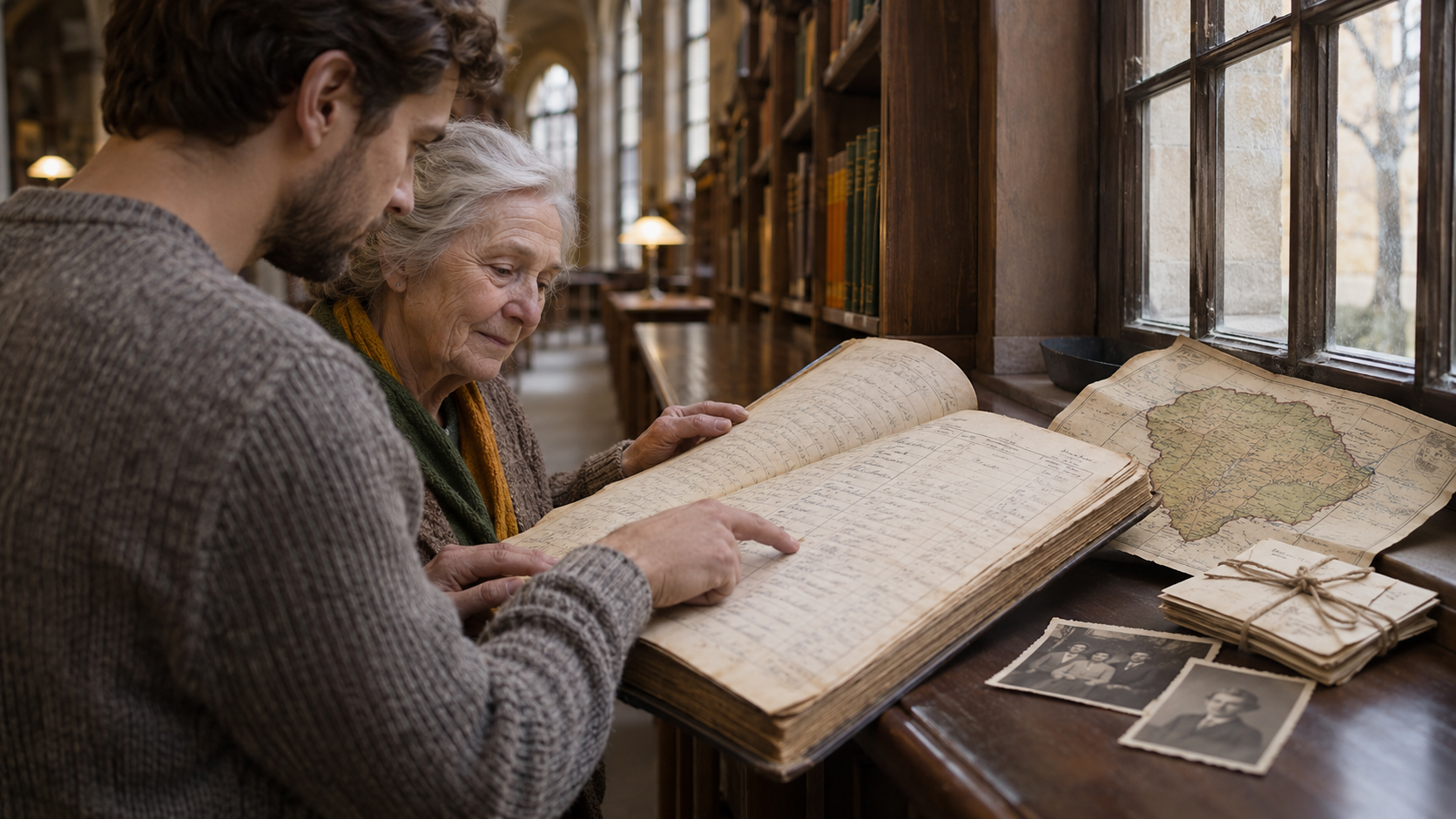
Most Latvian surnames come from the natural world, from farmsteads and places, from trades, or from a father’s given name. They are usually short Latvian words with a gendered ending, such as Bērziņš (“little birch”) or Ozols (“oak”). For family researchers in the United States, the meaning matters less than the spelling. The same surname can show up in German, Russian, Latin and English forms in different records, and an ancestor can be missed simply because someone searched for the wrong version.
This guide covers where Latvian surnames come from, what common ones mean, how male and female forms differ, and which spelling variants you are likely to see in historical documents.
What Makes a Surname Latvian?
Latvian is an inflected Baltic language, so surnames behave like ordinary nouns. A masculine surname usually ends in -s, -š or -is, and the ending changes with grammatical case and with the bearer’s gender.
Many surnames are plain everyday words: trees, birds, landscape features or tools. Others are built with diminutive suffixes, which is why so many end in -iņš or -ītis. A third group came into Latvian from German, Russian, Polish or Lithuanian and was adapted to Latvian spelling and endings.
Latvian letters with diacritics, including ā, ē, ī, ū, č, ģ, ķ, ļ, ņ, š and ž, are part of the correct spelling. They are also the first thing to disappear in foreign records, and a lot of spelling variation starts there.
When Did Latvians Get Surnames?
For centuries most rural Latvians had no fixed hereditary surname. Peasants on Baltic German estates were usually recorded by given name, by a father’s name, or by the name of the farmstead they lived on. Town dwellers, clergy, craftsmen and families of German or other non-Latvian origin often had surnames much earlier.
Fixed surnames for the rural population came in the first half of the nineteenth century, after serfdom was abolished in the Baltic provinces of the Russian Empire. Estate administrations often assigned the names, and many were drawn from nature, the local landscape or the farm name. Because of this, families with no blood relationship can share a surname such as Kalniņš or Ozoliņš. A shared name on its own says little about kinship.
Common Latvian Surnames and Their Meanings
Lists of the most common Latvian surnames tend to include the same core group. Their meanings show which naming patterns were most widespread:
- Bērziņš: little birch
- Kalniņš: little hill
- Ozoliņš and Ozols: little oak, oak
- Liepiņš and Liepa: little linden, linden
- Krūmiņš: little bush
- Eglītis: little spruce
- Zariņš: little branch
- Balodis: dove or pigeon
- Vītols: willow
- Kļaviņš: little maple
- Jansons and Pētersons: son of Jānis, son of Pēteris
These Latvian last names and their meanings describe common, everyday things, which matches how many of them were assigned. Rankings differ between sources and over time, so treat any “top ten” list as approximate.
Types of Latvian Surnames: Nature, Occupations, Places, Personal Traits
Researchers usually sort Latvian surname origins into a few broad groups. Knowing the group can help you guess at older spellings and at the region a family came from.
Nature names are the largest group. Trees (Ozols, Liepa, Egle), birds (Balodis, Zīle, Strazds) and animals (Lācis for “bear,” Vilks for “wolf”) are common. Many of these were handed out in bulk when surnames were introduced.
Occupational surnames name a trade: Kalējs (smith), Zvejnieks (fisherman), Mucenieks (cooper) and Podnieks (potter). Some go back to a farmstead or estate role, not a trade the family actually followed for generations.
Toponymic surnames come from landscape features or farm names, such as Kalns (hill), Krasts (bank or shore), Purviņš (little bog) and Upītis (little river). In rural Latvia the farmstead name could be more stable than a personal name, and it sometimes became the surname.
Surnames based on personal traits are less common. Some come from words for color, size or character, though a name that looks descriptive was not necessarily chosen for a real quality of the first bearer.
Patronymic surnames, often ending in -sons, follow the Germanic “son of” pattern. Jansons, Pētersons, Andersons and Jēkabsons are typical examples.
Latvian Surnames of German, Russian and Polish Origin
German influence on Latvian surnames comes from the centuries when Baltic Germans dominated landholding, the church and administration. Some German surnames were simply respelled in Latvian, so Schmidt became Šmits and Müller became Millers. Others are German compounds with a Latvian ending, such as Grīnbergs (from Grünberg), Rozenbergs or Freimanis. Many Latvian-language surnames were also first written down by German-speaking pastors and clerks, so a name of purely Latvian origin may first appear in German spelling.
Russian surnames such as Ivanovs, Petrovs and Kuzņecovs became more common through migration, especially in the twentieth century. In Latvian they take a Latvian ending, so Ivanov becomes Ivanovs.
In Latgale, eastern Latvia, Polish and Lithuanian influence is stronger because of the region’s Catholic heritage and history. Surnames ending in -skis or -ckis, such as Jankovskis, often go back to Polish forms, and parish records there may be in Polish or Latin instead of German.
Male and Female Latvian Surname Endings
A Latvian surname has a masculine and a feminine form, and this is set in official naming rules. Cabinet Regulation No. 114 of 2 March 2004 governs how personal names are written in Latvian. It provides that gender is shown by a masculine or feminine declinable ending, except for indeclinable names.
In practice, the usual Latvian surname endings for men and women follow a few patterns:
- Masculine -s usually becomes -a or -e: Ozols / Ozola, Vītols / Vītola
- Masculine -š becomes -a: Bērziņš / Bērziņa, Kalniņš / Kalniņa
- Masculine -is becomes -e: Balodis / Balode, Lācis / Lāce
This matters in research. A brother and sister appear under different forms of the same surname, and a married woman takes the feminine form of her husband’s surname. In the United States, many Latvian women used the masculine form (for example, Mrs. Kalnins instead of Kalniņa), so one family can appear under both forms in American and Latvian records.
Diminutive Endings: -iņš, -ītis, -ēns
Many of the most common Latvian surnames are diminutives. The suffix -iņš (feminine -iņa) means “little,” so Kalniņš is “little hill” and Bērziņš is “little birch.” The suffix -ītis (feminine -īte) works the same way, as in Eglītis (“little spruce”) and Upītis (“little river”).
The suffix -ēns (feminine -ēna) usually means the young of something, much like “cub” or “-ling” in English. As ordinary words, lācēns means a bear cub and zaķēns a young hare.
These suffixes often get changed or dropped in foreign records. German clerks might write -iņš as -ing or -in, and English-speaking officials often removed the diacritics, so you see -ins or -in.
Why One Latvian Surname Appears in Many Spellings
Latvian surname spelling variations have several causes, and a single family can collect them over a few generations. Before the twentieth century, Latvian was written in an orthography based on German. Records were kept in German, Russian, Latin or Polish, depending on the period, the region and the institution. Clerks wrote names down by ear. Later, emigrants and officials abroad adapted names to local spelling.
Modern Latvian rules accept that variation of this kind exists. Under Section 146 of Regulation No. 114, nobody may dispute that the same person bears names that differ only in certain listed ways, such as the ending, orthography, dialect versus literary form, or grammatical case. Even so, linking variants in official proceedings usually still depends on documents that connect the forms, and each case is assessed on its own records.
Common Spelling Variants in German, Russian and Latin Records
Latvian surnames in historical records often look quite different from the modern form. In older German-based spelling, look for these patterns:
- “sch” for š and “tsch” for č: Schmits, Kreetsch
- “w” for v: Wihtol or Witol for Vītols
- a silent “h” marking a long vowel: Ohsol for Ozols, Behrsin for Bērziņš
- “ee” for ie: Leepin or Leepiņ for Liepiņš
- “s” for z and “ss” for s: Osoling for Ozoliņš
- -ing or -in for -iņš: Kalning, Kalnin, Behrsing
Russian-language records from the imperial and Soviet periods spell the name in Cyrillic and often drop or change the Latvian ending, so Bērziņš may be written as Берзинь or Берзиньш. When these are transliterated back into the Latin alphabet, more variants appear, such as Berzin, Berzinsh or Berzins. Soviet documents may also add a patronymic that was never part of the family’s own naming practice.
Latin church records usually Latinize the given name (Jānis may appear as Joannes) and leave the surname in whatever form the clergyman used. In Latgale, Polish spelling conventions can turn up in the surname as well.
Americanized and Anglicized Latvian Surnames
Latvians came to the United States in several waves. One came around the turn of the twentieth century, and a larger one came as displaced persons after the Second World War. In both, surnames were often simplified. The usual first step was dropping diacritics, so Bērziņš became Berzins and Kalniņš became Kalnins.
Some families went further. They dropped the ending (Berzin, Ozolin), translated the meaning, or took an English name that sounded similar, such as Johnson for Jansons. Naturalization papers, military records and census entries may each show a different version, and the form on a gravestone may not match any of them.
Surname Changes in the 20th Century
Latvian surname changes after 1918 came from several sources. When independent Latvia was established, Latvian spelling was standardized, and many names were rewritten from the German-based orthography into the modern Latvian alphabet. In the 1930s some citizens with German-sounding or foreign-sounding surnames adopted Latvian-language forms. Soviet occupation then brought Russian-language documentation, and emigration led to the Americanized forms described above.
Today, changes of surname in Latvia are governed by the Law on the Change of a Given Name, Surname and Nationality Record, in force since 13 May 2009. It covers things such as taking a spouse’s surname or regaining a family or premarital surname. It does not set spelling rules.
How to Use Surname Variants When Searching for Latvian Ancestors
If you want to trace a Latvian surname’s origin, start with the modern Latvian spelling and work backwards, writing down every plausible form. A practical sequence:
- Confirm the modern Latvian spelling, including diacritics and the correct masculine and feminine forms.
- List the likely German-orthography versions using the patterns above.
- Add Cyrillic and transliterated Russian forms for later imperial and Soviet records.
- Add the Americanized or anglicized forms used by the family in the United States.
- Search by place and by given names as well as by surname, since spellings shift more than locations do.
Keep in mind that a surname alone does not establish descent from a particular person, and it does not establish eligibility for Latvian citizenship. For the route based on an ancestor who was a Latvian citizen on 17 June 1940, the Office of Citizenship and Migration Affairs describes documenting that the ancestor belonged to the Latvian citizen community on that date, as well as documenting kinship to that ancestor. When a surname changes form between generations, birth, marriage and name-change records are often what connect the versions. Foreign-issued documents generally have to be legalised and translated into Latvian, though there are exceptions for some countries. Whether a given set of records is enough depends on the applicant’s situation and on how the authorities assess it.
Frequently Asked Questions
What is the most common Latvian surname?
Bērziņš, meaning “little birch,” is usually listed among the most common Latvian surnames. Kalniņš, Ozoliņš, Jansons and Ozols also appear near the top of most lists. Exact rankings vary by source and year, and they count masculine and feminine forms in different ways. Treat any single ranking as an approximation, not a fixed fact.
Why does my Latvian grandmother’s surname end differently from my grandfather’s?
Latvian surnames have separate masculine and feminine forms. A man named Kalniņš has a wife or daughter named Kalniņa, and a man named Balodis has a female relative named Balode. Official Latvian naming rules show gender through the ending. In the United States, families often used only the masculine form, so the two versions may both appear in your records.
Are Latvian surnames with German spellings still Latvian?
Often, yes. Before modern Latvian spelling was standardized, Latvian names were commonly written in a German-based orthography, so Ozols might appear as Ohsol and Vītols as Wihtol. Some surnames really are German in origin, though, such as Šmits from Schmidt. Comparing the name with the modern Latvian word and with the family’s location usually helps tell the two apart.
Does having a Latvian surname mean I qualify for Latvian citizenship?
No. A surname alone does not establish eligibility. Citizenship by descent routes look at documented facts, for example whether an ancestor was a Latvian citizen on 17 June 1940 and whether you can document your kinship to that ancestor. The outcome depends on the records available, the family line and how the authorities assess the documents.
How do I find my Latvian ancestor if records spell the name differently?
Build a list of variants before searching: the modern Latvian form, German-orthography versions, Cyrillic and transliterated Russian forms, and Americanized spellings. Search by place and given names as well, because locations tend to stay more stable than spellings. Marriage, birth and name-change records are often the documents that link the different forms of a surname.

 English [EN]
