
Jul 3, 2026 | Blog
Latvia allows dual citizenship in specific legally defined situations, but it does not treat every second nationality in the same way. For many applicants, especially US citizens applying through Latvian ancestry, the key question is not only whether they may qualify for Latvian citizenship by descent, but also whether they may keep their existing passport after Latvian citizenship is recognized or registered.
The Latvia dual citizenship countries list is best understood by categories rather than by one simple alphabetical list. Latvian law generally permits dual citizenship with citizens of EU member states, EFTA member states, NATO member states, Australia, Brazil, and New Zealand. Some additional exceptions may apply depending on how the second citizenship was acquired, the applicant’s family history, and the legal basis for Latvian citizenship.
For US-based applicants, this distinction is especially important. The United States is a NATO member state, so Latvia dual citizenship with USA is usually possible when the applicant also meets the substantive requirements for Latvian citizenship. However, nationality alone is not enough. A person normally still needs to prove eligibility, Latvian ancestry, family connection, identity, and relevant citizenship history through documents.
Does Latvia Allow Dual Citizenship?
Latvia does allow dual citizenship, but not as an unrestricted rule for every country and every situation. Latvian dual citizenship rules depend on the person’s existing nationality, the way Latvian citizenship is acquired or restored, and whether a specific exception applies.
In many cases, Latvian citizenship may be retained if the person also holds citizenship of another EU member state, EFTA member state, NATO member state, Australia, Brazil, or New Zealand. These are the main Latvia dual citizenship permitted countries and categories most often discussed in citizenship by descent cases.
There are also situations where dual citizenship may be possible outside the standard permitted-country framework. For example, certain persons registering as Latvians, Livs, or descendants of exiles may have broader rights to retain another citizenship. Children of Latvian citizens may also hold dual citizenship with any country, although additional rules may apply when they reach adulthood if the other nationality is from a non-permitted country.
Because of these distinctions, the answer to “does Latvia allow dual citizenship?” is generally yes, but only within the applicable legal categories. The result may depend on the applicant’s citizenship, family line, documents, and the specific legal route used.
Latvia Dual Citizenship Countries List by Category
The Latvian dual citizenship countries list is not limited to countries named individually in the law. Instead, it is structured around groups of countries.
The main permitted categories are EU member states, EFTA member states, NATO member states, Australia, Brazil, and New Zealand. This means that many European, North American, and certain other nationalities may be compatible with Latvian dual citizenship, provided the person is otherwise eligible under Latvian citizenship law.
EU member states include countries such as Austria, Belgium, Bulgaria, Croatia, Cyprus, Czechia, Denmark, Estonia, Finland, France, Germany, Greece, Hungary, Ireland, Italy, Lithuania, Luxembourg, Malta, the Netherlands, Poland, Portugal, Romania, Slovakia, Slovenia, Spain, and Sweden. Latvia itself is also an EU member state, but the dual citizenship rule is usually relevant when a Latvian citizen has or acquires another citizenship.
EFTA member states are Iceland, Liechtenstein, Norway, and Switzerland. These countries are also within Latvia’s permitted dual citizenship framework.
NATO member states include the United States, Canada, the United Kingdom, Albania, Belgium, Bulgaria, Croatia, Czechia, Denmark, Estonia, Finland, France, Germany, Greece, Hungary, Iceland, Italy, Latvia, Lithuania, Luxembourg, Montenegro, the Netherlands, North Macedonia, Norway, Poland, Portugal, Romania, Slovakia, Slovenia, Spain, Sweden, Türkiye, and others within the alliance. For US applicants, the most relevant point is that the United States falls within the NATO category.
Australia, Brazil, and New Zealand are separately included as permitted countries. This means that citizens of those countries may also fall within the Latvia dual citizenship allowed countries framework, assuming the other requirements are met.
Is the United States on the Latvia Dual Citizenship Countries List?
Yes. The United States is covered because it is a NATO member state. In practical terms, Latvia dual citizenship with USA is usually allowed for a US citizen who qualifies for Latvian citizenship by descent or another recognized route.
This does not mean that every American with Latvian ancestry automatically becomes a Latvian citizen. The applicant must still show a valid legal basis. In citizenship by descent cases, this usually involves proving that an ancestor was a Latvian citizen and that the family line from that ancestor to the applicant can be documented.
The United States generally does not require a US citizen to give up US citizenship merely because they acquire another nationality. However, Latvian law still has its own requirements. A US citizen should therefore consider both sides: US nationality rules and Latvian citizenship rules.
For most US-based applicants, the more difficult part is not proving that the United States is a permitted country. The more difficult part is usually preparing the documentary evidence needed to prove Latvian descent, family connection, name continuity, and relevant citizenship history.
What Countries Allow Dual Citizenship with Latvia?
The question “what countries allow dual citizenship with Latvia” can mean two different things. First, it can refer to Latvian law: which countries Latvia allows for dual citizenship. Second, it can refer to the other country’s law: whether that country allows its citizens to hold Latvian citizenship as a second nationality.
Latvia may permit dual citizenship with a specific country, but the other country may have its own rules. Some countries allow dual citizenship broadly. Others restrict it, require notification, or may treat acquisition of a foreign citizenship as a reason for losing the original citizenship. This is why applicants should not look only at Latvian law when assessing dual nationality.
For US citizens, the practical issue is usually simpler because the United States generally permits dual nationality in practice. Still, an applicant who holds more than one existing citizenship should review all nationalities involved. A person who is a US citizen and also holds citizenship of a non-permitted country may face a more complex analysis.
Why the Country List Is Only One Part of Eligibility
The Latvia dual citizenship countries list answers only one question: whether the applicant’s current nationality is generally compatible with retaining Latvian citizenship. It does not prove that the person qualifies for Latvian citizenship by descent.
For citizenship by descent, the core issue is usually whether the applicant can prove a connection to a Latvian citizen in the family line. This may involve showing that the ancestor was a Latvian citizen before a relevant historical date, that the ancestor left Latvia during a legally relevant period, or that the family falls under another recognized category.
The exact requirements may vary depending on the applicant’s situation. The authority may review the family line, the ancestor’s citizenship status, emigration history, available archive records, and the applicant’s identity documents. If the documents are incomplete or inconsistent, additional evidence may be requested.
This is why a US citizen may be in a favorable position under Latvia dual citizenship permitted countries rules but still need a strong evidence file to support the citizenship application.
Why Documents Matter in Latvian Citizenship by Descent Cases
Documents are central in Latvian citizenship by descent cases because the application is based on proof, not only on family memory or ethnic background. The applicant usually needs to show who the Latvian ancestor was, how that ancestor connects to the applicant, and why the family history fits the relevant legal category.
In many cases, the file must connect records from Latvia with records from the United States or another country where the family later lived. This can include civil records, immigration records, naturalization records, archive documents, and proof of name changes.
The authority reviewing the application may need to see that the person named in Latvian records is the same person who appears in later US records. This can become complicated when names were translated, shortened, misspelled, Americanized, or changed after marriage.
A strong document file does not simply collect certificates. It explains the continuity of identity across generations.
What Documents Are Usually Needed for Latvian Citizenship by Descent?
The required documents may vary depending on the applicant’s legal basis, family line, and available records. However, Latvian citizenship by descent cases usually require documents proving the Latvian ancestor, documents proving the family line, and documents proving the applicant’s identity.
Documents proving Latvian ancestry may include Latvian birth records, passports, internal identity documents, residence records, military records, archive certificates, church records, or other documents showing that the ancestor had a legally relevant connection to Latvia.
Documents proving the family line usually include birth certificates, marriage certificates, and sometimes death certificates. These records help connect the Latvian ancestor to the next generation, then to the applicant’s parent, and finally to the applicant.
For US-based applicants, American civil records are often essential. A US birth certificate may prove the applicant’s parentage. A parent’s birth certificate may connect the parent to the grandparent. Marriage certificates may explain surname changes and link spouses across records. Death certificates may help confirm identity, dates, family members, or place of birth, although they are usually supporting evidence rather than the only proof.
Identity documents for the applicant may include a valid passport and other personal identification documents. Depending on the case, additional records may be needed to explain citizenship history, immigration history, or changes in personal data.
Documents Proving Latvian Ancestry
Documents proving Latvian ancestry are used to show that the family connection is not only genealogical, but legally relevant for Latvian citizenship purposes. A family tree alone is usually not enough. The file should contain records that identify the Latvian ancestor and support the claim that the ancestor falls within the relevant citizenship category.
Latvian archive records can be especially important. These may include birth records, residence registration, pre-war identity documents, documents showing citizenship, or records related to emigration, exile, displacement, or departure from Latvia. The exact type of archive evidence depends on the period, locality, and available records.
In some cases, records may use historical place names, older administrative divisions, Russian or German forms, or different spellings of Latvian names. These differences do not automatically make the case impossible, but they should be addressed carefully. The goal is to show that the documents refer to the same person and the same family line.
Documents Proving the Family Line
The family line connects the Latvian ancestor to the applicant. This is usually proven generation by generation through civil status records.
Birth certificates are often the backbone of the file because they identify parents and children. Marriage certificates are important when surnames changed, especially for women whose maiden name appears in one record and married name appears in another. Death certificates may help when earlier records are missing or when a record confirms a parent, spouse, birthplace, or date of birth.
For example, if the Latvian ancestor was the applicant’s great-grandparent, the file may need to connect the great-grandparent to the grandparent, the grandparent to the parent, and the parent to the applicant. Each link should be supported by documents rather than assumptions.
If one record is missing, alternative evidence may sometimes help, but the file should still make the relationship clear. The authority may request additional evidence if a link in the family line is weak, inconsistent, or unsupported.
US Civil Records for Latvian Citizenship by Descent
US civil records can play a major role in Latvian citizenship by descent cases. Many applicants have Latvian ancestors who emigrated to the United States, married in the US, had children in the US, naturalized in the US, or changed their names after arrival.
US birth certificates may prove parent-child relationships. US marriage certificates may explain surname changes and connect maiden names with married names. US death certificates may provide useful details such as place of birth, spouse, parents, or last residence. In some cases, court records or official name change documents may be needed if the name changed outside marriage.
The evidentiary value of US records depends on the record type, issuing authority, completeness, and consistency with other documents. A certified copy is often more useful than an unofficial scan or family copy. Depending on the document and where it will be used, apostille, translation, or legalization may be needed.
Naturalization Records for Latvian Citizenship by Descent
Naturalization records are often important in Latvian citizenship by descent cases because they may show when the Latvian ancestor became a citizen of another country. This can matter when assessing citizenship history and the legal category under which the applicant may qualify.
US naturalization records may include a declaration of intention, petition for naturalization, certificate of naturalization, oath records, or related court and immigration records. These documents can contain valuable information such as former nationality, date and place of birth, date of arrival, spouse, children, address, and name variations.
A US naturalization certificate may be useful, but it is not always the only relevant record. Sometimes the petition or declaration contains more detailed genealogical information than the certificate itself. In other cases, a certified search result or archival record may be needed if the certificate is unavailable.
Naturalization should be reviewed carefully. The date of naturalization, the ancestor’s citizenship status before naturalization, and the legal route used in the Latvian application may all affect the analysis.
Name Changes, Spelling Differences, and Americanization
Name differences are common in Latvian citizenship by descent files. A Latvian surname may appear with Latvian endings in one record, a German or Russian spelling in another, and an Americanized version in US records. First names may also change. Jānis may appear as John, Kārlis as Charles, or Anna may appear with different spellings depending on the record.
Marriage-related surname changes are also common. A woman may appear under her maiden name in a birth record, under a married surname in US records, and under a slightly different spelling in naturalization or census records.
These differences do not necessarily prevent an application, but they should be documented. Marriage certificates, court name change orders, naturalization records, immigration files, and consistent family details across records can help show that different names refer to the same person.
A common mistake is assuming that spelling differences are obvious and do not need explanation. In a legal citizenship file, the connection should be clear to the reviewing authority.
How to Prove Latvian Descent with US Records
US records can help prove Latvian descent when they connect the applicant to the Latvian ancestor and support the identity of each person in the family line. The strongest approach is usually to build a chronological record chain.
The file should show the Latvian ancestor’s identity in Latvia, the ancestor’s movement or later life abroad, the birth and marriage records connecting each generation, and the applicant’s own identity documents. If names changed, the record chain should explain how and why the names differ.
For example, a Latvian archive record may identify the ancestor under a Latvian name. A US passenger record or naturalization record may show a modified spelling. A marriage certificate may connect the person to a spouse. A child’s birth certificate may connect that ancestor to the next generation. Later civil records may continue the line to the applicant.
The authority may look at the whole file, not a single document in isolation. Consistency in dates, places, relatives, and names can be important, especially when one document contains an error or incomplete information.
What If Documents Are Missing or Inconsistent?
Missing or inconsistent documents are common in ancestry-based citizenship cases. Records may have been lost, destroyed, never created, or recorded under a different spelling. US documents may list Latvia as Russia, the Russian Empire, Courland, Livonia, or another historical place name depending on the time period and the record source.
A missing document does not always end the case, but it can make the evidentiary burden more difficult. Alternative evidence may include archive certificates, church records, census records, immigration files, naturalization records, military records, probate files, or other official records. The usefulness of each document depends on what it proves.
Inconsistencies should be handled directly. If a birth date differs by one day, a name has a different spelling, or a birthplace is described using an older geopolitical term, the file may need an explanation supported by records. Larger conflicts may require stronger evidence.
The key issue is whether the full document set reasonably proves the applicant’s identity, family line, and Latvian ancestry under the relevant legal standard.
Certified Copies, Apostilles, Translations, and Legalization
For Latvian citizenship purposes, documents often need to be submitted in an official form. The exact requirements may depend on the country that issued the document, the type of document, and how it is submitted.
Certified copies are often needed because unofficial copies may not have sufficient legal force. US vital records, naturalization records, and court records may need to be obtained from the correct issuing authority. Documents issued in one country for use in Latvia may require an apostille if the country is part of the Hague Apostille Convention. In some situations, legalization may apply instead.
Translations may also be required if the document is not in Latvian or another accepted language for the procedure. A translation should accurately reflect names, dates, places, seals, and official annotations. Poor translations can create unnecessary inconsistencies, especially where historical names or surname endings are involved.
Applicants should avoid assuming that a document is acceptable merely because it is readable. Legal validity and evidentiary clarity are separate issues.
Common Mistakes Applicants Should Avoid
One common mistake is focusing only on the Latvia dual citizenship countries list and ignoring the eligibility file. Being a US citizen may help with the dual nationality issue, but it does not prove Latvian citizenship by descent.
Another mistake is treating family stories as a substitute for records. Family history can guide the research, but the application usually depends on official documents.
Applicants also sometimes overlook name changes. A small spelling difference may seem minor, but several unexplained differences across generations can weaken the file. Marriage-related surname changes, transliteration, and Americanization should be documented where possible.
A further mistake is relying on incomplete or uncertified records. A scanned copy, online index, or family document may help with research, but the authority may require certified documents, apostilles, translations, or additional proof.
Finally, applicants should avoid assuming that all dual citizenship cases are the same. A US citizen applying through Latvian ancestry may be treated differently from a person who holds citizenship of a non-permitted country or a person applying through another legal route.
FAQ
Does Latvia allow dual citizenship with the USA?
Yes, Latvia generally allows dual citizenship with the United States because the United States is a NATO member state. However, the applicant must still qualify for Latvian citizenship under a recognized legal route. In Latvian citizenship by descent cases, this usually means proving Latvian ancestry, family connection, identity, and relevant citizenship history through documents.
What countries are on the Latvia dual citizenship countries list?
Latvia generally permits dual citizenship with citizens of EU member states, EFTA member states, NATO member states, Australia, Brazil, and New Zealand. Certain exceptions may also apply, including some cases involving descendants of exiles, Latvians, Livs, children of Latvian citizens, Cabinet permission, or citizenship acquired automatically through marriage or adoption.
Can Latvian citizens have dual citizenship with any country?
Not in every situation. Latvia permits dual citizenship with specific countries and categories, and some special exceptions may apply. Children of Latvian citizens may hold dual citizenship with any country, but if the second citizenship is from a non-permitted country, they may need to make a choice by age 25 unless an exception applies. Some categories, such as descendants of exiles, may have broader rights depending on the case.
Is Latvian citizenship by descent automatic?
Latvian citizenship by descent is not usually automatic in practice. A person normally needs to apply or register through the appropriate procedure and submit documents proving eligibility. The authority may review the ancestor’s Latvian citizenship, the family line, name changes, civil records, naturalization history, and the applicant’s identity documents.
What documents are needed for Latvian citizenship by descent?
The required documents may vary, but applicants usually need records proving the Latvian ancestor, records proving each generation in the family line, and documents proving the applicant’s identity. Birth certificates, marriage certificates, naturalization records, archive records, name change documents, and certified US civil records may be relevant depending on the family history.
Can US naturalization records help prove Latvian citizenship eligibility?
Yes. US naturalization records can help prove when an ancestor became a US citizen, what nationality or birthplace was recorded, and how the ancestor’s name appeared after immigration. A naturalization certificate may be useful, but declarations, petitions, and related court or immigration records may sometimes contain more detailed evidence.
What if my Latvian ancestor’s name is spelled differently in US records?
Different spellings are common, especially because of transliteration, Americanization, marriage, clerical errors, and historical language differences. These differences do not automatically prevent an application, but they should be explained through supporting documents. Marriage certificates, naturalization files, court name change records, and consistent family details can help connect the records.
What if some documents are missing?
Missing documents may make the case more complex, but alternative evidence may sometimes help. Archive certificates, church records, immigration records, census records, military records, naturalization files, or other official records may be useful depending on what is missing. The authority may request additional evidence if the file does not clearly prove the family line or citizenship history.
Jun 30, 2026 | Blog
Jun 30, 2026 | Blog
For many U.S.-based applicants, Latvian citizenship by descent is not only a question of family history. It is also a document-based legal process. Even when a person has a Latvian parent, grandparent, or great-grandparent, the application usually depends on whether the family line can be proven with acceptable records.
This guide explains what documents are needed for Latvian citizenship by descent when the applicant’s family records are mainly in the United States. It focuses on U.S. civil records, including birth certificates, marriage certificates, naturalization records, and name change documents. These records may be necessary to connect the applicant to a Latvian ancestor and to explain changes in surnames, citizenship status, or personal identity across generations.
The exact document set can vary depending on the application category, the ancestor’s history, and the position of the Latvian authorities reviewing the file. However, most U.S. cases follow the same basic logic: the applicant must prove identity, prove each generation in the family chain, and support the ancestor’s legal connection to Latvia.
Why U.S. Civil Records Matter in Latvian Citizenship by Descent Cases
U.S. civil records for Latvian citizenship by descent are important because they often create the documentary bridge between the modern applicant and the Latvian ancestor. Latvian archive records may show that the ancestor was born in Latvia, lived there, or held Latvian citizenship before the relevant historical period. U.S. records usually show how that ancestor connects to the applicant.
In many cases, the Latvian side of the file and the U.S. side of the file serve different purposes. Latvian records may help prove the ancestor’s Latvian status, while U.S. birth, marriage, and naturalization documents help prove descent, identity, and continuity of names.
This is especially important for families that emigrated to the United States during or after major historical disruptions. Names may have been transliterated, shortened, Americanized, misspelled, or changed through marriage. A Latvian surname in one document may appear in a different form in a U.S. birth certificate, census record, passenger record, marriage certificate, or naturalization file. A strong application usually explains these differences through official records rather than leaving them unresolved.
The Core Document Logic: Identity, Lineage, and Latvian Connection
A Latvian citizenship by descent document checklist usually has three main layers. The first layer proves the applicant’s current identity. The second layer proves the family relationship from the applicant back to the Latvian ancestor. The third layer supports the ancestor’s connection to Latvia and, where relevant, to Latvian citizenship or exile status.
U.S. civil records mostly belong to the first and second layers. They show who the applicant is, who their parents are, who their grandparents were, and how surnames changed over time. Without these records, even strong Latvian archive evidence may not be enough, because the authorities still need to see that the applicant is legally connected to the qualifying ancestor.
This is why the question is not simply whether the family has Latvian roots. The more practical question is how to prove Latvian descent with U.S. records in a way that is clear, consistent, and legally usable.
Birth Certificate for Latvian Citizenship by Descent
A birth certificate for Latvian citizenship by descent is usually one of the most important records in the file. The applicant’s own birth certificate helps establish identity and parentage. If the application is based on a parent, grandparent, or great-grandparent, birth certificates from each generation may be needed to prove the uninterrupted family line.
For U.S. applicants, long-form birth certificates are generally more useful than short-form certificates. A long-form record usually includes the names of the parents and may include their places of birth, ages, or other identifying information. This can be important when the certificate is being used to prove the link between generations.
For example, if the applicant is claiming descent through a Latvian-born grandparent, the applicant’s birth certificate may identify the applicant’s parent, and the parent’s birth certificate may identify the Latvian grandparent. Together, these records create the chain of descent. If one certificate lacks parental information, the chain may become weaker and may require additional supporting records.
Birth records should be reviewed carefully for spelling differences. A parent’s name may appear with an Americanized surname, initials, a middle name, or a simplified version of a Latvian name. These differences do not always create a problem, but they should usually be explained through the document set.
Marriage Certificate for Latvian Citizenship by Descent
A marriage certificate for Latvian citizenship by descent often becomes important when surnames changed between generations. In U.S. families, this commonly affects women whose surnames changed after marriage, but marriage records may also clarify broader identity questions in the family line.
Marriage certificates can help explain why a person appears under one surname on a birth certificate and another surname on a later document. For example, a grandmother may be listed under her birth surname in a Latvian record, under her married surname in a U.S. census record, and under a slightly different spelling in a child’s birth certificate. A marriage certificate can help connect those identities.
In some cases, more than one marriage record may be needed. If the relevant person remarried, divorced, or used different surnames at different times, the document file may need to show the full sequence. Divorce decrees may also be relevant if they explain a later surname, custody issue, or family relationship.
U.S. marriage records vary by state and county. Some certificates provide detailed information, while others are brief. When possible, applicants should obtain certified copies that include the full available information rather than decorative or abbreviated versions.
Naturalization Records for Latvian Citizenship by Descent
Naturalization records for Latvian citizenship by descent can play several roles. They may help identify the ancestor, explain a name change, confirm immigration history, or show how the person described their former nationality. However, the legal importance of naturalization records depends on the specific facts of the case.
A US naturalization certificate for Latvian citizenship purposes may be useful if it confirms that the ancestor naturalized in the United States under a particular name. It can also help connect an earlier Latvian or immigrant identity to a later American identity. In some cases, naturalization petitions, declarations of intention, certificates of arrival, or court records may contain more detail than the final certificate alone.
Naturalization records may also show a birthplace, former nationality, date of birth, date of arrival, spouse, children, or prior name. These details can help resolve inconsistencies in other records. For example, if a Latvian ancestor used one surname on a passenger list and a modified surname after becoming a U.S. citizen, the naturalization file may help explain the transition.
At the same time, naturalization records should not be treated as a substitute for every other document. A U.S. naturalization document may support the case, but the applicant may still need birth certificates, marriage certificates, Latvian archive records, and documents proving the relationship between generations.
Name Change Documents for Latvian Citizenship by Descent
Name change documents for Latvian citizenship by descent are important when a person’s name changed for reasons other than a simple marriage surname change. These records can include court orders, naturalization documents, amended birth certificates, adoption records, or other official documents showing a legal change of first name, middle name, or surname.
Name discrepancies are common in Latvian ancestry cases. Latvian, German, Russian, Yiddish, Polish, and English forms of a name may appear across historical records. A surname may lose diacritics, gain an English ending, or be spelled phonetically by U.S. officials. The question is whether the file still makes it clear that the records refer to the same person.
Minor spelling variations may often be explainable within the broader document set. Larger differences usually require stronger evidence. If the ancestor was Jānis Bērziņš in a Latvian record, John Berzins in a U.S. record, and John Burns in a later naturalization file, the application may need a careful paper trail showing that these are not three different people.
A good name-change file does not simply list different names. It explains the sequence. It shows when the name changed, why it changed, and how each version belongs to the same individual in the same family line.
Documents to Prove Latvian Ancestry
Documents to prove Latvian ancestry usually include records from Latvia or historical sources connected to Latvia. U.S. civil records may prove the family chain, but the applicant may also need evidence that the ancestor had the necessary Latvian connection.
Depending on the case, relevant Latvian-side documents may include a pre-war Latvian passport, a Latvian birth certificate, a marriage record, a civil registry extract, archive records, census-related records, military records, tax records, or other documents showing the ancestor’s status in Latvia. In some cases, records from refugee, immigration, or displacement contexts may also help explain the ancestor’s route out of Latvia.
For U.S. applicants, this means the document strategy should not stop at American records. U.S. records can prove descent from a person, but the file must also address why that person qualifies as the relevant Latvian ancestor. The stronger the Latvian-side evidence, the easier it usually is to connect the U.S. family records to the legal basis for the application.
How U.S. Records Prove the Family Chain
The family chain should usually be clear from one generation to the next. The applicant’s birth certificate identifies the parents. The parent’s birth certificate identifies the grandparents. If needed, the grandparent’s birth certificate or marriage certificate identifies the great-grandparents. Marriage records then explain surname changes between those documents.
This chain should be reviewed as a single evidentiary sequence. A document may be valid by itself but weak in context if it does not clearly connect to the next generation. For example, a birth certificate that names only one parent may create a gap if the claim depends on the other parent’s line. A marriage certificate that lacks birth names may be less helpful if the main issue is a surname discrepancy.
Applicants should also check whether dates and places are consistent. A one-year difference in age may be understandable in historical records, but a major difference in date of birth, birthplace, or parent names may require additional evidence. The goal is to avoid leaving unresolved contradictions in the file.
Certified Copies, Apostilles, and Latvian Translation
U.S. civil records used for Latvian citizenship by descent usually need to be issued in a form that can be accepted by Latvian authorities. In many cases, this means certified copies from the relevant state, county, court, or federal authority, not informal photocopies or family scans.
Because U.S. documents are foreign public documents for use in Latvia, they may need apostille authentication from the competent authority in the state or jurisdiction where the document was issued. For many U.S. vital records, this is handled through the Secretary of State of the issuing state. Federal records may follow a different authentication route.
Translation is also a key part of the process. Documents issued in English may need to be translated into Latvian. The translation should usually preserve names, dates, seals, apostille text, and official details accurately. Poor translation can create avoidable problems, especially in cases involving name variants, old place names, or handwritten records.
The apostille and translation sequence should be handled carefully. Requirements can depend on the document type, issuing authority, and submission method. Applicants should avoid assuming that a notarized photocopy is equivalent to a certified original or that a translation alone makes a document legally usable.
Common Problems in U.S. Civil Records
One common problem is the use of short-form birth certificates that do not show parents’ full names. These certificates may be insufficient to prove the family link, even if they are official. A long-form version may be needed to show the necessary parent-child relationship.
Another frequent issue is inconsistent surname spelling. Latvian names were often adapted in the United States, especially when families wanted simpler English spellings. Sometimes the same person appears under several versions of a surname across birth, marriage, death, immigration, and naturalization records.
A third issue is missing marriage records. If a surname changes between generations and there is no marriage certificate or name change document, the file may not clearly explain the identity transition. This can be especially important when the Latvian line passes through a female ancestor.
Naturalization records can also create complications. They may contain useful information, but they may also introduce spelling variants, approximate dates, or simplified nationality descriptions. These records should be checked against Latvian archive evidence rather than treated as automatically decisive.
How to Build a Practical U.S. Document Checklist
A practical U.S. checklist should begin with the applicant’s own certified long-form birth certificate and current identity document. If the applicant is married and the surname has changed, the marriage certificate should be included. If the applicant has had a legal name change, the official name change document should be added.
The next step is to collect the birth certificates for each generation between the applicant and the Latvian ancestor. If surnames changed, marriage certificates and divorce records may be needed to explain those changes. If the ancestor naturalized in the United States, the naturalization certificate or related court file may help connect the Latvian identity to the American identity.
The final step is to compare the U.S. records with the Latvian-side evidence. Names, dates, places, and family relationships should be reviewed together. The file should make the lineage understandable to a reviewer who does not know the family story and is relying only on the documents.
When Additional Records May Be Needed
Additional records may be needed when the main civil documents do not fully prove the family connection. These may include death certificates, adoption records, court orders, probate records, census records, immigration files, passenger records, military records, or Social Security records. These documents are usually supporting evidence rather than the core file, but they can be useful when the primary records are incomplete.
For example, a death certificate may confirm a parent’s names or birthplace. A census record may show a family living together under a particular surname. A passenger record may connect an immigrant ancestor to a specific place of origin. A naturalization petition may list a spouse and children, helping connect the ancestor to later U.S. generations.
The need for supporting records depends on the strength of the main documents. A clean chain of long-form birth and marriage certificates may require fewer extras. A file with missing records, conflicting names, or unclear parentage may require a more detailed evidentiary strategy.
FAQ
What documents are needed for Latvian citizenship by descent?
The documents usually include the applicant’s identity document, birth certificate, records proving each generation in the family line, marriage or divorce records where relevant, name change documents if names changed, and evidence of the Latvian ancestor’s connection to Latvia. U.S. applicants may also need apostilles and Latvian translations for U.S.-issued civil records.
Do I need a birth certificate for Latvian citizenship by descent?
In many cases, yes. A birth certificate is usually needed to prove identity and parentage. If the application is based on a parent, grandparent, or great-grandparent, birth certificates for the relevant generations may be needed to show the family chain.
Are U.S. marriage certificates required for Latvian citizenship by descent?
U.S. marriage certificates may be required when they explain a surname change or help connect one generation to another. They are especially important when the Latvian line passes through a person whose surname changed after marriage.
Can U.S. naturalization records help prove Latvian descent?
U.S. naturalization records can help, especially when they show an ancestor’s former name, birthplace, prior nationality, immigration history, or later American identity. However, they usually support the file rather than replace birth, marriage, and Latvian archive records.
What if my ancestor’s name is spelled differently in U.S. and Latvian records?
Different spellings are common in Latvian descent cases. Minor variations may be explainable, but larger differences may require name change documents, marriage records, naturalization records, or other evidence showing that the records refer to the same person.
Do U.S. documents need apostille authentication for Latvia?
In many cases, U.S.-issued civil records intended for use in Latvia need apostille authentication from the proper authority. The exact process depends on the issuing state or authority and the type of document.
Do U.S. records need to be translated into Latvian?
U.S. documents may need Latvian translation before they are submitted. The translation should accurately reflect the full document, including names, dates, official seals, and apostille text where applicable.
Jun 25, 2026 | Blog
The cost of Latvian citizenship by descent in 2026 is usually not a single fixed amount. For many applicants, the official government fee is only one part of the total expense. The real cost often depends on how complete the family document trail is, where the applicant lives, whether U.S. records need apostilles, whether documents must be translated into Latvian, and whether historical archive research is required.
This is especially important for Americans applying through Latvian parents, grandparents, or great-grandparents. A simple case with clear birth, marriage, and citizenship records may be relatively inexpensive. A more complex case involving name changes, missing documents, displaced persons records, or multiple generations of proof can involve additional costs before the application is ready.
This guide explains the main categories of expenses connected with Latvian citizenship by descent in 2026, including official fees, document costs, translation, apostille, archive searches, passport fees, and possible professional assistance.
What “Cost” Means in a Latvian Citizenship by Descent Case
When people ask how much Latvian citizenship by descent costs, they often expect a direct government price. In practice, the total cost is made up of several separate parts. The application may involve civil records from the United States, historical Latvian records, apostilles, certified translations, notarized copies, postal delivery, passport or eID fees after approval, and sometimes legal or genealogical assistance.
The cost also depends on the legal category used for the application. Some applicants may apply as descendants of Latvian citizens. Others may rely on the Latvian exile category if their ancestor left Latvia or was displaced during the relevant historical period. A person of Latvian or Liv origin may fall under a different route. Each category can involve different evidence, and different evidence can change the practical cost of preparing the case.
For this reason, it is more accurate to think of Latvian citizenship by descent as a document-based legal process rather than a fixed-price form submission. The state fee may be modest, but proving eligibility can require careful reconstruction of a family line.
Official State Fees in 2026
The official state fee connected with documenting restoration of Latvian citizenship is relatively low compared with many other immigration-related procedures. In 2026, the state fee for documenting restoration of Latvian citizenship is 21.34 euros. In certain limited situations, a reduced fee of 7.11 euros may apply, for example for specific protected categories where supporting documents are provided. Some applicants may be exempt if the case concerns citizenship lost because of a legal error or unlawful revocation.
However, applicants should not treat this fee as the full cost of Latvian citizenship by descent. It is only the official fee for a specific administrative service. The larger practical expense often comes from obtaining and preparing documents that prove Latvian citizenship by descent eligibility.
Applicants should also verify the current fee shortly before filing. Government fees can change, and the correct amount should be confirmed with the competent Latvian authority or the relevant consular office at the time of submission.
Passport and eID Costs After Citizenship Is Recognized
Latvian citizenship and a Latvian passport are connected, but they are not the same step. First, a person must be recognized or registered as a Latvian citizen under the applicable legal route. Only after that can the person normally apply for Latvian identity documents, such as a passport or eID card.
In 2026, the standard state fee for issuing a Latvian passport within 10 working days is 50 euros. Expedited issuance within two working days costs 75 euros. For a Latvian eID card, the standard 10-working-day fee is 30 euros, while expedited issuance costs 45 euros. Reduced fees may apply to certain categories of people, such as minors, pensioners, or persons with qualifying disabilities.
For U.S.-based applicants, passport issuance may also involve practical consular costs. Depending on where the applicant lives, they may need to travel to the Latvian Embassy or another Latvian consular office that accepts identity document applications. Travel, accommodation, and scheduling delays can therefore become part of the overall cost, even though they are not government citizenship fees.
Document Costs for U.S.-Based Applicants
For many Americans, the biggest cost is not the Latvian state fee but the collection of U.S. civil records. Latvian citizenship by descent documents usually need to show a direct family chain between the applicant and the Latvian ancestor. This often means obtaining birth certificates, marriage certificates, divorce records, death certificates, name change records, naturalization records, and sometimes court documents.
Each U.S. state has its own fees for issuing certified copies of vital records. A birth or marriage certificate may be inexpensive in one state but more costly in another. If several generations must be documented, the total can add up quickly. For example, an applicant applying through a grandparent may need records for the applicant, the parent, and the grandparent. A case involving Latvian citizenship by descent through great grandparents may require even more records to prove each generational link.
Document availability also matters. If a certificate is easy to obtain from a state vital records office, the cost may be limited. If the record is old, incomplete, sealed, misspelled, or held by a county court, church archive, or historical repository, the process may take longer and cost more.
Apostille and Legalization Expenses
U.S. documents submitted for use in Latvia usually need to be properly authenticated. In many cases, this means obtaining an apostille from the Secretary of State in the state where the document was issued. For federal documents, a different authentication process may apply.
Apostille fees vary by state. Some offices charge only a modest amount per document, while others charge more or require additional handling. Applicants may also need to pay for mailing, tracking, courier services, or expedited processing. If documents come from several U.S. states, apostille costs may be multiplied across different state offices.
This is one reason why Latvian citizenship by descent requirements should be reviewed before ordering documents. Ordering the wrong version of a certificate, or apostilling a document that later turns out to be insufficient, can create unnecessary cost.
Translation Costs
Documents issued in English or another foreign language may need to be translated into Latvian. In many cases, the translation must meet formal standards, especially when the document is submitted to Latvian authorities. The cost depends on the number of documents, the length of each document, the language pair, and whether certification or notarization is required.
Short vital records are usually less expensive to translate than long court files or immigration records. However, even simple certificates can become costly if the applicant has many generations to document. A Latvian citizenship by descent documents package may include several birth certificates, marriage certificates, divorce judgments, naturalization papers, and name change records.
Translation costs can also increase when historical records contain old spellings, handwritten text, multiple languages, or inconsistent names. Latvian, Russian, German, Polish, Yiddish, and other language variants may appear in family records, especially for families connected with Latvia before or during the Second World War.
Archive Research and Historical Records
Many Latvian citizenship by descent cases depend on historical evidence. The applicant may need to prove that an ancestor was a citizen of Latvia before the occupation period, lived in Latvia at a relevant time, left Latvia under specific historical circumstances, or belonged to a qualifying category under Latvian citizenship law.
If the family already has an old Latvian passport, birth record, marriage record, military document, refugee record, or displaced persons document, the research cost may be lower. If the family has only oral history or incomplete U.S. records, archive research may be necessary.
Archive-related costs can vary widely. Some applicants may only need one certified historical record. Others may need broader searches across Latvian archives, civil registry records, church records, displaced persons files, immigration records, or naturalization records. The more uncertain the family history, the more time and cost may be involved.
This is especially relevant for Latvian citizenship by descent through grandparents or great grandparents. Older cases often involve changed borders, changed names, missing records, and documents issued by different authorities in different languages.
Legal or Professional Assistance Costs
Professional assistance is not always legally required, but some applicants choose to use it. The need for assistance depends on the complexity of the case, the applicant’s confidence in handling foreign documents, and whether the family history is straightforward.
A simple case may not require much professional support. A complex case may benefit from legal review, genealogical research, document strategy, translation coordination, or help identifying the correct citizenship category. This can be particularly important where the applicant must distinguish between general Latvian citizenship by descent eligibility, the exile-descendant route, Latvian or Liv origin, or another legal basis.
Professional fees are not government fees, and they can vary significantly. Some providers charge fixed packages, while others charge by task, hour, or document search. Applicants should be cautious with any provider that promises a guaranteed outcome, because citizenship decisions depend on documents, legal criteria, and the assessment of competent authorities.
Does Latvian Citizenship by Descent Have a Language Requirement?
The Latvian citizenship by descent language requirement depends on the route used. In many descent or restoration cases, the central issue is not current Latvian language ability but documentary proof of citizenship, descent, and legal continuity. For descendants of Latvian citizens or Latvian exiles, the key question is often whether the applicant can prove the ancestor’s qualifying status and the direct family line.
However, language knowledge may become relevant under other citizenship routes. For example, a person applying under a category based on Latvian or Liv origin may face different requirements from a person applying as a descendant of a Latvian citizen or exile. The applicant’s category should therefore be identified before assuming that no language requirement applies.
From a cost perspective, this matters because a language requirement could create additional expenses, such as language courses, testing, or preparation. In many U.S.-based descent cases, those costs may not be relevant, but the answer depends on the legal basis of the application.
How Eligibility Affects the Total Cost
Latvian citizenship by descent eligibility directly affects the final cost. If eligibility is clear, the applicant can focus on collecting standard civil records and preparing the application. If eligibility is uncertain, additional research may be needed before the applicant can reasonably decide whether to proceed.
For example, an applicant whose parent was a Latvian citizen at the time of birth may have a different evidentiary path from an applicant whose great-grandparent was a Latvian citizen before 1940. A person applying through the exile category may need documents showing not only descent but also the ancestor’s departure, deportation, or displacement during the relevant historical period. A person claiming Latvian citizenship by descent through great grandparents may need a longer chain of records and stronger historical evidence.
This is why two applicants can face very different costs even if both have Latvian ancestry. One may already possess the key Latvian documents. Another may need months of archival work before the application can be prepared.
How the Latvian Citizenship by Descent Process Affects Cost
The Latvian citizenship by descent process usually begins with an eligibility review and document audit. The applicant needs to identify the qualifying ancestor, confirm the likely legal category, and determine which records are needed to prove the family chain. This stage can prevent unnecessary spending because it helps avoid ordering documents that do not support the case.
The next stage is document collection. For U.S. applicants, this may include certified civil records from state or county authorities, federal immigration or naturalization records, court documents, and historical records. Once the documents are collected, they may need apostilles, translations, notarized copies, or other formal preparation.
After the application is submitted, the competent Latvian authority reviews the documents and may request additional information. If additional documents are requested, the cost can increase. This is why a well-prepared file is important. It does not guarantee approval, but it can reduce the risk of avoidable delays and repeated document work.
Processing Time and Cost Planning
Latvian citizenship by descent processing time is often discussed together with cost because longer cases may require more document updates, additional correspondence, or further research. A relatively straightforward application may be reviewed within several months, but timing can vary depending on the legal basis, completeness of the file, workload of the authorities, and whether additional documents are requested.
Applicants should avoid planning travel, relocation, passport use, or EU-related decisions around an assumed approval date. Citizenship recognition and passport issuance are separate steps, and both require time. If the applicant needs a Latvian passport after approval, passport or eID scheduling and issuance should also be included in the timeline.
From a budgeting perspective, it is sensible to separate the cost into preparation costs, submission-related costs, and post-approval identity document costs. This gives a more realistic picture than focusing only on the official state fee.
Is Latvian Dual Citizenship by Descent More Expensive?
Latvian dual citizenship by descent is not necessarily more expensive simply because the applicant keeps another citizenship. The cost usually depends more on documents than on the fact of dual citizenship itself. However, the applicant’s current citizenship can matter legally because Latvia allows dual citizenship under specific conditions and categories.
For U.S. citizens, dual citizenship may be possible in many Latvian descent cases, but the analysis should still be tied to the applicant’s exact category. A descendant of a Latvian exile may be treated differently from a person applying under another route. If the case requires additional legal review to confirm whether dual citizenship can be retained, that review may add to the total cost.
The practical takeaway is that dual citizenship should be assessed early. It is not just a final passport question. It can affect the application strategy, the documents needed, and the applicant’s understanding of the risks and obligations involved.
Typical Cost Ranges to Expect
There is no universal cost for Latvian citizenship by descent in 2026. A simple case may involve the official state fee, several certified records, apostilles, translations, postage, and later passport or eID fees. A more complex case may involve archive research, multiple generations of documents, professional translation, legal review, and possible follow-up document requests.
For planning purposes, applicants should expect the official Latvian fee to be only a small part of the total. The larger variable costs are usually U.S. documents, apostilles, translations, archive research, and professional support if used. The total may be relatively modest for a complete and well-documented family line, but it can increase significantly when records are missing, names differ across documents, or the qualifying ancestor’s status is unclear.
The best way to estimate the cost is to begin with a document inventory. The applicant should identify what they already have, what must be ordered, what must be translated, what must be apostilled, and what historical proof is still missing.
Common Mistakes That Increase the Cost
One common mistake is ordering documents before confirming which legal category applies. Latvian citizenship by descent requirements differ depending on the basis of the application. A document that seems useful for family history may not be enough for a citizenship file.
Another mistake is relying on uncertified copies, family scans, or online genealogy records without checking whether official versions are required. Online records can be helpful for research, but they may not be acceptable as formal evidence.
Name discrepancies can also increase cost. Many Latvian families changed or adapted names after immigration to the United States. Small spelling differences may be explainable, but larger differences may require additional records, affidavits, court documents, or historical context.
A further mistake is treating passport costs as part of the initial citizenship application. The passport is usually a later step. Applicants should budget for it, but they should not confuse passport issuance with citizenship recognition.
FAQ
How much is the official Latvian citizenship restoration fee in 2026?
In 2026, the official state fee for documenting restoration of Latvian citizenship is 21.34 euros. A reduced fee of 7.11 euros may apply in limited cases, and some applicants may be exempt depending on the reason for restoration. Applicants should verify the current fee before filing because government fees can change.
Is the official fee the full cost of Latvian citizenship by descent?
No. The official fee is usually only one part of the total cost. Applicants may also need to pay for certified U.S. records, apostilles, translations, notarized copies, archive searches, postage, and later passport or eID issuance.
How much does a Latvian passport cost after approval?
In 2026, a Latvian passport costs 50 euros for standard issuance within 10 working days and 75 euros for expedited issuance within two working days. A Latvian eID card costs 30 euros for standard issuance and 45 euros for expedited issuance. Reduced fees may apply to certain categories of applicants.
Does applying through grandparents or great grandparents cost more?
It can. Latvian citizenship by descent through grandparents or great grandparents often requires more documents because each generational link must be proven. Older cases may also require archive research, translations of historical records, and additional evidence to resolve name changes or missing documents.
Do U.S. documents need apostilles for Latvian citizenship by descent?
In many cases, U.S. documents submitted for use in Latvia need apostille authentication. The exact requirement depends on the type of document and how it is submitted. Apostille fees vary by U.S. state and should be included in the applicant’s budget.
Do documents need to be translated into Latvian?
Foreign-language documents often need Latvian translation before submission. Translation costs depend on the number of documents, their length, language, and whether certified or notarized translation is required.
Is there a Latvian language requirement for citizenship by descent?
In many Latvian citizenship by descent or exile-descendant cases, the main requirement is documentary proof rather than Latvian language knowledge. However, language requirements may apply under other routes, such as certain applications based on Latvian or Liv origin. The correct answer depends on the applicant’s legal category.
How long does Latvian citizenship by descent take?
Latvian citizenship by descent processing time can vary. Some cases may be reviewed within several months, while more complex cases can take longer, especially if documents are missing or additional evidence is requested. Applicants should not rely on a fixed timeline until their document package has been assessed.
Can U.S. citizens keep dual citizenship with Latvia by descent?
U.S. citizens may be able to retain Latvian dual citizenship by descent in many cases, especially where the applicant qualifies under an eligible descent or exile-related route. However, dual citizenship rules depend on the applicant’s legal basis and personal circumstances, so the issue should be reviewed before submission.
Jun 23, 2026 | Blog
Latvian dual citizenship can give a person the rights of a Latvian and European Union citizen, but it can also raise questions about civic duties. One of the most common concerns for citizens living outside Latvia is whether Latvian dual citizenship creates military service obligations.
This issue has become more important since Latvia reintroduced National Defence Service. For U.S.-based Latvian citizens, descendants applying for citizenship, and families considering Latvian citizenship by descent, it is useful to understand how Latvia dual citizenship conscription rules may apply, what role residence abroad can play, and why each case may depend on age, registration status, previous service, and official decisions by Latvian authorities.
This article explains Latvian dual citizenship military service in a general informational way. It does not replace legal advice or an official decision from the Latvian Ministry of Defence or other Latvian authorities.
Does Latvian Dual Citizenship Create Military Obligations?
In general, Latvian citizenship can carry national defence duties. A person who holds Latvian citizenship is not treated only as a foreign resident or only as a citizen of another country. If they are a Latvian citizen, Latvia may consider them within the scope of certain civic obligations, depending on the applicable law and the person’s circumstances.
This means that dual citizenship alone does not automatically remove Latvian citizenship military obligations. A Latvian-American dual citizen, for example, may still need to understand Latvian national defence rules, especially if they are within the relevant age group or have an official registered address connected to Latvia.
At the same time, the answer is not as simple as saying that every dual citizen abroad must serve. Latvia military obligations for citizens abroad may depend on whether the person permanently resides outside Latvia, whether their residence abroad has been properly registered, whether they have already completed military or alternative service in another country, and whether they are actually selected or contacted under the National Defence Service system.
What Is Latvia’s National Defence Service?
Latvia’s National Defence Service is the system through which eligible Latvian citizens may be required or allowed to serve in national defence. It was reintroduced as part of Latvia’s broader defence policy and is intended to strengthen national security and increase the number of citizens with basic defence training.
For many readers, the key point is that the system is citizenship-based. It is not limited only to people who live in Latvia full-time. Latvian citizens abroad military service questions arise because a person may live in the United States, Canada, the United Kingdom, Australia, or another country while still legally being a Latvian citizen.
The National Defence Service can involve military service, but Latvia also recognizes that some situations require different treatment. Depending on the case, voluntary service, service in the National Guard, reserve officer training, or state defence civilian service may be relevant. The exact available route can depend on the person’s status, age, eligibility, health, education, and whether they volunteer or are selected.
Who Is Most Likely to Be Affected?
Latvia mandatory military service for dual citizens is mainly a concern for younger Latvian citizens, especially male citizens within the age group covered by the National Defence Service rules. People outside this age range are less likely to face the same immediate issue, although they may still have broader civic or defence-related responsibilities in exceptional circumstances.
For families in the Latvian diaspora, the most relevant group is usually young adults who have Latvian citizenship or who may acquire Latvian citizenship through descent. A person who restores or obtains Latvian citizenship later in life may have a different practical risk profile from a young adult who is within the National Defence Service age range.
Women may be able to volunteer for National Defence Service, but compulsory service has been framed differently for men and women. Because the rules can change, and because national defence policy is sensitive to security conditions, citizens abroad should avoid relying on old assumptions about how Latvia handled military service before the current system was reintroduced.
Are Latvian Citizens Abroad Drafted?
Latvian national defence service citizens abroad is one of the most important parts of this topic. Current public guidance indicates that Latvian citizens permanently residing abroad and properly registered as living abroad are treated differently from citizens residing in Latvia.
For citizens abroad, residence registration matters. A Latvian citizen who permanently lives outside Latvia should make sure that their foreign residence address is correctly registered with the Office of Citizenship and Migration Affairs. This can be relevant because Latvian authorities may use official residence data when determining who is included in or excluded from certain draft procedures.
As of the current guidance, Latvian citizens who permanently reside abroad and have properly registered their residence abroad are not drafted until 2027. After that, the treatment of citizens abroad may depend on further decisions by Latvian authorities and the development of the National Defence Service system.
This is why U.S.-based Latvian dual citizens should not assume that living abroad is irrelevant. Residence abroad may be important, but it usually needs to be reflected in official Latvian records.
Does Previous Military Service in Another Country Matter?
Previous military service can be highly relevant for Latvian dual citizens. In many cases, Latvian nationals with dual citizenship who have already served abroad or completed alternative civilian service in another country may fall outside the ordinary National Defence Service requirement.
This can matter for dual citizens who live in countries with their own military or national service systems. However, the practical result usually depends on documentation. A person may need to show that they completed recognized service or alternative service in another country. Informal statements or assumptions may not be enough.
If a Latvian dual citizen has started or completed service in another country, they may need to communicate with the Latvian Ministry of Defence and provide supporting documents. This is especially important if the person receives a notice, is selected, or needs official confirmation of their status.
What If a Dual Citizen Lives in the United States?
For U.S.-based readers, the key issue is that U.S. residence does not automatically cancel Latvian citizenship duties. A Latvian-American dual citizen is still a Latvian citizen under Latvian law, unless Latvian citizenship has been lost, renounced, or otherwise affected under the applicable rules.
In practice, a Latvian citizen living in the United States should pay attention to three points. First, their Latvian citizenship status should be clear. Second, their residence abroad should be properly registered with Latvian authorities. Third, if they are within the relevant age group, they should understand whether National Defence Service rules may apply now or in the future.
This is especially relevant for people who restore Latvian citizenship by descent. Some applicants focus mainly on ancestry documents, eligibility, and the passport process. However, citizenship is a legal status that can include both rights and duties. For younger applicants, parents, and families planning citizenship restoration, national defence duties should be part of the broader due diligence.
Does Applying for Latvian Citizenship by Descent Trigger Service?
Applying for Latvian citizenship by descent does not mean that a person is automatically sent to military service. Citizenship procedures and National Defence Service procedures are separate issues. However, once a person becomes a Latvian citizen, they may need to consider the obligations attached to that citizenship.
For many applicants, especially older adults, Latvian citizenship military obligations may not create a practical issue. For younger applicants, particularly men within the relevant age range, the question may be more important.
A person considering Latvian dual citizenship should look at their age, residence, existing citizenship, previous military or civilian service, health, education status, and long-term plans. If the person is close to the National Defence Service age range, it may be sensible to clarify the possible implications before or during the citizenship process.
Why Registered Residence Abroad Matters
For Latvian citizens abroad, official registration can be more than an administrative formality. Latvia may distinguish between citizens who live in Latvia and citizens who permanently reside abroad based on official records.
If a person lives in the United States but Latvian records still show a Latvian address, this could create confusion. Similarly, if a person has moved abroad but has not updated their address, Latvian authorities may not have accurate information when assessing their status.
Registered residence abroad does not necessarily resolve every question about Latvia dual citizenship conscription. However, it can be an important factor in how the person is treated under current National Defence Service guidance.
What Notices or Communications Should Citizens Watch For?
Latvian citizens may receive official communications through Latvian administrative channels. Young male citizens in the relevant age group may also need to pay attention to official electronic communication requirements.
For citizens abroad, this can be easy to overlook. A person who does not live in Latvia may not regularly check Latvian systems, may not understand the significance of official notices, or may assume that foreign residence makes the issue irrelevant.
Ignoring official communication can create problems. If a Latvian citizen receives a notice connected to National Defence Service, medical examination, status clarification, or documentation, the person should treat it seriously and respond through the appropriate official channel.
Can a Dual Citizen Choose to Serve in Another Country Instead?
In some cases, a dual citizen may have a connection to another country’s military service system. Latvian guidance recognizes that a citizen may need to clarify service in another country and provide documents if they wish to rely on foreign military or alternative service.
This does not mean that a person can simply choose any outcome without formal confirmation. Until the relevant foreign service is completed and documented, the person may still be considered subject to Latvian requirements if they otherwise fall within the applicable group.
For this reason, dual citizens should avoid relying on informal advice from forums or family members. The safer approach is to verify the issue with Latvian authorities, especially if the person has been selected, contacted, or is planning service in another country.
How This Affects the Latvian Diaspora
Latvian diaspora national defence service questions are often sensitive because many dual citizens abroad have limited practical ties to Latvia. Some may have inherited citizenship through family history. Others may be descendants restoring citizenship after generations abroad.
Even so, Latvia generally treats citizenship as a continuing legal relationship. That relationship can include the right to a Latvian passport, the right to live and work in the European Union, and the right to participate in Latvian civic life. It can also include duties connected with national defence.
For diaspora families, the best approach is to treat military service as a planning issue rather than a reason for panic. Most cases require individual assessment. Age, sex, residence registration, prior service, health, and official selection status can all affect the practical outcome.
What Dual Citizens Should Check Before Making Assumptions
Anyone concerned about do Latvian dual citizens have to serve in the military should begin with their exact legal position. The first question is whether the person is already a Latvian citizen or only eligible to apply. The second is whether they fall within the relevant National Defence Service age range. The third is whether their residence abroad is properly registered.
The person should also check whether they have completed military or alternative civilian service in another country and whether they can document it. If they have health, family, education, or other circumstances that may be relevant, those factors should be reviewed carefully.
Because national defence rules can change, it is important to rely on current official information rather than older articles or assumptions from the period when Latvia did not have the same National Defence Service framework.
FAQ
Do Latvian dual citizens have to serve in the military?
Latvian dual citizens may have National Defence Service duties if they are Latvian citizens and fall within the relevant legal criteria. Dual citizenship by itself does not automatically remove Latvian citizenship military obligations. However, the practical answer depends on age, residence, registration abroad, prior service in another country, health, and whether the person is selected or otherwise contacted by Latvian authorities.
Are Latvian citizens living abroad drafted?
Latvian citizens who permanently reside abroad and have properly registered their residence abroad are treated differently under current National Defence Service guidance. Current public guidance states that such citizens are not drafted until 2027. After that, the position may depend on future decisions and how the National Defence Service system develops.
Does previous military service in another country help?
Yes, it can be relevant. Latvian dual citizens who have served in another country’s military or completed alternative civilian service abroad may fall within a category that is not subject to ordinary National Defence Service requirements. In practice, the person may need documents proving the service and may need to submit them to Latvian authorities.
Does restoring Latvian citizenship by descent create military service duties?
Restoring or acquiring Latvian citizenship by descent does not automatically mean a person will be called to serve. However, once a person becomes a Latvian citizen, Latvian citizenship duties may become relevant. This is most important for younger applicants who fall within the National Defence Service age range.
Does living in the United States exempt a Latvian dual citizen?
Living in the United States does not automatically cancel Latvian citizenship military obligations. However, permanent residence abroad and proper registration of the foreign address with Latvian authorities can be important. U.S.-based Latvian citizens should make sure their Latvian records accurately reflect where they live.
Can women with Latvian dual citizenship serve?
Women with Latvian citizenship may be able to volunteer for National Defence Service if they meet the relevant conditions. Compulsory service has been framed differently for men, while voluntary service is open more broadly within the applicable age range.
What should a Latvian dual citizen abroad do if they receive a notice?
A Latvian dual citizen abroad should not ignore an official notice connected to National Defence Service. The person should review the notice carefully, confirm whether their residence and contact details are accurate, and respond through the official channel. If the situation involves prior foreign service, health issues, residence abroad, or other individual factors, supporting documents may be important.
Jun 23, 2026 | Blog
Latvian citizenship restoration after adoption can be more complex than a standard citizenship by descent case. In a typical descent-based application, the applicant must prove a clear legal family line from a qualifying Latvian ancestor to themselves. Adoption, amended birth records, sealed files, changed surnames, or later-established parentage can make that family line harder to document.
This does not always mean that an adopted person or a descendant affected by adoption is excluded. In many cases, the key issue is not adoption itself, but whether the applicant can prove the relevant legal or biological connection in a way that Latvian authorities can recognize. The answer may depend on when the adoption occurred, whether the applicant is relying on a biological or adoptive parent, how parentage is recorded, and what documents are available.
This guide explains how Latvian citizenship by descent adopted child cases are usually assessed, why legal parentage matters, and what types of documents may be important when adoption appears in the family history.
Why Adoption Matters in Latvian Citizenship by Descent Cases
Latvian citizenship by descent is document-driven. The applicant usually needs to show that a qualifying ancestor was connected to Latvian citizenship and that the applicant descends from that person through an identifiable family line. Each generation in that line normally has to be supported by civil records such as birth, marriage, name change, adoption, or court documents.
Adoption can affect this chain because it may change the legally recorded parent-child relationship. In some countries, an adoption creates a new birth certificate showing the adoptive parents and limiting access to the original biological birth record. In other cases, adoption records remain available but require a court order, agency release, or special archival request.
For Latvian citizenship adoption rules, the practical question is often whether the documents establish the parentage needed for the specific citizenship category. If the applicant is claiming through a biological Latvian parent or ancestor, the original biological line may need to be proven. If the applicant is claiming through an adoptive parent, the adoption must usually be legally recognized and relevant to the citizenship basis being used.
Latvian Citizenship Restoration After Adoption Is Not One Fixed Scenario
Adoption can appear in several different ways in a Latvian citizenship case. The legal analysis may change depending on which person in the family line was adopted and which ancestor is being used as the qualifying Latvian link.
One common scenario involves an applicant who was adopted as a child and later discovers a biological parent or grandparent with Latvian citizenship or Latvian exile history. In this situation, the applicant may need to prove the biological family line despite the adoption. The amended birth certificate alone may not be enough if it no longer names the biological parent.
Another scenario involves a person who was adopted by a Latvian citizen or by someone who later restored Latvian citizenship. This raises a different question: whether the adoptive relationship can serve as the legal parent-child link for citizenship purposes. The answer may depend on the timing of the adoption, the status of the adoptive parent, the applicant’s age at the time, and the way the adoption is recognized under Latvian law.
A third scenario involves legal parentage established outside a traditional birth record. This may include court-recognized paternity, later correction of a birth certificate, acknowledgment of parentage, or other legal acts that define who the applicant’s parent is. In Latvian citizenship legal parentage cases, the document proving parentage may be just as important as the biological facts.
Biological Parentage After Adoption
Many applicants ask whether adoption removes the possibility of claiming Latvian citizenship through a biological parent. The cautious answer is that it depends on the documents and the legal basis of the application.
If the citizenship claim is based on a biological Latvian family line, the applicant will usually need evidence connecting them to that biological parent and then connecting that parent to the qualifying Latvian ancestor. Adoption may make the records harder to access, but it does not necessarily erase the historical biological relationship for evidentiary purposes.
The main difficulty is often documentary rather than genealogical. Latvian authorities generally rely on official documents, not DNA results alone or family stories. If the original birth certificate, adoption file, court order, or other official record names the biological parent, it may help establish the descent family line. If the records are sealed or incomplete, the applicant may need to obtain a certified release, court-authorized copy, or equivalent official document from the country where the adoption occurred.
For this reason, Latvian citizenship biological parent after adoption cases should be reviewed carefully before filing. The applicant may have a real family connection, but the application can still be weak if the documents do not prove it clearly.
Citizenship Through an Adoptive Parent
Latvian citizenship through adoptive parent cases require a different analysis. Adoption can create a legal parent-child relationship, but not every legal parent-child relationship automatically creates eligibility for every Latvian citizenship route.
If the adoptive parent was already a Latvian citizen when the child was born or adopted, the child’s situation may need to be assessed under the rules for children of Latvian citizens and the recognition of the adoption. If the adoptive parent later restored Latvian citizenship, the child’s eligibility may depend on age, timing, parentage, and the specific procedure available.
A person adopted by a Latvian-descended parent should not assume that adoption alone is enough. Latvian citizenship by descent legal parentage usually requires both a recognized parent-child relationship and a qualifying citizenship link. The adoption decree, amended birth certificate, identity documents, and proof of the adoptive parent’s Latvian citizenship or descent may all become relevant.
For adult adoptees, the situation may be even more sensitive. Some citizenship systems treat adult adoption differently from childhood adoption, especially when the claim is based on descent. If an adoption occurred after the applicant reached adulthood, it should not be treated as automatically equivalent to a birth-based or childhood parentage link.
Legal Parentage and the Family Line
Legal parentage means the parent-child relationship recognized by law. In citizenship restoration cases, this can be decisive because the family line must be shown through legally acceptable records.
In a straightforward case, legal parentage is proven by a birth certificate naming the parent. In more complicated cases, the relevant document may be a court order, adoption decree, paternity acknowledgment, civil registry correction, or official extract from a birth register. If a person’s name changed after adoption, marriage, immigration, or naturalization, additional name-change documents may be needed to show that all records refer to the same person.
Latvian citizenship descent family line adoption cases often fail or receive additional document requests when the generational chain is unclear. For example, an applicant may have proof that a grandparent was Latvian, but the parent’s adoption record may not clearly connect that parent to the grandparent. In another case, the applicant may have an amended birth certificate naming adoptive parents, but no official record showing the biological parent through whom the Latvian claim is made.
The stronger the legal parentage documentation, the easier it is to present the case coherently.
Documents Usually Needed for Adopted Descendants
Latvian citizenship documents for adopted descendants vary depending on the facts, but the core principle is the same: each link in the family line should be supported by official records.
An applicant may need their current birth certificate, original birth certificate if available, adoption decree, amended birth certificate, court order, parentage acknowledgment, marriage certificates, divorce records, name-change documents, and death certificates where relevant. If the claim is based on a Latvian ancestor, the applicant may also need records proving that ancestor’s Latvian citizenship, residence, exile history, or other qualifying status.
Foreign documents often need to be issued as certified copies or official extracts. Depending on the issuing country and the submission method, documents may also need apostille, legalization, or certified translation into Latvian. Names should be consistent across the file, or the differences should be explainable through official records.
For U.S.-based applicants, adoption and birth records can vary significantly by state. Some states provide access to original birth certificates for adoptees; others may require a court petition or have restricted access rules. This can affect how the Latvian citizenship restoration file is prepared.
Common Problems in Adoption-Related Citizenship Cases
The most common issue is an incomplete family chain. The applicant may know the biological family history, but the available civil records may not prove it in a legally usable way. In citizenship cases, personal knowledge is rarely enough without documents.
Another common issue is the amended birth certificate. After adoption, the amended certificate may list only the adoptive parents. This can be useful when the claim is through the adoptive parent, but it may be insufficient when the claim is through the biological parent. In that situation, the original birth record or adoption file may be necessary.
Name discrepancies are also frequent. Adopted children may receive a new surname, immigrants may have changed names after arrival in the United States, and Latvian names may appear in different spellings across records. These inconsistencies do not always prevent an application, but they should be documented carefully.
A further complication is timing. Whether the adoption occurred before or after the applicant reached adulthood, whether the parent was a Latvian citizen at the relevant time, and whether citizenship was restored before or after the child’s birth can all affect the analysis.
How to Assess Eligibility Before Preparing the Application
Before preparing a Latvian citizenship restoration after adoption case, it is useful to identify the exact citizenship path being considered. The applicant should determine whether the claim is based on a biological Latvian ancestor, an adoptive parent, a parent who later restored Latvian citizenship, or another legal parentage route.
The next step is to map the family line generation by generation. Each connection should be supported by an official document. Where adoption changed the records, the applicant should identify whether the original record, adoption decree, or court file is available.
It is also important to separate genealogy from legal proof. A family tree, DNA match, or oral history may help guide research, but the citizenship file normally needs civil documents and official records. DNA evidence may support family research, but it usually cannot replace birth, adoption, or parentage documents.
Finally, the applicant should review whether dual citizenship rules, document legalization, translations, and name variations may affect the case. These issues do not always determine eligibility, but they can affect how the application should be organized.
When Adoption May Not Be Enough
Adoption does not automatically create a successful Latvian citizenship claim. If the adoptive parent has no qualifying Latvian citizenship link, adoption alone may not be relevant to Latvian citizenship by descent. Similarly, if the applicant claims through a biological parent but cannot obtain records proving that relationship, the case may be difficult to document.
Adult adoption may also be treated differently from adoption during childhood. Because descent-based citizenship usually focuses on family status and parentage, authorities may examine whether the legal relationship is sufficient for the specific citizenship category. This is especially important where adoption occurred primarily for inheritance, family unity, or other civil-law reasons after the person was already an adult.
The safest approach is to avoid assuming that adoption either guarantees or destroys eligibility. The better question is whether the applicant can prove a qualifying Latvian family line through documents that Latvian authorities are likely to accept.
FAQ
Can adopted children inherit Latvian citizenship by descent?
Adopted children may have a possible Latvian citizenship claim, but eligibility depends on the legal basis of the case. If the claim is through a biological Latvian parent or ancestor, the applicant usually needs records proving the biological family line. If the claim is through an adoptive parent, the adoption and the parent’s Latvian citizenship status must be legally relevant and properly documented.
Does adoption break the biological family line for Latvian citizenship restoration?
Adoption can complicate the proof of biological parentage, especially if the original birth certificate was sealed or replaced by an amended certificate. However, it does not necessarily make the biological line impossible to use. The practical issue is whether official records can prove the biological relationship and connect it to the qualifying Latvian ancestor.
Can I apply for Latvian citizenship through an adoptive parent?
It may be possible in some situations, but adoption through a Latvian or Latvian-descended parent should not be treated as automatic eligibility. The case may depend on when the adoption occurred, whether it is legally recognized, whether the adoptive parent was a Latvian citizen or had a qualifying Latvian citizenship link, and which citizenship procedure applies.
What documents are important for Latvian citizenship after adoption?
Important documents may include the original birth certificate, amended birth certificate, adoption decree, court order, parentage acknowledgment, name-change records, marriage records, and documents proving the Latvian ancestor’s citizenship or qualifying status. The exact document set depends on whether the claim is based on biological descent, adoptive parentage, or another legal parentage route.
Can DNA prove Latvian citizenship by descent after adoption?
DNA may help identify relatives or guide family research, but it usually cannot replace official civil records in a citizenship application. Latvian citizenship by descent adopted child cases generally need documentary proof of the legal or biological family line, such as birth records, adoption records, court documents, or civil registry extracts.
Page 7 of 14<...678...10...>



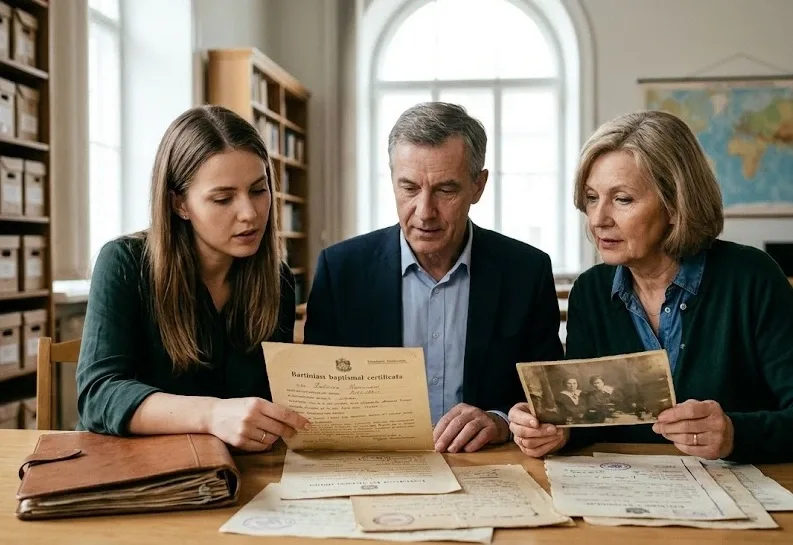



 English [EN]
