
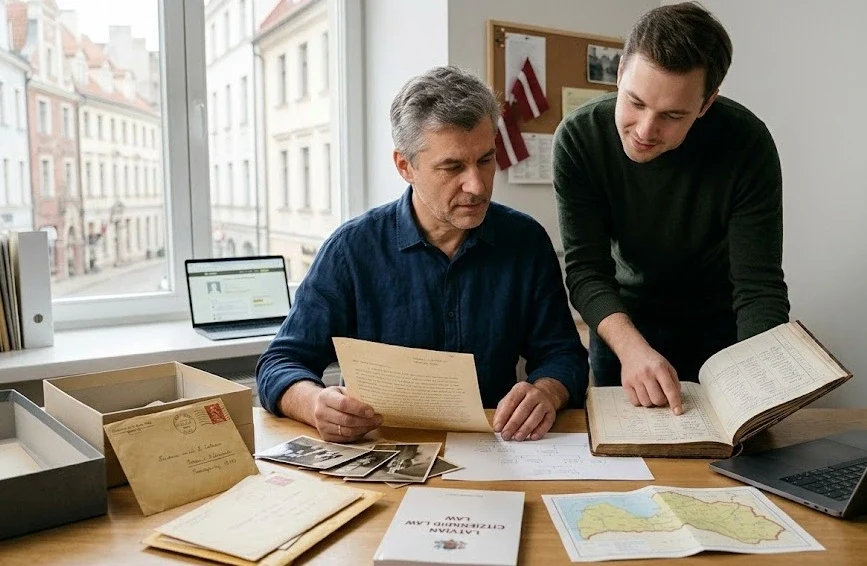
Latvian citizenship restoration after adoption can be more complex than a standard citizenship by descent case. In a typical descent-based application, the applicant must prove a clear legal family line from a qualifying Latvian ancestor to themselves. Adoption, amended birth records, sealed files, changed surnames, or later-established parentage can make that family line harder to document.
This does not always mean that an adopted person or a descendant affected by adoption is excluded. In many cases, the key issue is not adoption itself, but whether the applicant can prove the relevant legal or biological connection in a way that Latvian authorities can recognize. The answer may depend on when the adoption occurred, whether the applicant is relying on a biological or adoptive parent, how parentage is recorded, and what documents are available.
This guide explains how Latvian citizenship by descent adopted child cases are usually assessed, why legal parentage matters, and what types of documents may be important when adoption appears in the family history.
Why Adoption Matters in Latvian Citizenship by Descent Cases
Latvian citizenship by descent is document-driven. The applicant usually needs to show that a qualifying ancestor was connected to Latvian citizenship and that the applicant descends from that person through an identifiable family line. Each generation in that line normally has to be supported by civil records such as birth, marriage, name change, adoption, or court documents.
Adoption can affect this chain because it may change the legally recorded parent-child relationship. In some countries, an adoption creates a new birth certificate showing the adoptive parents and limiting access to the original biological birth record. In other cases, adoption records remain available but require a court order, agency release, or special archival request.
For Latvian citizenship adoption rules, the practical question is often whether the documents establish the parentage needed for the specific citizenship category. If the applicant is claiming through a biological Latvian parent or ancestor, the original biological line may need to be proven. If the applicant is claiming through an adoptive parent, the adoption must usually be legally recognized and relevant to the citizenship basis being used.
Latvian Citizenship Restoration After Adoption Is Not One Fixed Scenario
Adoption can appear in several different ways in a Latvian citizenship case. The legal analysis may change depending on which person in the family line was adopted and which ancestor is being used as the qualifying Latvian link.
One common scenario involves an applicant who was adopted as a child and later discovers a biological parent or grandparent with Latvian citizenship or Latvian exile history. In this situation, the applicant may need to prove the biological family line despite the adoption. The amended birth certificate alone may not be enough if it no longer names the biological parent.
Another scenario involves a person who was adopted by a Latvian citizen or by someone who later restored Latvian citizenship. This raises a different question: whether the adoptive relationship can serve as the legal parent-child link for citizenship purposes. The answer may depend on the timing of the adoption, the status of the adoptive parent, the applicant’s age at the time, and the way the adoption is recognized under Latvian law.
A third scenario involves legal parentage established outside a traditional birth record. This may include court-recognized paternity, later correction of a birth certificate, acknowledgment of parentage, or other legal acts that define who the applicant’s parent is. In Latvian citizenship legal parentage cases, the document proving parentage may be just as important as the biological facts.
Biological Parentage After Adoption
Many applicants ask whether adoption removes the possibility of claiming Latvian citizenship through a biological parent. The cautious answer is that it depends on the documents and the legal basis of the application.
If the citizenship claim is based on a biological Latvian family line, the applicant will usually need evidence connecting them to that biological parent and then connecting that parent to the qualifying Latvian ancestor. Adoption may make the records harder to access, but it does not necessarily erase the historical biological relationship for evidentiary purposes.
The main difficulty is often documentary rather than genealogical. Latvian authorities generally rely on official documents, not DNA results alone or family stories. If the original birth certificate, adoption file, court order, or other official record names the biological parent, it may help establish the descent family line. If the records are sealed or incomplete, the applicant may need to obtain a certified release, court-authorized copy, or equivalent official document from the country where the adoption occurred.
For this reason, Latvian citizenship biological parent after adoption cases should be reviewed carefully before filing. The applicant may have a real family connection, but the application can still be weak if the documents do not prove it clearly.
Citizenship Through an Adoptive Parent
Latvian citizenship through adoptive parent cases require a different analysis. Adoption can create a legal parent-child relationship, but not every legal parent-child relationship automatically creates eligibility for every Latvian citizenship route.
If the adoptive parent was already a Latvian citizen when the child was born or adopted, the child’s situation may need to be assessed under the rules for children of Latvian citizens and the recognition of the adoption. If the adoptive parent later restored Latvian citizenship, the child’s eligibility may depend on age, timing, parentage, and the specific procedure available.
A person adopted by a Latvian-descended parent should not assume that adoption alone is enough. Latvian citizenship by descent legal parentage usually requires both a recognized parent-child relationship and a qualifying citizenship link. The adoption decree, amended birth certificate, identity documents, and proof of the adoptive parent’s Latvian citizenship or descent may all become relevant.
For adult adoptees, the situation may be even more sensitive. Some citizenship systems treat adult adoption differently from childhood adoption, especially when the claim is based on descent. If an adoption occurred after the applicant reached adulthood, it should not be treated as automatically equivalent to a birth-based or childhood parentage link.
Legal Parentage and the Family Line
Legal parentage means the parent-child relationship recognized by law. In citizenship restoration cases, this can be decisive because the family line must be shown through legally acceptable records.
In a straightforward case, legal parentage is proven by a birth certificate naming the parent. In more complicated cases, the relevant document may be a court order, adoption decree, paternity acknowledgment, civil registry correction, or official extract from a birth register. If a person’s name changed after adoption, marriage, immigration, or naturalization, additional name-change documents may be needed to show that all records refer to the same person.
Latvian citizenship descent family line adoption cases often fail or receive additional document requests when the generational chain is unclear. For example, an applicant may have proof that a grandparent was Latvian, but the parent’s adoption record may not clearly connect that parent to the grandparent. In another case, the applicant may have an amended birth certificate naming adoptive parents, but no official record showing the biological parent through whom the Latvian claim is made.
The stronger the legal parentage documentation, the easier it is to present the case coherently.
Documents Usually Needed for Adopted Descendants
Latvian citizenship documents for adopted descendants vary depending on the facts, but the core principle is the same: each link in the family line should be supported by official records.
An applicant may need their current birth certificate, original birth certificate if available, adoption decree, amended birth certificate, court order, parentage acknowledgment, marriage certificates, divorce records, name-change documents, and death certificates where relevant. If the claim is based on a Latvian ancestor, the applicant may also need records proving that ancestor’s Latvian citizenship, residence, exile history, or other qualifying status.
Foreign documents often need to be issued as certified copies or official extracts. Depending on the issuing country and the submission method, documents may also need apostille, legalization, or certified translation into Latvian. Names should be consistent across the file, or the differences should be explainable through official records.
For U.S.-based applicants, adoption and birth records can vary significantly by state. Some states provide access to original birth certificates for adoptees; others may require a court petition or have restricted access rules. This can affect how the Latvian citizenship restoration file is prepared.
Common Problems in Adoption-Related Citizenship Cases
The most common issue is an incomplete family chain. The applicant may know the biological family history, but the available civil records may not prove it in a legally usable way. In citizenship cases, personal knowledge is rarely enough without documents.
Another common issue is the amended birth certificate. After adoption, the amended certificate may list only the adoptive parents. This can be useful when the claim is through the adoptive parent, but it may be insufficient when the claim is through the biological parent. In that situation, the original birth record or adoption file may be necessary.
Name discrepancies are also frequent. Adopted children may receive a new surname, immigrants may have changed names after arrival in the United States, and Latvian names may appear in different spellings across records. These inconsistencies do not always prevent an application, but they should be documented carefully.
A further complication is timing. Whether the adoption occurred before or after the applicant reached adulthood, whether the parent was a Latvian citizen at the relevant time, and whether citizenship was restored before or after the child’s birth can all affect the analysis.
How to Assess Eligibility Before Preparing the Application
Before preparing a Latvian citizenship restoration after adoption case, it is useful to identify the exact citizenship path being considered. The applicant should determine whether the claim is based on a biological Latvian ancestor, an adoptive parent, a parent who later restored Latvian citizenship, or another legal parentage route.
The next step is to map the family line generation by generation. Each connection should be supported by an official document. Where adoption changed the records, the applicant should identify whether the original record, adoption decree, or court file is available.
It is also important to separate genealogy from legal proof. A family tree, DNA match, or oral history may help guide research, but the citizenship file normally needs civil documents and official records. DNA evidence may support family research, but it usually cannot replace birth, adoption, or parentage documents.
Finally, the applicant should review whether dual citizenship rules, document legalization, translations, and name variations may affect the case. These issues do not always determine eligibility, but they can affect how the application should be organized.
When Adoption May Not Be Enough
Adoption does not automatically create a successful Latvian citizenship claim. If the adoptive parent has no qualifying Latvian citizenship link, adoption alone may not be relevant to Latvian citizenship by descent. Similarly, if the applicant claims through a biological parent but cannot obtain records proving that relationship, the case may be difficult to document.
Adult adoption may also be treated differently from adoption during childhood. Because descent-based citizenship usually focuses on family status and parentage, authorities may examine whether the legal relationship is sufficient for the specific citizenship category. This is especially important where adoption occurred primarily for inheritance, family unity, or other civil-law reasons after the person was already an adult.
The safest approach is to avoid assuming that adoption either guarantees or destroys eligibility. The better question is whether the applicant can prove a qualifying Latvian family line through documents that Latvian authorities are likely to accept.
FAQ
Can adopted children inherit Latvian citizenship by descent?
Adopted children may have a possible Latvian citizenship claim, but eligibility depends on the legal basis of the case. If the claim is through a biological Latvian parent or ancestor, the applicant usually needs records proving the biological family line. If the claim is through an adoptive parent, the adoption and the parent’s Latvian citizenship status must be legally relevant and properly documented.
Does adoption break the biological family line for Latvian citizenship restoration?
Adoption can complicate the proof of biological parentage, especially if the original birth certificate was sealed or replaced by an amended certificate. However, it does not necessarily make the biological line impossible to use. The practical issue is whether official records can prove the biological relationship and connect it to the qualifying Latvian ancestor.
Can I apply for Latvian citizenship through an adoptive parent?
It may be possible in some situations, but adoption through a Latvian or Latvian-descended parent should not be treated as automatic eligibility. The case may depend on when the adoption occurred, whether it is legally recognized, whether the adoptive parent was a Latvian citizen or had a qualifying Latvian citizenship link, and which citizenship procedure applies.
What documents are important for Latvian citizenship after adoption?
Important documents may include the original birth certificate, amended birth certificate, adoption decree, court order, parentage acknowledgment, name-change records, marriage records, and documents proving the Latvian ancestor’s citizenship or qualifying status. The exact document set depends on whether the claim is based on biological descent, adoptive parentage, or another legal parentage route.
Can DNA prove Latvian citizenship by descent after adoption?
DNA may help identify relatives or guide family research, but it usually cannot replace official civil records in a citizenship application. Latvian citizenship by descent adopted child cases generally need documentary proof of the legal or biological family line, such as birth records, adoption records, court documents, or civil registry extracts.



 English [EN]