

Many descendants of Latvian emigrants begin their citizenship research with one important date: when their ancestor left Latvia. Families who moved to the United States, Canada, Australia, the United Kingdom, or other countries before the Second World War often wonder whether an early departure strengthens or weakens a modern citizenship claim. A common question is, can I qualify for Latvian citizenship if my ancestor left before 1940? The answer cannot be determined from the emigration date alone. Latvian authorities consider the ancestor’s legal citizenship status, the circumstances and timing of departure, the applicant’s documented family connection to that person, and the legal pathway under which citizenship is requested. The Latvian citizenship 1940 cutoff is therefore important, but it should not be treated as a simple rule under which everyone whose relative departed before a particular date automatically qualifies. A person researching Latvian citizenship by descent before 1940 must first establish what legal status the ancestor actually held and how the family history fits within the applicable citizenship provisions.
The historical timeline becomes particularly important because Latvia experienced major political and legal changes during the twentieth century. For citizenship-by-descent cases, the June 17, 1940 cutoff can be relevant when determining how an ancestor’s citizenship history should be assessed and which legal route may apply to descendants. However, proving that a relative was born or lived in Latvia before that date is not necessarily the same as proving that the person was a Latvian citizen. This distinction is central when assessing Latvian citizenship where a pre-1940 ancestor forms the basis of the claim. Applicants may need official evidence establishing the ancestor’s citizenship, residence, departure, and later status in another country. The question of Latvian citizenship by descent ancestor emigration date should therefore be examined together with citizenship records rather than in isolation. When assessing Latvian citizenship, if an ancestor emigrated before 1940, the exact timeline may help establish the historical context of the case, but documentary evidence is still necessary to connect that history to the applicant and demonstrate that the relevant legal requirements are satisfied.
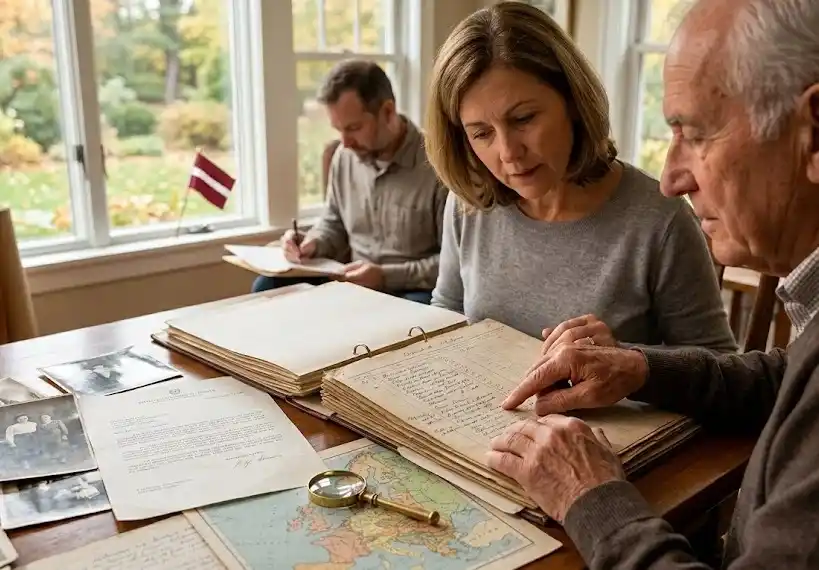
This is particularly relevant for families whose Latvian history survives mainly through stories, old photographs, foreign civil records, or a small collection of documents preserved after emigration. Someone researching Latvian citizenship if grandparent left Latvia before 1940 may know where the grandparent was born and approximately when the family departed, yet still need evidence establishing whether that grandparent held Latvian citizenship and how each subsequent generation is legally connected. The same principle applies when considering Latvian citizenship by descent eligibility before 1940 more broadly: ancestry is an important starting point, but citizenship eligibility is ultimately established through legal status and documentary evidence. Depending on the family history, relevant evidence may include Latvian archive records, birth and marriage certificates, passports, immigration and naturalization files, and U.S. civil records where the family settled in the United States. Understanding these elements before applying helps determine whether Latvian citizenship by descent 1940 rules are relevant to the particular case and prevents applicants from assuming that the date of departure alone guarantees either approval or refusal.
Why Does the 1940 Cutoff Matter for Latvian Citizenship?
The historical date connected with an ancestor’s departure can be important when assessing Latvian citizenship by descent 1940 cases, but the date should always be considered together with the ancestor’s actual legal status. The June 17, 1940 cutoff is particularly significant because Latvia’s occupation and the political changes that followed affected Latvian citizens and their descendants in different ways. For a modern applicant, however, showing that an ancestor lived in Latvia before this period is not necessarily enough. Authorities may need evidence that the person was legally recognized as a Latvian citizen and that the applicant can establish a documented family connection to that individual. This is why the Latvian citizenship 1940 cutoff should not be interpreted as an automatic eligibility test. A family member may have been born in Latvia, lived there for many years, or identified as Latvian without necessarily satisfying every legal condition relevant to a citizenship-by-descent application. Conversely, an ancestor who left the country before the occupation may still form part of a potentially qualifying family history if the required citizenship status and family relationship can be established. The legal assessment therefore begins with the historical timeline but must continue with documentary evidence showing what status the ancestor actually held.
The precise date of emigration can also help determine which historical circumstances and legal provisions need to be examined. When assessing Latvian citizenship, if an ancestor left before 1940, applicants should establish not only when the departure occurred but also what happened afterward. Immigration records, passenger lists, foreign residence documents, naturalization files, and later citizenship records may help reconstruct the sequence of events. This makes the Latvian citizenship by descent ancestor emigration date relevant to the assessment, particularly where the family settled permanently in another country and the ancestor later acquired another nationality. For example, when assessing Latvian citizenship, an ancestor who emigrated before 1940 may require applicants to compare Latvian evidence with records created in the United States or another destination country to determine whether the available documents support the claimed timeline. The important point is that emigration itself does not establish citizenship. Instead, the departure date becomes one element of a broader legal and documentary history that may include the ancestor’s Latvian citizenship, foreign naturalization, changes of name, and the civil records connecting each generation to the present applicant.
What Must You Prove If Your Ancestor Left Latvia Before 1940?
Applicants considering Latvian citizenship by descent before 1940 generally need to prove two connected elements: the relevant legal status of the Latvian ancestor and an uninterrupted documentary relationship between that ancestor and the applicant. Evidence of ancestry alone may not establish citizenship status, which is why historical documentation can become central to the application. Depending on what has survived within the family, Latvian archive records may help establish facts that cannot be demonstrated through documents currently in the applicant’s possession. Applicants may also rely on birth certificates, marriage certificates, historical passports, residence records, immigration files, naturalization documents, and other official sources. Where the family emigrated to America, U.S. civil records can be particularly useful for demonstrating marriages, births, deaths, surname changes, and connections between generations after departure from Latvia. The objective is to build a consistent documentary chain rather than rely on a single record. This is especially important when evaluating Latvian citizenship by descent eligibility before 1940, because the authorities need evidence that connects the historical Latvian citizen to the person applying today.
Families should also avoid assuming that they cannot proceed simply because old original documents have been lost. Records created many decades ago may have disappeared during migration, war, family moves, or the ordinary passage of time, and alternative official sources may sometimes provide the necessary evidence. At the same time, inconsistencies between records should be identified before an application is submitted. Different spellings of a surname, translated first names, conflicting dates of birth, or variations in places of birth can create questions about whether documents refer to the same person. These issues may be especially relevant when researching Latvian citizenship if grandparent left Latvia before 1940, because several generations of Latvian and foreign records may need to be connected. A Latvian citizenship case involving a pre-1940 ancestor should therefore begin with a review of the entire available documentary history: what proves the ancestor’s Latvian status, what establishes the departure timeline, and what connects every subsequent generation. This approach makes it possible to identify missing evidence before filing and determine whether additional archival or foreign-record research is required.
Does Leaving Latvia Before 1940 Automatically Make You Eligible?
Leaving Latvia before 1940 does not, by itself, automatically establish a right to Latvian citizenship today. The date of departure is an important historical fact, but authorities still need to determine whether the ancestor held the citizenship status required for the particular legal pathway and whether the applicant can document the family relationship. This distinction is especially important when assessing Latvian citizenship where an ancestor left before 1940. An old passenger list or immigration record may show when a person departed Europe, but it does not necessarily prove that the person was a Latvian citizen. Likewise, a Latvian place of birth or residence may support the historical narrative without independently establishing citizenship. Applicants researching Latvian citizenship by descent before 1940 should therefore avoid treating a single date or document as conclusive evidence. The complete history matters: who the ancestor was, what legal status that person held, when the person emigrated, what happened after emigration, and how the applicant is related to that ancestor through subsequent generations. This is why two families whose ancestors departed Latvia during a similar period may receive different eligibility assessments even when their migration stories initially appear almost identical.
The same principle applies when the qualifying relative is a grandparent or a more distant ancestor. Someone researching Latvian citizenship if grandparent left Latvia before 1940 may have a strong documented family connection but still need to establish the grandparent’s citizenship status and resolve any gaps between Latvian and foreign records. In other cases, the relevant person may be a Latvian citizenship pre-1940 ancestor several generations removed from the applicant, making the documentary chain more extensive. The number of generations does not replace the need for a legal analysis of the underlying citizenship history. Instead, every generation normally needs to be connected through reliable civil or archival evidence so that the authorities can determine that the applicant is genuinely descended from the person on whom the claim is based. This also explains why Latvian citizenship by descent eligibility before 1940 cannot be evaluated solely from a family tree. Genealogical information can help identify the relevant ancestor and records, but the final assessment depends on whether the documented facts satisfy the applicable legal requirements.
What If Your Latvian Ancestor Became a U.S. Citizen?
For families who emigrated to the United States, naturalization records may form an important part of the historical timeline. When examining Latvian citizenship where an ancestor emigrated before 1940, it may be necessary to determine not only when the ancestor arrived in the United States but also whether and when that person became a U.S. citizen. Declarations of intention, petitions for naturalization, certificates of naturalization, census records, and related U.S. civil records may help establish this chronology. The timing can matter because the citizenship history of the ancestor must be understood in the context of the legal pathway being considered. Applicants should therefore avoid assuming that obtaining U.S. citizenship automatically proves or destroys a modern Latvian citizenship claim. The relevant question is how the ancestor’s documented status and naturalization history interact with the provisions applicable to the descendant’s case. This is another reason the Latvian citizenship by descent ancestor emigration date should be evaluated together with later events rather than treated as an isolated fact.
Applicants also frequently ask whether successful recognition of Latvian citizenship would require them to surrender their American nationality. The possibility of dual citizenship with the United States depends on the legal basis and circumstances applicable to the individual case, so it should be considered as part of the citizenship assessment rather than assumed from another applicant’s experience. For someone researching Latvian citizenship by descent 1940, the first task remains establishing the relevant historical and family facts; questions about retaining another citizenship follow from the legal pathway identified through that analysis. This is particularly important because families often compare their cases with relatives or other descendants whose circumstances may differ in legally significant ways. One person may have a different current nationality, a different generational relationship to the Latvian ancestor, or different evidence concerning the ancestor’s status. A careful review of both Latvian and foreign documentation therefore provides a more reliable basis for determining eligibility than relying on the simple fact that an ancestor left Latvia before 1940.
Conclusion
The fact that an ancestor left Latvia before 1940 can be highly relevant to a citizenship assessment, but the departure date alone does not determine the result. A Latvian citizenship 1940 cutoff case requires a broader examination of the ancestor’s legal status, the timing and circumstances of emigration, and the documentary chain connecting that person to the applicant. Someone considering Latvian citizenship by descent before 1940 should therefore begin by establishing what can actually be proven through official records rather than relying only on family stories, birthplace, or the year of departure. Latvian archive records, foreign immigration and naturalization files, civil status documents, and other official evidence may all contribute to reconstructing the family history. Where records are missing or contain conflicting information, these issues should ideally be identified before the application is submitted so that additional evidence can be obtained where necessary.
Ultimately, the question can I qualify for Latvian citizenship if my ancestor left before 1940 cannot be answered by applying a single historical date to every family. The June 17, 1940 cutoff is an important part of the historical and legal analysis, but eligibility depends on the complete circumstances of the individual case. This applies whether the relevant person was a parent, grandparent, or another pre-1940 ancestor relevant to the Latvian citizenship claim. Applicants should first determine the ancestor’s citizenship status, establish the family relationship through reliable documentation, and review the emigration and naturalization timeline before choosing a legal pathway. A professional assessment at the beginning of the process can help identify missing evidence, determine which records require further research, and clarify whether the documented family history provides a potential basis for Latvian citizenship by descent.
Frequently Asked Questions
Can I qualify for Latvian citizenship if my ancestor left before 1940?
Potentially. An ancestor’s departure before 1940 may be relevant, but the date alone does not establish eligibility. The ancestor’s citizenship status, family relationship, emigration history, and available documentary evidence must also be assessed.
Does the Latvian citizenship 1940 cutoff automatically make descendants eligible?
No. The historical cutoff is important when determining which legal circumstances may apply, but applicants must still establish the relevant ancestor’s status and their documented relationship to that person.
What if my grandparent left Latvia before 1940?
A Latvian citizenship if grandparent left Latvia before 1940 case may provide a potential basis for further assessment. You will generally need documents establishing the grandparent’s relevant Latvian status and the family chain connecting you to that person.
Does my ancestor need to have had a Latvian passport?
Not necessarily. A surviving passport may be useful evidence, but other official or archival records may also help establish historical citizenship status depending on the circumstances.
What if the original family documents were lost?
The absence of original documents does not necessarily prevent further research. Relevant evidence may sometimes be obtained from Latvian archives, civil registries, immigration authorities, or institutions in the country where the ancestor settled.
Can U.S. records help prove my family history?
Yes. For families that settled in the United States, U.S. civil records, immigration files, naturalization documents, and other official sources may help establish family relationships, name changes, and the ancestor’s post-emigration history.
Does becoming a U.S. citizen affect Latvian citizenship eligibility?
It can be relevant to the legal analysis because the timing and circumstances of naturalization form part of the ancestor’s citizenship history. The effect should be assessed according to the legal pathway applicable to the individual case.
Can I keep my U.S. citizenship if I qualify?
The possibility of dual citizenship with the United States depends on the legal basis and circumstances of the case. Applicants should determine the applicable Latvian citizenship pathway before drawing conclusions about retaining another nationality.
What should I check before applying?
Start by identifying the relevant Latvian ancestor, determining when that person left Latvia, reviewing evidence of citizenship status, and establishing the family relationship through each generation. This initial review can reveal whether additional archival or foreign-record research is necessary before submitting an application.


 English [EN]