
Jul 27, 2026 | Blog
The Latvian passport ranking 2026 places Latvia among the countries with the strongest travel documents in the world. Latvian citizens benefit from extensive international travel access, European Union citizenship rights and the ability to move within much of Europe without obtaining a conventional immigration permit.
However, a passport ranking is not a permanent legal classification. Different indexes use different methodologies, count entry arrangements differently and update their data at different times. For that reason, a search for the Latvia passport ranking 2026 may produce more than one correct number.
As of July 2026, the Henley Passport Index ranks Latvia seventh globally, with access to 183 destinations without obtaining a conventional visa before departure. Passport Index gives Latvia a Passport Power Rank of fourth and a mobility score of 173. The difference does not indicate that one source is necessarily wrong. It reflects how each index defines accessible destinations and calculates tied positions.
Latvian Passport Ranking 2026 at a Glance
The two frequently cited passport indexes currently assess Latvia as follows:
- Henley Passport Index: seventh place, with access to 183 destinations without a prior visa.
- Passport Index: fourth place, with a mobility score of 173.
- Henley ranking for the United States: tenth place, with access to 180 destinations.
- Passport Index ranking for the United States: ninth place, with a mobility score of 168.
These figures confirm that Latvian passport strength in 2026 remains within the highest global tier. They should nevertheless be read within the methodology of the relevant index rather than combined into a single score.
Why Latvia Has Different Passport Rankings
There is no single government-operated global passport ranking. Private research organizations publish separate indexes based on their own definitions of travel access.
Two indexes may assess the same passport on the same date and still produce different rankings. The differences may result from how they treat visas on arrival, electronic travel authorizations, visitor permits, territories, suspended visa agreements and countries tied on the same score.
Henley Passport Index Latvia 2026
The Henley Passport Index ranks 199 passports against 227 destinations. Its core score measures the number of destinations passport holders can access without obtaining a visa before departure. The underlying travel information is based on International Air Transport Association data and is supplemented by ongoing research.
Henley updates its index periodically during the year. A country may therefore gain or lose a destination, change score or move to another tied rank after an entry policy changes.
In the current 2026 ranking, Latvia shares seventh place with several other countries. This means that “seventh place” does not necessarily mean that only six individual countries are ahead of Latvia. Multiple countries can occupy the same position because they have equal scores.
Latvia Passport Mobility Score
Passport Index uses a mobility score that combines several categories of travel access. Latvia’s current score of 173 includes destinations classified as visa-free, visa on arrival or accessible through an electronic travel authorization.
Passport Index currently places Latvia at Passport Power Rank four. That number should only be compared with other countries within the same index. Comparing Latvia’s Passport Index score directly with a Henley score would be misleading because the two organizations do not use identical calculations.
How Powerful Is the Latvian Passport?
The Latvian passport is a very strong travel document by international standards. Its holder can reach most destinations in Europe and many destinations in North America, Latin America, Asia and other regions without applying for a traditional embassy visa before every trip.
This level of access can reduce application costs, documentation requirements and advance planning for short visits. It can be particularly useful for people who travel regularly for tourism, family visits, conferences or business meetings.
The Latvian passport visa-free countries available to a particular traveler still depend on the destination, purpose of travel and length of stay. Entry without a prior visa usually applies to short visits. It does not automatically authorize employment, long-term residence, study or commercial activity.
Passport power also does not eliminate border controls. A traveler may still be asked to show proof of accommodation, sufficient funds, onward travel, insurance or a valid reason for the visit.
What Does a Passport Power Index Measure?
In most search results, “passport power” refers primarily to international travel mobility. A passport receives a stronger ranking when more destinations permit its holders to enter without completing a traditional visa application in advance.
Some indexes calculate only destination access. Others use additional factors such as taxes, personal freedom, international perception, dual citizenship rules or the economic value of accessible destinations. Henley also operates a separate Passport Power tool that considers the share of global economic output accessible to a passport holder without a prior visa. That is a different measurement from the standard Henley Passport Index ranking.
A ranking therefore answers a relatively narrow question: how broadly can the document normally be used for short international travel? It does not provide a complete measurement of the legal, economic or personal value of citizenship.
Latvian Passport Ranking Compared with the U.S. Passport
The Latvian passport ranking compared to the U.S. passport is notable in 2026 because Latvia is currently positioned above the United States in both major travel indexes.
In the current Henley ranking, Latvia is seventh with a score of 183, while the United States is tenth with a score of 180. In Passport Index, Latvia is fourth with a mobility score of 173, while the United States is ninth with a mobility score of 168.
This does not mean that a Latvian passport is superior for every individual journey. The practical difference depends on which destinations a person intends to visit. One passport may provide easier access to a particular country, while the other may have a different entry arrangement elsewhere.
The comparison also does not account for rights arising from European Union citizenship. A U.S. citizen may visit many European countries without a conventional visa for a limited period, but this is not the same as having the legal right to establish residence, accept employment or study under the rules applicable to EU citizens.
What the Ranking Means in Practice
A high ranking generally means that Latvian citizens face fewer advance visa applications when making short international trips. In practice, this can provide several advantages.
Travel planning may be faster because fewer visits require consular appointments. Travelers may need to submit fewer financial documents, invitation letters or detailed itineraries before departure. They may also have greater flexibility when plans change unexpectedly.
Visa-free travel for Latvian passport holders does not mean travel without conditions. A destination may require an electronic travel authorization, arrival registration or visitor permit. It may also impose a maximum stay, restrict paid work and require the passport to remain valid for a defined period after the planned departure date.
Travelers should verify the official rules for their destination before each trip. Entry requirements can change in response to diplomatic decisions, public health measures, security concerns or new electronic border systems.
What the Ranking Does Not Guarantee
The Latvian passport rank in the world does not guarantee entry into every destination included in an index. Border authorities generally retain the power to assess whether a traveler meets the applicable entry conditions.
A passport ranking also does not guarantee:
- admission after arrival at the border;
- permission to work or conduct business;
- long-term residence rights outside the EU framework;
- exemption from electronic travel authorization;
- exemption from health, financial or insurance requirements;
- consular intervention that overrides the law of another country;
- the continued availability of the same entry conditions in the future.
A previous immigration violation, criminal matter, travel restriction or incomplete documentation may affect entry even when the passport is normally eligible for visa-free access.
EU Citizenship Rights Add Value Beyond the Ranking
Latvian citizens are also citizens of the European Union. This provides legal rights that are not fully reflected in conventional passport rankings.
Subject to applicable registration requirements and other conditions, an EU citizen may move to another EU country to live, work, study, seek employment or retire. Latvian citizens also benefit from freedom of movement within the EU and from the Schengen framework for travel between participating countries.
These rights are legally different from visa-free tourist access. A high global mobility score concerns entry into foreign destinations, while EU citizenship creates a broader legal basis for residence and economic activity within the European Union.
Other Latvian passport benefits may include access to EU educational opportunities, employment markets and consular protection mechanisms. The precise conditions can depend on the destination country, duration of residence and the holder’s circumstances.
A Latvian Citizen Passport Is Not a Non-Citizen Passport
The ranking discussed in this article applies to the passport issued to citizens of the Republic of Latvia. It should not be applied automatically to an alien’s passport issued to a Latvian non-citizen.
Latvia issues a citizen’s passport to a person registered as a Latvian citizen. An alien’s or non-citizen’s passport is a separate identity and travel document issued to a person holding the legal status of a Latvian non-citizen. The two documents confirm different legal statuses and can provide different travel rights.
Latvian non-citizen status should also not be treated as identical to stateless status. Latvian law regulates non-citizens and stateless persons under separate legal frameworks, and a person subject to the Latvian non-citizen legislation may not automatically be recognized as stateless.
A relative’s Latvian non-citizen passport may be relevant when reconstructing family residence, identity or migration history. However, the document does not by itself prove that the relative was a Latvian citizen, and it does not automatically establish a descendant’s eligibility for Latvian citizenship.
Why the Ranking Matters to Americans with Latvian Ancestry
For an American researching Latvian ancestry, the ranking can illustrate one practical consequence of becoming legally recognized as a Latvian citizen. It does not determine whether that person qualifies.
An applicant cannot obtain a Latvian citizen passport solely by presenting evidence of Latvian ethnic background or a family connection. The person must first establish eligibility under an applicable citizenship category and be registered as a Latvian citizen. Only after the citizenship and personal data are recorded correctly can the person apply for a citizen passport.
Latvian law generally permits dual citizenship with the United States in qualifying situations because the United States falls within a permitted category of countries. Nevertheless, the correct result may depend on the applicant’s citizenship route, age, family history and other individual circumstances.
Understanding dual citizenship with the United States is therefore separate from determining whether the applicant can prove the relevant Latvian citizenship or descent requirements.
Documents That May Be Needed Before Applying for a Passport
A passport application normally comes after the citizenship question has been resolved. For citizenship by descent or restoration-related cases, documents are used to establish the identity of the Latvian ancestor, the ancestor’s legal status and the family line connecting that person to the applicant.
The exact evidence varies by citizenship category. Depending on the case, an applicant may need:
- records showing that an ancestor was a citizen of Latvia during the legally relevant period;
- Latvian birth, marriage, residence, census, passport or archive records;
- evidence relating to departure from Latvia, exile, deportation or residence history;
- birth certificates connecting each generation;
- marriage, divorce or death certificates where relevant;
- records documenting adoption or another legally recognized parent-child relationship;
- documents establishing every surname or legal name change;
- identity documents for the applicant and relevant relatives;
- evidence concerning the ancestor’s acquisition of another citizenship.
Official Latvian guidance identifies civil status records, archive materials, pre-war passports and documents confirming kinship as potentially relevant evidence. The necessary documents may vary substantially depending on the legal route being used.
U.S. Civil Records and Proof of Lineage
For applicants born in the United States, U.S. civil records frequently form the generational chain between the Latvian ancestor and the current applicant.
Birth certificates can establish parent-child relationships. Marriage and divorce records may explain surname changes. Death certificates can help identify parents, spouses, birthplaces or former names, although the evidentiary value of each record depends on its content and accuracy.
Applicants attempting to prove Latvian descent should examine whether names, dates and places remain consistent from one generation to the next. A record that contains incomplete or conflicting information may need to be supported by additional evidence.
A structured review of U.S. civil records can help identify gaps before documents are submitted. Applicants should not assume that an informal family tree or a collection of ordinary photocopies will be sufficient.
Naturalization Records and Citizenship History
U.S. naturalization records may be important because they can show when a Latvian ancestor became a U.S. citizen, how the person identified their former nationality and which name variants were used.
Relevant materials may include a declaration of intention, petition for naturalization, certificate of naturalization, certificate of citizenship, court record or related immigration file. The document needed depends on the period and the ancestor’s individual history.
Naturalization does not have the same legal effect in every Latvian citizenship category. Its significance may depend on when it occurred, which Latvian legal status the ancestor held and which route the descendant relies upon. The authority may request additional evidence if the available records do not establish the relevant citizenship history clearly.
Name Changes, Americanization and Transliteration
Latvian names may appear differently in U.S. records because of immigration practices, English-language spelling, omitted diacritical marks, marriage-related surname changes or transliteration from another alphabet.
For example, the same person may appear under a Latvian form of a surname in an archive document and an Americanized version in a naturalization or death record. A difference does not necessarily mean that the records concern different people, but the connection should be documented rather than assumed.
Marriage certificates, court-ordered name changes, naturalization files and other civil records may help connect the variations. Applicants should also consider Latvian passport name spelling and transliteration rules when reviewing how their name may ultimately appear in Latvian records or identity documents.
Certified Copies, Apostilles and Translations
Foreign public documents generally need to meet Latvian requirements regarding authenticity and language. Depending on the issuing country, document type and submission method, certified copies, notarization, an apostille, legalization or a Latvian translation may be required.
Official Latvian guidance states that supporting foreign documents generally must be translated into Latvian. It also explains that notarized copies certified with an apostille may be used in certain citizenship submissions when the applicant does not send original documents.
Requirements should be checked for the specific application category. A document accepted in one procedure or by one consular mission should not automatically be assumed to satisfy every citizenship case.
From Citizenship Recognition to a Latvian Passport
Once a person has been registered as a Latvian citizen and their information has been entered correctly in the Register of Natural Persons, they may proceed with the passport and eID application process.
Personal data such as the person’s name, surname, citizenship, marriage and place of residence should be current before the passport application is processed. A marriage or name change completed abroad may first need to be reported and entered in the Latvian register.
Applicants living in the United States may usually need to appear in person for biometric processing through the competent Latvian authority or diplomatic mission. Citizenship recognition and passport issuance remain separate administrative stages.
Understanding what happens after Latvian citizenship approval helps prevent the assumption that a passport is issued automatically when a citizenship decision is made.
Common Mistakes When Interpreting Passport Rankings
One common mistake is quoting a rank without naming the index. Saying that Latvia is fourth and seventh can both be accurate when the figures come from different methodologies.
Another mistake is treating every mobility score as the number of completely visa-free countries. Some scores include visas on arrival or electronic travel authorizations, while others count destinations according to whether a prior visa is required.
Travelers should also avoid assuming that visa-free entry permits employment, study or indefinite residence. These activities are usually governed by separate immigration or free-movement rules.
For citizenship research, common mistakes include:
- assuming Latvian ancestry automatically creates current citizenship;
- treating a Latvian non-citizen passport as proof of Latvian citizenship;
- failing to document every generation in the family line;
- overlooking U.S. naturalization records;
- ignoring surname changes and spelling inconsistencies;
- submitting unofficial copies or incomplete translations;
- applying for a passport before Latvian citizenship has been registered.
What the Latvian Passport Ranking Ultimately Means
The Latvian passport is one of the strongest passports in the world in 2026. Its current Henley ranking of seventh and Passport Index rank of fourth reflect extensive international travel access.
The practical value of Latvian citizenship extends beyond the ranking. Latvian citizens also hold EU citizenship and may exercise applicable free-movement rights within the European Union. For Americans with Latvian ancestry, these advantages may make citizenship research particularly relevant.
The ranking itself does not establish citizenship eligibility. A successful analysis normally depends on the ancestor’s legal status, the applicable citizenship category and the quality of the documentary chain connecting the ancestor to the applicant.
Frequently Asked Questions
What is the Latvian passport ranking in 2026?
As of July 2026, the Henley Passport Index ranks Latvia seventh with access to 183 destinations without a prior visa. Passport Index ranks Latvia fourth with a mobility score of 173. The figures differ because the indexes use different methodologies.
Why is Latvia ranked seventh in one index and fourth in another?
Henley and Passport Index classify entry arrangements differently and use separate ranking systems. Henley measures destinations accessible without obtaining a visa before departure, while Passport Index combines several mobility categories into its own score. A rank should therefore be compared only with other countries in the same index.
How many countries can Latvian passport holders visit without a visa?
The current Henley score gives Latvian citizens access to 183 destinations without a prior visa. This number may include different forms of facilitated entry and should not be interpreted as entry without any documentation or conditions.
Is the Latvian passport stronger than the U.S. passport?
Latvia currently ranks above the United States in both the Henley Passport Index and Passport Index. However, the practical advantage depends on the destination. Rankings aggregate global access and do not mean that Latvia has a better arrangement for every individual country.
Does visa-free travel mean no authorization is required?
Not always. A traveler may still need an electronic travel authorization, visitor registration, onward ticket, insurance or proof of sufficient funds. Visa-free entry also usually limits the permitted duration and purpose of the visit.
Can a U.S. citizen also hold a Latvian passport?
A U.S. citizen may be able to retain U.S. citizenship when acquiring or registering Latvian citizenship under an eligible route. The outcome depends on Latvian dual citizenship rules, the citizenship category and the applicant’s circumstances. A passport can be issued only after the person is registered as a Latvian citizen.
Does having a Latvian ancestor automatically qualify me for a passport?
No. An applicant usually needs to establish eligibility under a specific citizenship provision and provide evidence of the ancestor’s relevant Latvian status and the complete family line. Ancestry alone does not automatically result in citizenship or passport issuance.
Does a Latvian non-citizen passport prove Latvian citizenship?
No. A Latvian non-citizen passport is issued to a holder of Latvian non-citizen status, not to a Latvian citizen. It may be relevant to family history research, but its legal significance depends on the relative’s status and the other available civil or archive records.
What documents may be needed to prove Latvian descent from the United States?
Depending on the case, an applicant may need Latvian archive or civil records, U.S. birth and marriage certificates, evidence of name changes, naturalization records and documents connecting every generation. Certified copies, apostilles and Latvian translations may also be required.
Jul 22, 2026 | Blog
Latvia is one of the European countries that recognizes dual citizenship in many situations, allowing individuals to hold Latvian nationality alongside another citizenship. However, Latvian dual citizenship is governed by specific legal rules that depend on how citizenship was acquired, the applicant’s family history, and the country of the second nationality.
Many people researching Latvia dual citizenship are descendants of Latvian citizens who emigrated during the twentieth century. Others are Latvian citizens who later obtained another passport through work, marriage, or long-term residence abroad. Because the applicable rules differ depending on each individual’s circumstances, understanding the legal framework before applying is essential.
If you are exploring Latvian citizenship by descent, determining your Latvian citizenship eligibility is often the first step. The Latvian Citizenship Law contains several categories that may allow applicants to retain another nationality while becoming Latvian citizens. In many cases, applicants who qualify through descent do not need to renounce their existing citizenship.
This guide explains whether Latvia allows dual citizenship, who may qualify, which countries are recognized, how Latvian citizenship by descent works, what documents are generally required during the application process, and what legal obligations dual citizens should be aware of. Whether you are researching your Latvian family history or wondering if you can retain your current nationality, understanding the applicable legal framework is an essential first step before submitting an application
What Is Latvian Dual Citizenship?
Latvian dual citizenship means that one person legally holds Latvian citizenship together with the citizenship of another country. As a Latvian citizen, the individual enjoys the rights and responsibilities established under Latvian law while also remaining a citizen of another state according to that country’s legislation.
Unlike some countries that generally prohibit multiple nationalities, Latvia recognizes dual citizenship under clearly defined legal circumstances. These provisions are regulated by the Latvian Citizenship Law and apply differently depending on whether citizenship was acquired by descent, birth, naturalization, or another legal basis.
Today, Latvia dual citizenship is most commonly associated with descendants of former Latvian citizens living abroad. Thousands of families whose ancestors left Latvia during or after the Second World War may qualify to restore or acquire Latvian citizenship while legally keeping their current nationality.
Whether an applicant may hold two passports is determined by several factors, including the legal basis for citizenship, the country of the second nationality, and the applicable provisions of the Latvian Citizenship Law. Because every citizenship case is unique, applicants should carefully assess their eligibility before submitting any supporting documentation.
Does Latvia Allow Dual Citizenship?
One of the most common questions applicants ask is does Latvia allow dual citizenship. The answer is yes—but only in situations specifically provided by Latvian law.
For many applicants, Latvia permits dual citizenship with countries that share close legal, political, or security relationships with Latvia. Other applicants may qualify through special historical categories, including descendants of Latvian citizens and former Latvian exiles.
EU and EFTA Countries
Latvia generally allows dual citizenship with citizens of European Union Member States and countries belonging to the European Free Trade Association (EFTA). Individuals who become citizens of these countries may usually retain Latvian citizenship, provided they satisfy all legal requirements.
NATO Countries
Dual citizenship is also permitted with NATO member states. This provision is especially important for many members of the Latvian diaspora living in countries such as the United States, Canada, and the United Kingdom.
For example, many applicants wonder about dual citizenship Latvia USA because they are American citizens whose parents or grandparents were born in Latvia. In many situations, Latvian law allows eligible descendants to obtain Latvian citizenship without giving up their U.S. citizenship.
Australia, Brazil, and New Zealand
Latvia additionally recognizes dual citizenship with Australia, Brazil, and New Zealand. These countries have historically been home to large Latvian communities established after the Second World War, and many descendants continue to apply for Latvian dual citizenship by descent today.
Cabinet Permission for Other Countries
In exceptional circumstances, dual citizenship may also be approved with countries outside the standard list. Such decisions are generally considered individually and require authorization under Latvian law.
Individuals should never assume that obtaining another nationality automatically allows them to retain Latvian citizenship. Every situation must be assessed under the applicable provisions of the Citizenship Law to determine whether dual citizenship may be maintained.
Citizenship Acquired Automatically Through Marriage or Adoption
Latvian law also recognizes situations where another citizenship is acquired automatically rather than through a voluntary application. This may occur through marriage, adoption, or similar legal events depending on the legislation of another country.
Because these situations are assessed individually, applicants should obtain legal guidance before making decisions that could affect their citizenship status.
Who Can Hold Latvian Dual Citizenship?
Not everyone is automatically entitled to Latvian dual citizenship. Eligibility depends on the legal basis under which Latvian citizenship is acquired or retained. The Latvian Citizenship Law establishes several categories of people who may legally hold Latvian citizenship together with another nationality.
Understanding which category applies to your situation is one of the most important steps when assessing your Latvian citizenship eligibility. Different rules apply to descendants of Latvian citizens, former exiles, ethnic Latvians, children, and individuals who obtained citizenship through naturalization.
Latvian Citizens Who Acquire Another Nationality
Latvian citizens who later obtain the nationality of another country may, in many cases, continue to hold both citizenships. Whether they can retain Latvian citizenship depends primarily on the country whose citizenship they acquire and whether Latvian law recognizes dual citizenship in that particular case.
If the second nationality belongs to one of the countries permitted under Latvian legislation, the individual may usually keep both citizenships after fulfilling any applicable reporting requirements.
Applicants Who Acquire Latvian Citizenship While Keeping Another Nationality
Many applicants obtain Latvian dual citizenship while already holding another nationality. This situation is especially common among descendants of Latvian emigrants who were born abroad.
Applicants who qualify through descent often do not need to renounce their existing citizenship if the law allows dual nationality in their circumstances. Each application is assessed individually by the competent authorities based on the applicant’s specific legal and factual circumstances.
Latvian Exiles and Their Descendants
One of the most significant categories concerns Latvian exiles and their descendants. Individuals whose families left Latvia during periods of occupation may qualify for citizenship under special legal provisions.
These historical circumstances are recognized by Latvian law, allowing many descendants living abroad to recover their ancestral citizenship while keeping their current nationality. For many families in North America, Australia, and Western Europe, this remains one of the most common legal pathways to Latvian dual citizenship by descent.
Ethnic Latvians and Livs
Ethnic Latvians and members of the indigenous Liv community may also qualify for Latvian citizenship under separate legal provisions established by the Citizenship Law.
Eligibility depends on documentary evidence proving ethnic origin and other statutory requirements. Each application is assessed individually by the responsible authorities.
Naturalized Latvian Citizens
Applicants who become Latvian citizens through naturalization are generally subject to different rules regarding dual nationality. In some situations, obtaining another citizenship after naturalization may affect their Latvian citizenship status if the second nationality is not among the countries permitted under Latvian law.
For this reason, anyone considering naturalization should first understand the applicable Latvia dual citizenship rules before applying for another passport.
Latvian Dual Citizenship by Descent
For many applicants living abroad, Latvian dual citizenship by descent is the most straightforward legal pathway to becoming a Latvian citizen. Unlike naturalization, citizenship by descent recognizes an existing legal connection to Latvia through previous generations.
Thousands of people discover that a parent, grandparent, or even earlier ancestor was a Latvian citizen. If the legal requirements are met and the documentary evidence is sufficient, these descendants may qualify for Latvian citizenship while keeping their current nationality.
Citizenship Through a Latvian Parent
Children born to a Latvian citizen often acquire Latvian citizenship automatically or may register their citizenship under simplified procedures.
Whether the child was born in Latvia or abroad generally does not prevent recognition of citizenship, provided that the legal requirements in force at the time of birth are satisfied.
Descendants of Latvian Citizens on 17 June 1940
A particularly important category includes descendants of individuals who were Latvian citizens on 17 June 1940, the date marking the beginning of the Soviet occupation of Latvia.
Many modern applications rely on proving that an ancestor held Latvian citizenship on that date. Once this legal connection is established, descendants may become eligible for Latvian dual citizenship by descent, depending on their individual circumstances.
Descendants of Latvian Exiles
Descendants of Latvian exiles frequently benefit from special legal protections introduced to preserve their connection with Latvia after decades of displacement.
Because these cases often involve historical documents from several countries, applicants usually need to reconstruct their family’s documentary history before submitting an application.
Proving Latvian Citizenship and the Family Line
Every citizenship-by-descent application relies on a complete set of supporting documentation establishing both the ancestor’s citizenship and the uninterrupted family line.
Applicants typically need to demonstrate the ancestor’s Latvian citizenship, each family relationship connecting the applicant to that ancestor, identity and civil status documents, and any name changes that occurred across generations. The stronger and more complete the documentary chain, the smoother the application process is likely to be.
Latvian Dual Citizenship Rules for Children
Latvian law contains specific provisions regarding Latvian dual citizenship for children. In many situations, children may legally hold Latvian citizenship together with the citizenship of another country from birth. The applicable rules depend on how citizenship was acquired, the citizenship of the parents, and the legislation of the other country involved.
Parents who register a child’s Latvian citizenship should ensure that all legal requirements are satisfied from the beginning, as this may simplify future administrative procedures.
Children Who Hold Citizenship of Any Country
Children born to a Latvian citizen may often acquire Latvian citizenship regardless of where they are born. If the child also acquires another nationality through the other parent or the country of birth, both citizenships may be recognized under Latvian law.
In many cases, Latvian dual citizenship for children allows families living abroad to preserve their connection with Latvia while maintaining their existing nationality.
Choosing a Citizenship by Age 25
Some applicants believe that every child with dual nationality must automatically choose only one citizenship after reaching adulthood. However, this is not always the case.
Whether a person must make such a choice depends on the legal basis of their citizenship and the countries involved. Modern legislation provides broader opportunities for retaining dual citizenship than in previous decades.
Exceptions for Permitted Countries and Exile Descendants
Special legal exceptions exist for descendants of Latvian exiles and for citizens of countries with which Latvia permits dual citizenship.
As a result, many individuals who obtained two citizenships as children may continue holding both throughout adulthood without being required to renounce either nationality.
How to Keep Latvian Citizenship After Acquiring Another Nationality
Many Latvian citizens acquire another nationality later in life through employment, long-term residence, family reunification, or other legal pathways. Whether they may retain Latvian citizenship depends on the specific provisions of the Latvian Citizenship Law and the country whose citizenship they acquire. Understanding these rules before applying for another passport can help avoid unnecessary legal complications and protect an individual’s citizenship status.
Reporting a Second Citizenship to OCMA
Individuals who acquire another citizenship should determine whether they are required to report this fact to the Office of Citizenship and Migration Affairs (OCMA).
Keeping official records accurate helps ensure that Latvian authorities correctly recognize the individual’s citizenship status.
Acquiring Citizenship of an Unpermitted Country
If a Latvian citizen voluntarily acquires the nationality of a country not covered by Latvia’s dual citizenship provisions, different legal consequences may apply.
Because every situation depends on the specific legal basis of citizenship, applicants should seek professional advice before obtaining another passport.
When Renunciation May Be Required
Some situations may require an individual to renounce one nationality if dual citizenship is not legally permitted.
Whether renunciation is necessary depends on the Citizenship Law, the country of the second nationality, and the person’s citizenship category.
How Latvia Treats Dual Citizens in Legal Relations
Within Latvia, individuals holding multiple citizenships are generally treated as Latvian citizens.
This means that Latvian authorities apply Latvian law when dealing with matters such as identification documents, legal obligations, and administrative procedures.
Latvian Dual Citizenship Requirements and Documents
Understanding the Latvia dual citizenship requirements is one of the most important parts of any successful application. Although every case is unique, applicants are generally expected to provide evidence establishing both their identity and their legal right to Latvian citizenship.
Incomplete documentation is one of the most common reasons why applications require additional review.
Proof of the Legal Basis for Citizenship
Applicants must first demonstrate the legal category under which they qualify for citizenship.
Identity and Civil Status Documents
Applicants usually submit identity documents together with civil status records such as birth certificates, marriage certificates, or divorce documents where applicable.
Proof of Latvian Citizenship or Ancestry
Evidence connecting the applicant to a Latvian citizen is often the most important part of the application.
Birth, Marriage, and Name Change Records
When family members changed their names after marriage or immigration, applicants should provide documentary evidence linking every generation.
Translation and Legalization Requirements
Foreign documents frequently require certified translations into Latvian. Depending on the country where the documents were issued, legalization or an Apostille may also be required before submission.
How Latvian Dual Citizenship Is Registered or Reported
After determining eligibility and collecting all supporting documents, applicants must follow the appropriate administrative procedure to register or report their citizenship.
Determining the Correct Citizenship Category
Before preparing any documents, applicants should identify the correct legal basis for their case.
Preparing the Application
Once eligibility has been confirmed, applicants should complete the official application forms and gather all required supporting documents.
Submitting Documents to OCMA or a Latvian Mission
Applications may generally be submitted either to the Office of Citizenship and Migration Affairs in Latvia or to a Latvian embassy or consulate abroad.
Reporting Citizenship Acquired Abroad
Individuals who acquire another nationality after already becoming Latvian citizens should determine whether Latvian authorities must be notified.
Application Review and Decision
Once all documents have been submitted, the responsible authority reviews the application, verifies the evidence, and issues its decision.
Rights and Responsibilities of Latvian Dual Citizens
Holding Latvian dual citizenship provides individuals with the benefits of Latvian nationality while allowing them to maintain another citizenship where permitted by law. At the same time, dual citizens remain subject to certain legal obligations in Latvia.
Understanding both the rights and responsibilities associated with Latvian dual nationality helps applicants make informed decisions before applying for citizenship.
Latvian and EU Citizenship Rights
A Latvian citizen is also a citizen of the European Union. This provides the right to live, work, study, and establish a business throughout the EU.
Individuals who obtain a Latvian citizenship second passport through descent or another legal category enjoy the same constitutional rights as other Latvian citizens.
Passport and Travel Requirements
Latvian citizens may apply for a Latvian passport and identity card after citizenship has been recognized. A Latvian passport allows visa-free or visa-on-arrival access to many countries.
Consular Protection and Legal Status in Latvia
While abroad, Latvian citizens may receive consular assistance from Latvian diplomatic missions. Within Latvia they are generally treated solely as Latvian citizens.
Military Service Obligations
Military service obligations depend on the legislation in force at the relevant time. Applicants should review current legal requirements.
Citizenship and Tax Residence
Holding Latvian citizenship does not automatically make a person a Latvian tax resident. Tax residence is determined under separate tax legislation.
What Happens If Dual Citizenship Is Not Permitted?
Although Latvia recognizes dual citizenship in many situations, there are cases where holding another nationality may have legal consequences. The outcome depends on how Latvian citizenship was acquired, the country of the second nationality, and the relevant provisions of the Citizenship Law. Understanding these rules in advance helps applicants make informed decisions and avoid unexpected complications.
Renunciation of Latvian Citizenship
Where required by law, an individual may choose to renounce Latvian citizenship before or after obtaining another nationality.
Loss or Revocation of Citizenship
Failure to comply with the Citizenship Law may affect a person’s citizenship status in certain circumstances.
Correcting an Unreported Citizenship Status
Applicants who have not properly reported another citizenship may need to update their records with the authorities.
Conclusion
Latvian dual citizenship offers valuable opportunities for many people with Latvian family roots or existing legal connections to Latvia. Understanding the applicable legislation before applying is essential.
Carefully preparing documents and determining the correct legal category significantly improves the likelihood of a successful application. If you are unsure whether you qualify for Latvia dual citizenship, obtaining a professional legal assessment is strongly recommended.
Frequently Asked Questions
Does Latvia Allow Dual Citizenship With the United States?
Yes. Latvia generally allows dual citizenship with the United States in situations permitted under the Latvian Citizenship Law. Many U.S. citizens who qualify for Latvian citizenship by descent are able to obtain Latvian citizenship without renouncing their American nationality. Each application is assessed individually, and applicants should ensure they meet all legal and documentary requirements.
Which Countries Does Latvia Allow Dual Citizenship With?
Latvia permits dual citizenship with citizens of European Union and EFTA countries, NATO member states, Australia, Brazil, New Zealand, and several other categories established by law. In certain exceptional cases, dual citizenship may also be approved by the Cabinet of Ministers. Because the applicable rules vary, applicants should verify whether their country is covered before applying.
Can I Get Latvian Dual Citizenship Through a Grandparent?
Possibly. If your grandparent was a Latvian citizen and you can prove your family relationship with official documents, you may qualify for Latvian citizenship by descent. The application requires evidence of both your ancestor’s citizenship and the uninterrupted family line connecting you to that ancestor.
H3: Can I Hold Three or More Citizenships?
In some situations, yes. Latvian law does not automatically prohibit multiple citizenships if the applicable legal requirements are satisfied. However, applicants must also consider the laws of the other countries involved, as not every country recognizes multiple nationality.
Do I Need to Renounce My Current Citizenship?
Not necessarily. Many applicants who qualify for Latvian citizenship by descent are allowed to retain their existing nationality. Whether renunciation is required depends on the legal basis of your application and the country whose citizenship you currently hold.
Can Children Keep Two Citizenships After Turning 18?
In many cases, yes. Latvian law allows children who acquired dual citizenship under the applicable legal provisions to continue holding both citizenships into adulthood. Whether any additional requirements apply depends on the individual’s legal circumstances and the countries involved.
Do I Need to Live in Latvia?
No. Applicants applying for Latvian citizenship by descent are generally not required to establish permanent residence in Latvia before obtaining citizenship. Instead, eligibility is determined primarily by the applicant’s family history and supporting documentary evidence.
Is a Latvian Language Test Required?
Applicants obtaining Latvian citizenship by descent are generally not required to pass the same Latvian language examination that applies to most naturalization applicants. The applicable requirements depend on the legal basis under which citizenship is acquired.
Does Marriage to a Latvian Citizen Provide Citizenship?
No. Marriage to a Latvian citizen does not automatically grant Latvian citizenship. While marriage may affect a person’s immigration status or future eligibility under certain circumstances, citizenship must still be obtained through the procedures established by the Latvian Citizenship Law.
Must I Notify Latvia About Another Citizenship?
Depending on your circumstances, yes. Latvian citizens who acquire another nationality may need to report this to the Office of Citizenship and Migration Affairs (OCMA). Keeping citizenship records up to date helps avoid administrative issues when applying for passports or other official documents in the future.
Jul 21, 2026 | Blog
A Latvian passport provides extensive international mobility across Europe, North America, Latin America, Asia, Africa and Oceania. Latvian citizens can enter many destinations without obtaining a traditional visa from an embassy before departure.
However, “visa-free” does not always mean that a traveler can simply board a flight without completing any formalities. Some countries require an electronic travel authorization, online registration, arrival card or other pre-departure approval. Others issue a visa at the border or allow Latvian citizens to apply for an eVisa.
This Latvian passport visa-free countries 2026 guide separates destinations by access type and explains the practical restrictions Latvian citizens should verify before traveling.
The information applies to ordinary Latvian citizen passports. A Latvian non-citizen passport is a different travel document and is subject to a separate set of entry requirements.
How Strong Is the Latvian Passport in 2026?
The Latvian passport remains one of the stronger passports for international travel. The 2026 Henley Passport Index places Latvia seventh, with access to approximately 182 destinations without obtaining a traditional visa before departure. Other passport databases produce different totals because they classify eVisas, electronic authorizations, dependent territories and visas on arrival differently.
For example, one mobility database records 118 visa-free destinations, 45 destinations accessible through a visa on arrival or comparable simplified procedure, 10 electronic authorization destinations and 25 destinations placed in its visa-required category. These figures should be understood as comparative mobility indicators rather than definitive legal guarantees.
The Latvian Ministry of Foreign Affairs maintains its own list of countries and territories that Latvian citizens may enter without a visa. It also emphasizes that visa exemption normally applies to short private visits, tourism or limited business travel. It does not automatically authorize employment, study or long-term residence, and the final admission decision remains with the destination country’s border authorities.
How to Read the Latvian Passport Visa-Free Map
Visa requirements for Latvian citizens generally fall into five categories.
Freedom of movement applies within the European Union and associated European countries. Latvian citizens may travel, live and work in other EU countries, although registration or residence formalities can apply to longer stays.
Visa-free entry means that no traditional visa is normally required for an eligible short visit. The permitted stay may be 14, 30, 60, 90 or 180 days, depending on the destination.
Electronic travel authorization means that a visa is not normally required, but the traveler must obtain online permission before departure. Examples include ESTA for the United States and ETA for the United Kingdom.
Visa on arrival means that permission is issued at an airport, land border or other approved entry point. A fee, photograph, hotel booking or proof of onward travel may be required.
eVisa entry requires an online visa application before traveling. Although the procedure is usually simpler than applying through an embassy, an eVisa is still a visa and approval is not automatic.
European Countries Latvian Citizens Can Access Without a Visa
As Latvian citizens are EU citizens, their European mobility rights are broader than ordinary tourist visa exemptions. They generally have the right to travel to other EU countries with a valid Latvian passport or national identity card. They may also live, study and work in another EU country, subject to the applicable registration conditions for longer residence.
European destinations accessible without a traditional visitor visa include:
- Albania
- Andorra
- Austria
- Belgium
- Bosnia and Herzegovina
- Bulgaria
- Croatia
- Cyprus
- Czech Republic
- Denmark
- Estonia
- Finland
- France
- Georgia
- Germany
- Greece
- Hungary
- Iceland
- Ireland
- Italy
- Kosovo
- Liechtenstein
- Lithuania
- Luxembourg
- Moldova
- Monaco
- Montenegro
- Netherlands
- North Macedonia
- Norway
- Poland
- Portugal
- Romania
- San Marino
- Serbia
- Slovakia
- Slovenia
- Spain
- Sweden
- Switzerland
- Türkiye
- Ukraine
- Vatican City
Travel within the EU and Schengen Area should not be confused with the usual 90-day tourist permissions granted by non-European countries. Latvian citizens benefit from EU free-movement rights, although stays exceeding three months may require registration and evidence of employment, study, self-employment or sufficient resources.
Switzerland is not an EU member, but EU citizens benefit from mobility rights under the EU–Switzerland free-movement arrangements. Iceland, Liechtenstein and Norway participate through the European Economic Area framework.
Visa-Free Countries in the Americas and the Caribbean
Latvian passport holders can visit a wide range of destinations in North America, Central America, South America and the Caribbean without applying for a traditional consular visa.
Visa-free or visa-waiver destinations include:
- Antigua and Barbuda
- Argentina
- Bahamas
- Barbados
- Belize
- Bolivia
- Brazil
- Chile
- Colombia
- Costa Rica
- Dominica
- Ecuador
- El Salvador
- Grenada
- Guatemala
- Haiti
- Honduras
- Jamaica
- Mexico
- Nicaragua
- Panama
- Paraguay
- Peru
- Saint Lucia
- Saint Vincent and the Grenadines
- Trinidad and Tobago
- Uruguay
- Venezuela
Several Caribbean territories may also permit short visa-free stays, but the rules may depend on which European country administers the territory. Travelers should not assume that permission to enter a sovereign state automatically covers all of its overseas territories.
The Dominican Republic normally does not require a traditional visa for a qualifying short tourist visit, but travelers may need to complete an electronic entry and exit form. Suriname may require online registration and payment of an entry fee rather than a conventional embassy visa.
Visa-Free Countries in Asia and the Middle East
Latvian citizens have visa-free access to a significant number of Asian and Middle Eastern destinations.
These include:
- Armenia
- Brunei
- China
- Hong Kong
- Japan
- Kazakhstan
- Kyrgyzstan
- Macao
- Malaysia
- Mongolia
- Philippines
- Singapore
- South Korea
- Taiwan
- Tajikistan
- Thailand
- Timor-Leste
- United Arab Emirates
- Uzbekistan
China permits Latvian ordinary passport holders to enter without a visa for eligible tourism, business and family visits for up to 30 days under a temporary arrangement stated to remain in effect until December 31, 2026. Travelers planning a trip close to or after that date should verify whether the policy has been extended.
Malaysia, Singapore and Thailand may require travelers to submit an electronic arrival card even though the underlying visit is treated as visa-free. An arrival card is not necessarily a visa, but failure to complete it may prevent boarding or delay entry.
South Korea may impose an electronic travel authorization requirement depending on the traveler’s date of arrival and any temporary exemption in force. The current requirement should be checked shortly before departure.
Visa-Free Countries in Africa
Visa-free travel for Latvian passport holders is available in several African countries, although the permitted period and documentary requirements vary considerably.
Destinations commonly offering visa-free short stays include:
- Angola
- Botswana
- Eswatini
- Gambia
- Lesotho
- Mauritius
- Morocco
- São Tomé and Príncipe
- Senegal
- South Africa
- Tunisia
- Zambia
Some destinations may require proof of yellow fever vaccination, travel insurance, confirmed accommodation, sufficient funds or an onward ticket. A traveler may also need additional authorization to enter particular regions within a country.
Cape Verde generally applies a visa-exemption system combined with electronic pre-registration. Seychelles requires travel authorization or tourist registration even though visitors do not normally obtain a conventional visa from an embassy.
Visa-Free Countries in Oceania
Latvian citizens may travel without a traditional visa to several Pacific destinations, including:
- Fiji
- Kiribati
- Marshall Islands
- Micronesia
- Palau
- Samoa
- Solomon Islands
- Tonga
- Tuvalu
- Vanuatu
The permitted stay can differ substantially between Pacific states. Travelers may be asked to present accommodation details, proof of sufficient funds and a confirmed ticket for leaving the country.
Australia and New Zealand are generally accessible without an embassy visa, but both require electronic permission before departure.
Countries Requiring Electronic Travel Authorization
An electronic travel authorization is normally simpler than a traditional visa, but it remains a mandatory pre-travel requirement. Approval should be obtained before purchasing non-refundable travel arrangements whenever possible.
United States
Latvian citizens may generally visit the United States for tourism or qualifying business activities for up to 90 days under the Visa Waiver Program. A valid biometric passport and approved ESTA are required before boarding an eligible flight or vessel.
ESTA authorization does not guarantee admission. A US Customs and Border Protection officer makes the final entry decision. Travelers who are ineligible for ESTA because of previous travel, immigration history, criminal matters or another restriction may need to apply for a visitor visa.
Canada
Latvian citizens flying to Canada generally need an electronic travel authorization. Different documentation may apply when entering by land or sea. The authorization is electronically connected to the passport used in the application.
United Kingdom
Latvian citizens normally need a UK ETA before traveling for a short visit unless an exemption applies. An ETA can permit travel for visits of up to six months, but it does not authorize unrestricted employment or guarantee admission.
Australia
Australia normally requires Latvian citizens to obtain an eVisitor authorization before departure. The permitted activities and duration depend on the authorization granted.
New Zealand
Latvian citizens generally need a New Zealand Electronic Travel Authority before traveling. An international visitor levy may also apply.
Other Electronic Authorization Destinations
Depending on the current rules, electronic authorization or advance registration may be required for:
- Cape Verde
- Israel
- Kenya
- Saint Kitts and Nevis
- Seychelles
These systems should not be confused with automatic visa-free entry. An application may be refused, delayed or referred for additional review.
Latvian Passport Visa-on-Arrival Countries
Visa-on-arrival access allows eligible Latvian citizens to obtain entry permission after reaching an approved border crossing. Commonly listed visa-on-arrival destinations include:
- Bahrain
- Bangladesh
- Burundi
- Cambodia
- Comoros
- Djibouti
- Egypt
- Ethiopia
- Guinea-Bissau
- Indonesia
- Iran
- Jordan
- Kuwait
- Laos
- Lebanon
- Madagascar
- Malawi
- Maldives
- Mozambique
- Namibia
- Nepal
- Oman
- Qatar
- Rwanda
- Saudi Arabia
- Sierra Leone
- Sri Lanka
- Tanzania
- Zimbabwe
Some of these countries also offer an eVisa. Applying online before departure may reduce processing time at the border, but the more suitable option depends on nationality rules, arrival point and travel purpose.
A visa on arrival may only be available at specified international airports or land borders. Travelers may need cash for the visa fee, passport photographs, proof of accommodation and evidence of a return or onward journey.
eVisa Countries for Latvian Citizens
An eVisa allows the traveler to complete most or all of the visa process online. Countries commonly offering an eVisa to Latvian passport holders include:
- Afghanistan
- Azerbaijan
- Bahrain
- Benin
- Bhutan
- Burkina Faso
- Burundi
- Cambodia
- Cameroon
- Chad
- Democratic Republic of the Congo
- Côte d’Ivoire
- Cuba
- Djibouti
- Egypt
- Equatorial Guinea
- Ethiopia
- Gabon
- Ghana
- Guinea
- Guyana
- India
- Indonesia
- Iran
- Iraq
- Jordan
- Kuwait
- Laos
- Liberia
- Libya
- Madagascar
- Malawi
- Mauritania
- Mozambique
- Myanmar
- Namibia
- Nepal
- Nigeria
- Oman
- Pakistan
- Papua New Guinea
- Qatar
- Russia
- Rwanda
- Saudi Arabia
- Sierra Leone
- Somalia
- South Sudan
- Sri Lanka
- Tanzania
- Togo
- Uganda
- Vietnam
- Zimbabwe
The availability of an eVisa may depend on the intended entry point, duration and reason for travel. Some systems issue approval within a few days, while others may require supporting documents or additional review.
Travelers should apply only through an official government portal. Commercial websites may imitate official application systems, charge additional fees or provide inaccurate information.
Countries Requiring a Visa for Latvian Citizens
A traditional visa must be obtained before departure when a destination does not provide visa-free entry, an eVisa, electronic authorization or a visa on arrival.
Destinations consistently identified as requiring advance consular permission include:
- Algeria
- Central African Republic
- Republic of the Congo
- Eritrea
- Mali
- Nauru
- Niger
- North Korea
- Sudan
- Turkmenistan
- Yemen
The number of countries described as “visa required” differs among passport indexes. Some databases place eVisa destinations in the visa-required category because formal approval must still be obtained before travel. Other databases count eVisas as simplified access.
Political conditions can also cause a visa system to be suspended even when an online application technically exists. Travelers should verify whether the relevant embassy is processing applications and whether the intended border crossing is open.
Visa-Free Travel Does Not Guarantee Entry
Visa-free travel for Latvian passport holders removes the need to obtain a traditional visa in advance, but it does not create an unconditional right to enter a foreign country.
Border authorities may ask for:
- A passport valid for the required period
- One or more blank passport pages
- A return or onward ticket
- Confirmed accommodation
- Proof of sufficient funds
- Travel or medical insurance
- A vaccination certificate
- An invitation or business documentation
- Evidence that the traveler will leave before the permitted stay expires
A visa exemption also normally applies only to tourism, family visits or limited business activities. It usually does not permit local employment, long-term study, permanent residence or an extended remote-work arrangement.
The Latvian Ministry of Foreign Affairs specifically warns that visa-free status or possession of a visa does not guarantee admission. Border officials make an individual decision after reviewing the traveler’s documents and circumstances.
Latvian Citizen Passport vs Latvian Non-Citizen Passport
A Latvian citizen passport and a Latvian non-citizen passport do not provide the same legal status or travel rights.
A Latvian citizen is a citizen of Latvia and therefore a citizen of the European Union. Latvian citizens benefit from EU free-movement rights and the broader visa-waiver arrangements available to Latvian nationals.
A Latvian non-citizen is not a Latvian citizen. Non-citizen status is a specific legal status created in Latvia and should not automatically be equated with citizenship, permanent residence, foreign nationality or statelessness.
A non-citizen passport is a valid travel document, but it does not prove Latvian citizenship and does not provide the same access map as a Latvian citizen passport. The Latvian Ministry of Foreign Affairs publishes a separate and substantially narrower visa-free list for Latvian non-citizens.
Travelers must therefore check requirements using the exact type of passport they hold. An entry rule published for “Latvian citizens” should not be assumed to apply to Latvian non-citizens.
How Latvian Citizenship by Descent Affects Travel Rights
A person with Latvian ancestry does not receive Latvian passport travel rights merely because a parent, grandparent or great-grandparent was born in Latvia.
Visa-free rights generally become relevant only after the competent Latvian authorities recognize or restore the person’s citizenship and a valid Latvian passport is issued. Eligibility for Latvian citizenship by descent depends on the applicable legal category, the ancestor’s citizenship history, the family line and the available evidence.
For US-based applicants, the documentary record may include:
- Latvian birth, residence, citizenship or archive records
- US birth certificates connecting each generation
- Marriage certificates documenting surname changes
- Death certificates when relevant to the family line
- US naturalization petitions, certificates and related files
- Passenger, immigration or residence records
- Court orders or other evidence of legal name changes
- Documents explaining spelling differences or transliteration
US naturalization records can be especially important because the date on which a Latvian ancestor acquired US citizenship may affect the legal analysis. The consequences depend on the ancestor’s status, the applicable historical period and the specific route under Latvian citizenship law.
Name inconsistencies are also common. A Latvian surname may have been transliterated, shortened or Americanized after immigration. Marriage-related surname changes may create additional differences between Latvian archive records and later US civil documents.
Depending on where a document was issued, certified copies, apostilles and translations may be required. The authority may also request additional evidence when records are missing, damaged or inconsistent. The applicable apostille and translation requirements should be checked for each document rather than assumed for the entire application.
Common Travel Planning Mistakes
One common mistake is treating “visa-free” and “no preparation required” as identical. A country may waive its visa requirement while still requiring an ESTA, ETA, arrival card, online registration or travel authorization.
Another mistake is relying on the total shown by a passport-ranking website without checking how it defines visa-free access. A ranking may combine visa-free entry, visas on arrival and electronic authorizations into one headline number.
Travelers also sometimes overlook the permitted purpose of entry. A visa exemption for tourism does not normally authorize employment, long-term study or relocation.
Another risk is assuming that the entry rules for Latvian citizens also apply to holders of a Latvian non-citizen passport. These are separate travel documents with materially different access rights.
Finally, travelers should not rely exclusively on information collected several months before departure. Visa policies, temporary exemptions, border restrictions and electronic authorization systems may change with limited notice.
FAQ
How many countries can Latvian passport holders visit without a visa in 2026?
The answer depends on how “without a visa” is defined. The 2026 Henley Passport Index places Latvia at approximately 182 destinations accessible without obtaining a prior traditional visa, including destinations that issue permission on arrival. Other databases use different classifications and therefore publish different totals.
Can Latvian citizens travel to the United States without a visa?
Latvian citizens may generally use the US Visa Waiver Program for eligible tourism or business visits of up to 90 days. They need a qualifying biometric passport and approved ESTA before departure. Previous immigration problems, certain travel history or other eligibility issues may require a regular US visa instead.
Do Latvian citizens need a visa for Canada?
Latvian citizens generally do not need a traditional visitor visa for a qualifying short trip to Canada, but travelers arriving by air normally need an approved eTA. Entry requirements may differ for arrival by land or sea.
Do Latvian citizens need a visa for the United Kingdom?
Latvian citizens normally do not need a visitor visa for an eligible short stay, but they generally need an electronic travel authorization before traveling unless an exemption applies.
Can Latvian passport holders travel to China visa free in 2026?
Latvian citizens may enter China without a visa for certain short tourism, business and family visits under a temporary arrangement scheduled to remain effective through December 31, 2026. The rule should be rechecked before departure, particularly for travel near the end of the year.
Is an eVisa the same as visa-free travel?
No. An eVisa is a visa obtained through an online process. The traveler must apply and receive approval before travel. Visa-free entry does not require a visa, although an electronic authorization or arrival registration may still be necessary.
Does visa-free entry allow a Latvian citizen to work abroad?
Usually not. Visa-free entry generally covers tourism, private visits or limited business activities. Employment, long-term study and residence usually require separate authorization unless the traveler is exercising EU free-movement rights within an eligible European country.
Does a Latvian non-citizen passport have the same visa-free access?
No. Latvian non-citizens are not Latvian citizens, and their travel document is subject to a different and narrower set of visa exemptions. Requirements must be checked specifically for a Latvian non-citizen passport.
Does Latvian ancestry automatically give someone visa-free travel rights?
No. Latvian ancestry alone does not provide the travel rights of a Latvian citizen. The person must first qualify under Latvian law, have citizenship recognized or restored and obtain a valid Latvian passport.
What documents may help prove Latvian citizenship by descent?
Relevant evidence may include Latvian archive records, birth certificates, marriage certificates, US naturalization records, name-change documents and civil records connecting every generation. The required documents may vary depending on the family history, citizenship category and available evidence.
Can a destination refuse entry even when Latvian citizens are visa exempt?
Yes. A visa exemption permits a traveler to request entry without first obtaining a visa. It does not guarantee admission. Border authorities may refuse entry when the traveler cannot demonstrate an eligible purpose, sufficient funds, valid accommodation, onward travel or compliance with other entry rules.
Jul 20, 2026 | Blog
A Latvian non-citizen passport is a travel and identity document issued by Latvia to people who hold the country’s special legal status of “non-citizen.” Despite the document’s Latvian origin, its holder is not a Latvian citizen and does not receive citizenship of the European Union.
This distinction is important for travel, employment, voting rights, residence in other European countries, and family research. It can also matter to Americans examining whether an ancestor’s connection to Latvia may support a Latvian citizenship by descent application.
The terms “non-citizen,” “alien passport,” “stateless person,” and “Latvian passport holder” are sometimes used interchangeably online. Legally, however, they do not necessarily describe the same status. Understanding what is a Latvian non-citizen passport therefore requires looking at both the historical background and the rights attached to the document.
What Is a Latvian Non-Citizen Passport?
A Latvian non-citizen passport, officially described as an alien’s or non-citizen’s passport, is an identity and international travel document issued by the Republic of Latvia to persons who have Latvian non-citizen status.
The document is issued by the Latvian Office of Citizenship and Migration Affairs. It generally identifies the holder as a Latvian non-citizen rather than as a citizen of Latvia. The passport allows the person to prove identity, leave Latvia, travel where the document is accepted, and return to Latvia.
It is not the same as a Latvian citizen passport. A Latvian citizen passport confirms Latvian nationality and EU citizenship. A non-citizen passport confirms a separate domestic legal status that provides permanent ties to Latvia but does not grant EU citizenship.
The term “alien’s passport” can be misleading for English-speaking readers. It does not mean that the holder is merely a foreign visitor or temporary resident. Latvian non-citizens have a legally protected connection to Latvia and generally have the right to reside in and return to the country.
Who Are Latvian Non-Citizens?
Latvian non-citizens are primarily former citizens of the Soviet Union and certain qualifying family members who lived in Latvia but did not become Latvian citizens after Latvia restored its independence.
Latvia considers the modern Republic of Latvia to be the continuation of the state that existed before the Soviet occupation. Citizenship was therefore restored primarily to people who had been Latvian citizens before the occupation and to their descendants. Many people who moved to Latvia during the Soviet period did not fall within that restored-citizenship group.
After the Soviet Union ceased to exist, some permanent residents of Latvia no longer possessed Soviet citizenship and had not acquired citizenship of Latvia or another country. Latvian law created the non-citizen status to regulate their residence, identity documents, travel, and other legal rights.
The status is not based solely on ethnicity or language. Although many Latvian non-citizens belong to Russian-speaking communities, a person must satisfy the statutory conditions for the status. Ethnic background by itself does not determine whether someone is a Latvian citizen, non-citizen, foreign citizen, or stateless person.
At the beginning of 2026, Latvian non-citizens represented approximately 8.7 percent of Latvia’s population. The proportion has declined significantly since the naturalization process began in the 1990s.
The History of Latvian Non-Citizen Status
The history of Latvian non-citizen status is connected to Latvia’s incorporation into the Soviet Union, demographic changes during the Soviet period, and the restoration of Latvian independence in 1991.
When Latvia restored its independence, it also restored the legal continuity of its pre-occupation citizenship. People who had been Latvian citizens before the occupation and their qualifying descendants could generally have their citizenship recognized or registered.
Other former Soviet citizens residing in Latvia were not automatically granted Latvian citizenship. A special legal status was subsequently established for individuals who had permanent links to Latvia but were neither Latvian citizens nor citizens of another country.
The status was intended to address the legal position of a large population following the dissolution of the Soviet Union. It provided documentation, residence rights, state protection, and the ability to travel, while maintaining a distinction between citizenship and permanent non-citizen status.
Since January 1, 2020, Latvia has generally stopped granting non-citizen status to newborn children of Latvian non-citizens. Subject to the applicable conditions, such children are recognized as Latvian citizens unless another citizenship is selected or already held.
Difference Between a Latvian Citizen and Non-Citizen
The main difference between a Latvian citizen and non-citizen is that only the citizen holds Latvian nationality and citizenship of the European Union.
A Latvian citizen may vote in Latvian parliamentary elections and, subject to the relevant rules, participate in local and European Parliament elections. Citizenship can also provide access to positions in the civil service and occupations connected with public authority or national security.
A Latvian non-citizen generally has the right to reside permanently in Latvia, return to Latvia, receive Latvian state protection, and access many of the same social guarantees available to citizens. However, non-citizens do not have the same electoral rights and may be restricted from certain public-sector or national-security positions.
Another major difference concerns movement within the European Union. Latvian citizens are EU citizens and benefit from EU free-movement rules. They may generally move to another EU or EEA country to live, work, or study, subject to the conditions applicable to EU citizens.
Latvian non-citizens are not EU citizens. Although they may visit many European countries without obtaining a short-stay visa, they do not automatically have the right to relocate or work in another EU country. A residence permit, work authorization, or another legal basis may be required.
Rights of Latvian Non-Citizens in Latvia
The rights of Latvian non-citizens in Latvia are broader than those normally associated with a temporary resident or foreign visitor.
A person holding this status generally has a permanent right to live in Latvia. The holder may leave the country, live abroad, and return to Latvia without losing the underlying connection merely because of an extended period outside the country.
Non-citizens also receive Latvian protection while abroad and have access to many social rights and public services in Latvia. The exact entitlement to a benefit, pension, profession, or public service can still depend on the legislation governing that specific area.
The status does not provide full political participation. In particular, non-citizens do not have the same voting and candidacy rights as Latvian citizens. Certain occupations involving the exercise of state authority, civil service functions, or national security may also require citizenship.
A Latvian non-citizen who acquires citizenship of another country normally cannot continue holding Latvian non-citizen status. For example, a person who becomes a U.S. citizen may be required to renounce the Latvian non-citizen status and return the non-citizen passport.
Latvian Non-Citizen Passport Travel Rights
Latvian non-citizen passport travel rights depend on the immigration rules of the destination country. The passport is an internationally recognized travel document, but it does not provide the same visa-free access as a Latvian citizen passport.
A visa exemption normally permits only a short private, family, business, or tourist visit. It does not automatically permit employment, long-term study, or permanent residence. Border authorities may also request proof of accommodation, return travel, financial resources, insurance, or the purpose of the trip.
Visa-free entry never guarantees admission. The final decision is generally made by the destination country’s border authority.
Travel rules can change with limited notice. A traveler should therefore verify requirements according to the exact document type shown in the passport. Selecting “Latvian citizen” on an airline, visa, or electronic travel authorization form when using a Latvian non-citizen passport may result in an incorrect application or problems at the border.
Can Latvian Non-Citizens Travel Visa-Free?
Latvian non-citizens can travel visa-free to a number of countries, but their access is more limited than that available to Latvian citizens.
The Latvian Ministry of Foreign Affairs currently lists visa-free access for non-citizen passport holders to the Schengen states for short stays, generally limited to 90 days within a 180-day period. The list also includes certain non-Schengen destinations, such as Albania, Andorra, the Bahamas, Bosnia and Herzegovina, Costa Rica, Georgia, Kosovo, the Maldives, Moldova, Montenegro, Panama, Russia, Samoa and San Marino.
The length and conditions of a permitted stay vary by destination. Some countries allow only 30 days, while others allow up to 90 days or impose restrictions connected to the purpose of travel. Tunisia, for example, may apply a visa exemption only to qualifying organized tourist groups.
Because national immigration policies change, travelers should not rely exclusively on an old passport index, forum post, or list copied from another website. The requirements should be confirmed with the embassy, consulate, or immigration authority of the destination country before departure.
Can Latvian Non-Citizens Travel Within the European Union?
Latvian non-citizens can generally make short visa-free visits to Schengen countries, but this is not equivalent to EU freedom of movement.
For short visits, the general limit is usually 90 days in any 180-day period across the Schengen Area. Time spent in several Schengen countries is normally counted together rather than separately for each country.
The visa exemption does not provide an unrestricted right to live, work, establish a business, or enroll in long-term studies in another EU country. Those activities may require a national visa, residence authorization, work permit, or a separate status under EU or national law.
Ireland is an EU member but is not part of the Schengen Area. The United Kingdom is neither an EU member nor a Schengen member. Their entry requirements must therefore be checked separately.
Can a Latvian Non-Citizen Travel to the United States Without a Visa?
A Latvian non-citizen passport holder cannot generally use the U.S. Visa Waiver Program solely on the basis of that document.
Latvian citizens who meet the relevant conditions may be eligible to travel to the United States using an approved ESTA. Latvian non-citizen passport holders are not treated as Latvian citizens for Visa Waiver Program purposes and generally need an appropriate U.S. visa before traveling.
Holding a Latvian residence right or having a passport issued by Latvia does not by itself create ESTA eligibility. The traveler must enter the correct nationality and document status when completing any U.S. immigration or airline form.
Latvian Non-Citizen Passport vs Stateless Person
A Latvian non-citizen is not classified in Latvian law as an ordinary stateless person. Latvian authorities describe non-citizenship as a distinct legal status that includes a permanent right of residence, the right to return to Latvia, state protection, and other rights beyond the minimum protections normally associated with stateless status.
Latvian courts have similarly treated non-citizens as a specific category rather than as citizens, foreigners, or stateless persons in the conventional domestic-law sense.
International organizations sometimes discuss Latvian non-citizens within the wider context of statelessness because the holders do not possess Latvian citizenship or the citizenship of another country. UNHCR reporting nevertheless distinguishes between Latvian non-citizens and persons formally recognized as stateless under Latvia’s statelessness procedure.
For practical purposes, the correct classification depends on the legal context. A person completing a visa, immigration, banking, or employment form should not automatically describe the passport as a Latvian citizen passport. At the same time, the holder should not assume that every authority will classify the status in exactly the same way as a conventional stateless-person travel document.
Can Latvian Non-Citizens Become Citizens?
Latvian non-citizens may be able to become Latvian citizens through naturalization if they satisfy the applicable statutory requirements.
Naturalization generally requires a qualifying period of permanent residence in Latvia, knowledge of the Latvian language, knowledge of Latvia’s Constitution, history, culture and national anthem, and evidence of a lawful source of financial support. Legal restrictions may apply depending on criminal history, national security considerations, tax obligations, foreign military service, or other circumstances.
The precise evidence and testing requirements can vary according to age, legal status, health, education, and other individual circumstances. Certain applicants may qualify for exemptions or modified requirements.
Naturalization is different from citizenship by descent. A descendant of a historical Latvian citizen may qualify under a registration or restoration category without following the standard naturalization route. Eligibility depends on the ancestor’s status, the family line, the relevant historical period, the applicant’s other citizenship, and the available documents.
Why the Distinction Matters for Latvian Citizenship by Descent
For U.S.-based families, finding a Latvian non-citizen passport among a parent’s or grandparent’s records can create confusion. The passport demonstrates a legal connection to Latvia, but it does not by itself prove that the holder was a Latvian citizen.
A citizenship by descent case normally requires evidence that the relevant ancestor held Latvian citizenship or qualified under a specific category recognized by Latvian citizenship law. The authority may need to determine whether the ancestor was a Latvian citizen before the Soviet occupation, an exile who left because of occupation, a descendant of such a person, or a person eligible under another statutory route.
A non-citizen passport may still be useful as identity evidence. It can confirm the holder’s full name, birth details, personal identity number, residence, or relationship to Latvian records. However, it should not be presented as if it were a Latvian citizen passport.
The title of a document is not the only factor. Older family files may contain Soviet passports, refugee documents, Latvian civil records, pre-war Latvian passports, naturalization records, alien registration files, or later non-citizen passports. Each document must be evaluated according to the date it was issued and the status it actually records.
Why Documents Matter in Latvian Citizenship by Descent Cases
Documents matter because citizenship by descent is based on a legally documented family connection, not simply a family story, surname, place of birth, or DNA result.
The evidence normally needs to establish two separate elements. First, the applicant may need to prove that the relevant ancestor had the necessary Latvian citizenship, residence, exile, ethnic, or other historical status. Second, the applicant must usually document an unbroken family line from that ancestor to the present applicant.
A record that proves Latvian ancestry may not prove the family line. Conversely, a complete collection of U.S. birth certificates may establish the family relationship but say little about whether the original ancestor was legally a Latvian citizen.
The required documents may vary depending on the citizenship category, the ancestor’s date of birth, the date and reason for leaving Latvia, subsequent naturalization, and the applicant’s current citizenship.
What Documents Are Usually Needed for Latvian Citizenship by Descent?
A Latvian citizenship by descent application generally begins with the applicant’s identity document and birth certificate. Additional civil records are then used to document every generation between the applicant and the Latvian ancestor.
A typical family line may require the applicant’s birth certificate, a parent’s birth and marriage records, a grandparent’s birth and marriage records, and documents showing the Latvian ancestor’s identity and status.
Death certificates may be relevant when they clarify identity, confirm the names of family members, or establish dates and places that help locate other records. They are not necessarily required in every case.
The Latvian part of the evidence may include a pre-war Latvian passport, Latvian birth or marriage record, population register entry, archival certificate, census record, military document, residence record, or another official document showing the ancestor’s legal connection to Latvia.
For descendants of Latvian exiles, documents may also be needed to show when and under what circumstances the person left Latvia. The authority may request additional evidence if the available records do not clearly support the claimed category.
Documents Proving Latvian Ancestry
Documents proving Latvian ancestry identify the original family member connected to Latvia. A birth certificate issued in Latvia is often an important starting point, but birth in Latvian territory does not automatically prove Latvian citizenship in every historical period.
Historical borders changed, and some records may describe a birthplace using the Russian Empire, the Soviet Union, Germany, Poland, or a regional name rather than “Latvia.” The legal significance of a birthplace depends on the date, jurisdiction, and citizenship category.
A pre-1940 Latvian passport can be strong evidence that an ancestor was a Latvian citizen. Archival confirmations, population records, citizenship files, and official registry extracts may also be relevant.
Church registers, passenger lists, census records, obituaries, and family documents can help locate official records or resolve discrepancies. However, secondary records may not always replace the civil, archival, or citizenship evidence requested by the Latvian authority.
Documents Proving the Family Line
The family line should normally be documented generation by generation.
Birth certificates are usually the principal records connecting a child to the parents named on the certificate. Marriage certificates can explain surname changes and link a person’s birth identity to the name used in later records.
Divorce decrees, adoption records, court orders, or parentage records may be needed when the family structure is not clear from standard birth and marriage certificates. Death certificates can help distinguish between people with similar names or confirm a spouse, child, birthplace, or parent.
Each generational link should be reviewed independently. A family tree prepared by the applicant can help organize the case, but it is not usually a substitute for official evidence.
US Civil Records for Latvian Citizenship by Descent
For American applicants, U.S. civil records often form most of the documentary chain between the Latvian ancestor and the applicant.
Birth, marriage, divorce, death, adoption, and court records are generally issued by state or local authorities. Requirements vary by state, and a genealogical copy or online database image may not be acceptable when a certified long-form record is required.
The information recorded on U.S. documents should be compared across generations. Names, dates, birthplaces, and parents’ details should be sufficiently consistent to demonstrate that the records refer to the same family.
Latvia’s embassy in the United States states that relevant U.S.-issued birth, marriage, and divorce documents submitted for certain citizenship procedures must be authenticated with an apostille from the competent Secretary of State. The exact document formalities depend on how and where the application is submitted.
Naturalization Records for Latvian Citizenship by Descent
Naturalization records for Latvian citizenship by descent may be important when an ancestor immigrated to the United States and later became a U.S. citizen.
The date of naturalization can help establish the ancestor’s citizenship history. Depending on the legal category, the timing of the acquisition of foreign citizenship may affect how the Latvian authorities assess the case.
A U.S. naturalization certificate can be relevant, but it may not contain all the information needed. Related records may include a declaration of intention, petition for naturalization, certificate of arrival, oath of allegiance, court order, alien registration file, immigration file, or certificate of nonexistence when no naturalization record can be found.
These documents may record the ancestor’s original name, Americanized name, date and place of birth, previous nationality, immigration date, residence, spouse, and children. They can therefore support both the citizenship chronology and the identification of the correct ancestor.
Applicants should avoid assuming that a census notation such as “naturalized” proves the exact date or legal completion of naturalization. Census records are useful research evidence, but the underlying court or federal file may still be needed.
Name Changes, Spelling Differences and Americanization
Name discrepancies are common in Latvian-American family records.
A Latvian surname may have been transliterated from Latvian, Russian, German, Yiddish, or another language. Latvian grammatical endings may have been removed in the United States. Clerks may also have recorded names phonetically or translated a given name into an English equivalent.
Marriage-related surname changes are often documented through marriage certificates. Other changes may require a court order, naturalization petition, amended birth record, or another official record connecting the old and new names.
Minor spelling differences do not necessarily make a case impossible. The issue is whether the documentary record sufficiently demonstrates that the names refer to the same person.
When the connection is not obvious, it may be necessary to provide several records showing the transition. For example, an immigration record may contain the original Latvian name, a naturalization petition may show both names, and later U.S. civil records may use the Americanized version.
What Happens If Documents Are Missing or Inconsistent?
Missing or inconsistent documents do not always end a citizenship by descent inquiry, but they may require additional research.
If a U.S. birth or marriage record is unavailable, the applicant may need to obtain a delayed certificate, certified search result, letter of no record, court record, church record, census entry, or other evidence. Whether alternative evidence is accepted depends on the missing document and the authority’s assessment.
Latvian records may be found through civil registry offices, the Latvian National Archives, regional archives, church collections, passport files, population registers, or historical administrative records.
Inconsistencies should be identified before submission. A one-year difference in a birth date, a different birthplace, or a surname variation may be explainable, but unexplained conflicts can lead to requests for additional evidence.
The authority may ask for corrections, amended records, archival confirmations, sworn explanations, or other supporting documents. The appropriate solution depends on whether the discrepancy resulted from translation, transliteration, clerical error, legal name change, inaccurate family information, or two different people being confused.
Certified Copies, Apostilles and Latvian Translations
Foreign public documents may need to be submitted as originals or properly certified copies. Photocopies, screenshots, family-tree exports, and unofficial database images may be useful for research but may not satisfy formal filing requirements.
U.S. public documents commonly require an apostille issued by the competent authority in the state where the record or notarization originated. Federal documents may follow a different authentication procedure.
Documents may also need to be translated into Latvian. Translation requirements can depend on the document type, country of issuance, submission channel, and citizenship category. The authority may require a translation that meets Latvian procedural standards.
An apostille does not verify that every statement in the underlying record is historically accurate. It authenticates the public official’s signature or seal so that the document can be used abroad.
Applicants should confirm formalities for each document rather than apostilling or translating an entire family archive without first determining which records are actually relevant.
Common Mistakes Applicants Should Avoid
One common mistake is treating every Latvia-issued passport as proof of Latvian citizenship. A non-citizen passport, Soviet passport, refugee travel document, and Latvian citizen passport establish different legal facts.
Another mistake is proving Latvian birth without proving Latvian citizenship. An ancestor may have been born within the territory of present-day Latvia without holding Latvian citizenship during the legally relevant period.
Applicants may also collect records about the Latvian ancestor but fail to document one of the later generations. A missing marriage certificate or unexplained surname change can break an otherwise strong documentary chain.
Relying on indexes instead of certified records is another frequent problem. Online genealogy databases are valuable for finding documents, but the indexed information may contain transcription errors and may not be accepted as official evidence.
Applicants should also avoid altering, translating, or “correcting” names informally. Differences should be documented through official records or explained through an appropriate evidentiary method.
Finally, travel rights should not be confused with nationality. Visa-free entry to a country does not mean that the destination recognizes the holder as a Latvian citizen, and a Latvian-issued travel document does not automatically provide EU citizenship rights.
FAQ
Is a Latvian non-citizen passport a Latvian passport?
It is a passport-like travel and identity document issued by Latvia, but it is not a Latvian citizen passport. The holder has Latvian non-citizen status rather than Latvian citizenship and EU citizenship.
Is a Latvian non-citizen considered stateless?
Latvian law treats non-citizenship as a distinct legal status rather than conventional stateless status. International organizations may discuss the group in the context of statelessness, but they also distinguish Latvian non-citizens from people formally recognized as stateless under Latvia’s separate procedure.
Can Latvian non-citizens travel visa-free in Europe?
They can generally make short visa-free visits to Schengen countries, usually for up to 90 days within a 180-day period. This does not provide an automatic right to work, study long-term, or settle in another EU country.
Which countries can Latvian non-citizens visit without a visa?
The current official list includes Schengen countries and selected destinations outside Schengen, including Albania, Bosnia and Herzegovina, Costa Rica, Georgia, Kosovo, Moldova, Panama and Russia. Conditions and permitted periods vary, and travelers should verify the rules before each trip.
Can a Latvian non-citizen use ESTA to travel to the United States?
Generally, no. ESTA eligibility available to qualifying Latvian citizens does not extend to a person solely because they hold a Latvian non-citizen passport. The traveler will usually need an appropriate U.S. visa.
Can a Latvian non-citizen work in another EU country?
Not automatically. Latvian non-citizens are not EU citizens and do not receive unrestricted EU free-movement employment rights. A work permit, residence authorization, or another qualifying status may be required.
Can Latvian non-citizens become Latvian citizens?
They may apply for naturalization if they satisfy the applicable residence, language, knowledge, financial, and legal requirements. A person who independently qualifies for citizenship by descent or another registration category may be assessed under different rules.
Does a Latvian non-citizen passport prove eligibility for citizenship by descent?
Not by itself. It may help establish identity or a connection to Latvia, but it does not prove that the holder was a Latvian citizen. An applicant usually needs separate evidence of the ancestor’s qualifying status and documents connecting every generation to the applicant.
How can an American prove Latvian descent?
An American applicant may need Latvian archival or civil records identifying the ancestor, together with U.S. birth, marriage, death, adoption, name change, and naturalization records documenting the family line. The required documents depend on the legal category and the available historical evidence.
What should an applicant do if names are different across the records?
The applicant should determine why the difference occurred and gather documents connecting the variations. Marriage certificates, naturalization petitions, court orders, immigration files, amended records, and archival documents may help explain transliteration, Americanization, spelling differences, or legal surname changes.
Jul 13, 2026 | Blog
Latvian archive records can be essential when a family no longer has an ancestor’s original passport, birth certificate, residence document, or other evidence connecting that person to Latvia. They may help identify the ancestor, establish where the person lived, confirm family relationships, and document Latvian citizenship or membership in Latvia’s pre-war community of citizens.
However, finding an ancestor in a Latvian historical record and proving eligibility for Latvian citizenship by descent are not necessarily the same task. A birth entry may establish birthplace and parentage without proving citizenship. An internal passport file may provide stronger evidence of identity and residence, but its legal significance still depends on the applicant’s citizenship category and the complete documentary record.
This guide explains how to request Latvian archive records, what information to provide, which records may be relevant, and how to connect Latvian evidence with U.S. civil and naturalization documents.
Why Documents Matter in Latvian Citizenship by Descent Cases
Latvian citizenship by descent applications are usually assessed through documentary evidence. Family stories, photographs, online family trees, and DNA results may help with genealogical research, but they generally do not replace official records proving identity, family relationships, and the ancestor’s relevant legal connection to Latvia.
Depending on the applicant’s situation, the documents may need to establish several separate facts. The applicant may need to prove that the ancestor was the person identified in Latvian records, that the applicant descends from that person through a documented family line, and that the ancestor had the Latvian citizenship status required under the applicable legal pathway.
The records may also need to resolve inconsistencies. An ancestor’s Latvian name may have been transliterated into Russian, German, Polish, Yiddish, or English. A surname may have changed through marriage or been shortened after immigration to the United States. Dates and places of birth may differ among passenger lists, naturalization petitions, death certificates, and Latvian archive files.
For these reasons, a citizenship case is usually built from a consistent chain of evidence rather than from one isolated document.
What Latvian Archive Records May Help Prove
Latvian archive records for citizenship by descent may serve several different purposes. Some records establish ancestry, while others may provide evidence of residence, identity, citizenship, military service, property ownership, or participation in Latvian public life.
A Latvian birth or baptism record may identify the ancestor’s parents, birthplace, date of birth, religion, and parish. A marriage record may connect the ancestor to a spouse and explain later surname changes. Census, tax, residence, and passport records may show where the person lived and how the person was recorded by Latvian authorities.
For certain citizenship pathways, evidence connected to the period of Latvia’s independence before Soviet occupation can be especially important. Relevant records may include a pre-war Latvian passport, internal passport file, 1935 census information, tax administration records, military conscription files, citizenship documents, or other records produced by Latvian state institutions.
The legal value of a record depends on what it actually establishes. A document showing that an ancestor was born within the territory of present-day Latvia does not automatically prove that the person was a Latvian citizen. The authority may examine the document together with the ancestor’s residence, citizenship history, emigration, naturalization, and other available evidence.
Proof of Latvian Ancestry and Proof of Citizenship Are Different
People researching how to find Latvian citizenship records often begin by searching for a birth certificate. Although a birth record can be central to the family line, it may not answer the citizenship question by itself.
Proof of Latvian ancestry usually establishes that the applicant descends from a particular person connected to Latvia. Proof of citizenship addresses whether that ancestor belonged to the Latvian community of citizens at the legally relevant time.
The distinction is particularly important when searching for proof of Latvian citizenship before 1940. The phrase “before 1940” is commonly used in general discussions, but citizenship eligibility may depend on a specific historical date, legal category, and family history. Applicants should therefore avoid assuming that any pre-war Latvian document will be sufficient.
An archive request should identify both objectives. It may ask for records confirming the ancestor’s birth and parentage, as well as records that may demonstrate citizenship, residence, passport issuance, census registration, military conscription, or other official status.
Where Latvian Historical Records May Be Held
The correct institution depends on the type of document, the date of the event, the ancestor’s place of residence, and whether the applicant needs a historical archive copy or a current civil status certificate.
Latvian State Historical Archives
The Latvian State Historical Archives hold extensive collections covering historical institutions, churches, congregations, personal files, and the institutions of the Republic of Latvia during the interwar period. These collections may contain church registers, parish lists, census materials, passport files, tax records, military records, citizenship-related documents, and other historical sources.
The Latvian State Historical Archives are commonly relevant when an applicant is looking for Latvian citizenship records before 1940, internal passport files, historical birth and marriage entries, or records showing where an ancestor lived during the period of Latvian independence.
Not every record is indexed by name, and the archive may require sufficiently precise information before staff can identify the correct collection. A targeted request is usually more practical than asking the archive to research an entire family history without dates, locations, or record types.
Civil Registry Authorities
A Latvian civil registry authority may be the appropriate source for certain birth, marriage, or death certificates and official statements from civil status registers. The correct route can depend on when and where the event was registered and whether the person is living or deceased.
An applicant should distinguish between a historical copy of an original register entry and a newly issued civil status certificate or statement. Both may contain useful information, but they are different documents and may be obtained through different procedures.
Regional and Zonal Archives
Records created by local institutions may be held in a regional or zonal archive rather than in the main historical archive in Riga. This can be relevant for documents from cities and districts outside Riga, particularly when the records relate to local government, employment, education, property, or post-war administrative activity.
If the archive receiving the request does not hold the relevant collection, it may identify another division. Providing the historical place name and modern municipality can make that determination easier.
Latvian Genealogy Records Online
Online databases can help narrow the search before a formal archive request is submitted. Latvian genealogy records online may include digitized church books, civil registers, census materials, passport indexes, residence records, and databases prepared by genealogical organizations.
Raduraksti, FamilySearch, JewishGen, and other genealogy platforms may help identify a parish, year, household, record number, or archival reference. Some collections are indexed by name, while others require browsing images by location and date.
Online access should generally be treated as a research tool rather than an automatic substitute for an official archive document. An index entry may contain transcription errors or only part of the original information. Access restrictions and digitized collections may also change.
When an online database provides an archival reference, applicants should preserve it exactly. A reference identifying the archive, collection, inventory, file, page, or record number can significantly improve the accuracy of a later request.
Information to Gather Before Contacting the Archive
A productive archive request begins with a detailed profile of the ancestor. Even approximate information may be useful, but uncertainties should be identified rather than presented as established facts.
The request should include the ancestor’s full name and all known spelling variations. It should also provide the approximate date and place of birth, parents’ names, spouse’s name, religion or congregation if known, occupation, addresses in Latvia, and the approximate date of emigration.
For an ancestor from Riga, a street address or district may help distinguish between people with similar names. For an ancestor from a smaller town, the parish, congregation, estate, district, or historical county may be important.
Historical geography requires particular attention. A birthplace may appear under Latvian, Russian, German, Polish, or Yiddish names. The same town may have belonged to a different administrative district at the time the record was created. Providing both the historical and modern versions can help archive staff locate the correct collection.
U.S. records should be reviewed before sending the request. Naturalization petitions, passenger manifests, draft registrations, Social Security applications, marriage records, and death certificates may contain clues that are absent from family memory.
How to Request Latvian Archive Records
The most effective request clearly identifies the person, the record sought, and the purpose for which the document will be used.
Define the Purpose of the Request
State that the requested records are intended to support a Latvian citizenship by descent application or another official citizenship procedure. This helps distinguish a request for an archive statement or document copy from an open-ended genealogy project.
The request can explain that the applicant is seeking evidence of the ancestor’s birth, parentage, residence, citizenship, passport issuance, census registration, tax registration, or military status. It should not claim that the archive must confirm citizenship if the available records may establish only residence or identity.
Identify the Specific Records Sought
A broad request asking for “everything about my Latvian family” may be difficult to process. A more focused request could ask whether the archive holds a birth entry for a named person in a specified parish and year, a pre-war internal passport file, 1935 census information, a military conscription record, or documentation of Latvian citizenship.
When the exact record type is unknown, the request can describe the fact that needs to be established. For example, the applicant may ask whether the available collections contain records showing that the ancestor was registered as a Latvian citizen or resided at a specific address during the interwar period.
Provide Name Variations
Include every documented version of the ancestor’s name. Latvian surnames may use different masculine and feminine endings, while Russian-language or German-language records may use other spellings. U.S. records may omit diacritics, simplify consonants, translate a first name, or use an Americanized version.
Each variation should be connected to the source in which it appears. This makes it easier to understand whether the variations likely refer to the same person.
Request the Appropriate Form of Evidence
Applicants may need an official archive statement, a certified archival copy, a reproduction of the original record, or a combination of these documents. A plain transcription or informal email confirming that a record exists may be useful for research but may not be sufficient for an official application.
The request can ask the archive to explain what form of official document it can issue for citizenship purposes. It may also ask for copies of all relevant pages, attachments, photographs, address entries, or family annotations contained in a file.
An internal passport file, for example, may include more than the passport’s identity page. Associated pages may document addresses, marriage, children, prior documents, or the surrender of the passport.
Choose the Submission Method
The National Archives of Latvia provides procedures for requesting archive statements and copies. Requests may generally be submitted through the applicable online service, by regular mail, or in person. A formal email request may require a secure electronic signature, which many U.S.-based applicants do not possess.
An ordinary email may still be useful for asking which archive holds a collection or how a foreign applicant should submit a formal request. However, applicants should not assume that an unsigned email will be accepted as the official order.
The request normally needs the applicant’s identifying and contact details, including name, date of birth, postal address, telephone number, and email address. The archive may request additional information or an identity document depending on the record and applicable access restrictions.
Address Fees and Delivery
Archive searches, statements, document copies, certification, and delivery may involve separate fees. The amount can depend on the complexity of the search, the number of pages, the format requested, and the destination.
The archive may first assess the request and provide payment instructions. Applicants should follow the payment reference and banking instructions carefully, especially when paying from a U.S. account.
Processing time can vary. A well-defined request with a record reference may be easier to process than a request requiring staff to search multiple collections, parishes, years, or people with similar names.
How to Find Latvian Birth Records
Applicants asking how to find Latvian birth records should first determine whether the event was recorded in a church register, a civil status register, or both.
Older Latvian birth information is frequently found in church books. The correct record may depend on the ancestor’s religious affiliation and congregation, not only the nearest modern city. Lutheran, Roman Catholic, Orthodox, Jewish, Baptist, and other communities maintained separate records.
A birth or baptism entry may identify the child, parents, residence, occupation, witnesses, or godparents. These details can help connect the Latvian record to later U.S. documents. However, handwriting, language, calendar differences, and historical place names can complicate interpretation.
For later events, the applicant may need to request a certificate or statement from the relevant civil status authority. The issuing authority may limit access to records concerning living people or require proof of relationship.
If the exact birthplace is unknown, U.S. naturalization documents, passenger lists, military registrations, marriage licenses, obituaries, and Social Security records may help identify the Latvian town or parish.
Latvian Internal Passport Records
Latvian internal passport records can be particularly valuable for ancestors who lived in Latvia during the interwar period. These documents were used as domestic identity and residence records and may contain a photograph, date and place of birth, address history, family information, marital status, occupation, and annotations about other documents.
An internal passport can help connect a person across multiple records. It may show that the individual recorded in a Latvian birth entry later lived at a particular Riga address, married a named spouse, or used a specific Latvian spelling of the surname.
Internal passport records may also support an inquiry into the ancestor’s legal status during the relevant period. However, their significance should be assessed together with other citizenship evidence. The existence of an internal passport entry should not be treated as an automatic guarantee of citizenship eligibility.
Indexes may identify a file number or passport issuance entry without displaying the complete file. In that situation, the archive request should include the reference and ask for an official statement and copies of the underlying documents.
Documents Usually Needed for Latvian Citizenship by Descent
Archive evidence is only one part of a citizenship application. The complete file usually needs to connect the Latvian ancestor to the current applicant through each generation.
Birth certificates commonly establish parent-child relationships. Marriage certificates may explain surname changes and connect records issued under different names. Divorce decrees, adoption records, court orders, and legal name-change documents may also be required depending on the family history.
Death certificates can provide supporting evidence of identity, birthplace, parents, spouse, and residence. They may be especially useful when earlier records are missing, although information on a death certificate is often supplied by another person and may contain errors.
The applicant may also need a passport or identification document, evidence concerning current citizenship, and documents required for the particular Latvian citizenship category. The authority may request additional records if the submitted documents do not clearly establish lineage, identity, or the ancestor’s status.
Using U.S. Civil Records to Prove the Family Line
U.S. civil records for Latvian citizenship by descent usually provide the documentary bridge between the Latvian ancestor and later generations born in the United States.
For example, a Latvian archive record may identify the ancestor’s birth and parents. A U.S. marriage certificate may show the ancestor under an Americanized name. The ancestor’s child’s birth certificate may establish the next generation, followed by additional birth and marriage records leading to the applicant.
Each generation should be reviewed as part of one continuous chain. It is not enough to collect several documents containing the same surname if the records do not establish the legal parent-child relationships connecting the applicant to the Latvian ancestor.
Long-form or full certified copies are often more useful than short abstracts because they may include parents’ names, places of birth, prior surnames, ages, residences, and other identifying details.
Naturalization Records for Latvian Citizenship by Descent
Naturalization records for Latvian citizenship by descent can help establish when an ancestor became a U.S. citizen, what nationality the person previously claimed, and which name, birthplace, and immigration details were used during the process.
A U.S. naturalization certificate may confirm the date of naturalization, court, and certificate number. However, the certificate may contain less biographical information than the complete naturalization file.
Declarations of intention, petitions for naturalization, certificates of arrival, court orders, and related files may include the ancestor’s original name, date and place of birth, former nationality, spouse, children, address, occupation, arrival date, and vessel.
The correct source for the file can depend on the date and court involved. Records may be held by a federal court, state or local archive, the National Archives and Records Administration, or U.S. Citizenship and Immigration Services.
Applicants should avoid requesting only a replacement naturalization certificate without investigating whether the underlying petition and court file contain more useful evidence. The complete file can be particularly important when the ancestor’s name or place of birth differs from Latvian records.
Name Changes, Transliteration, and Americanization
Spelling differences are common in Latvian-American family records and do not necessarily mean that the documents refer to different people. Nevertheless, each significant difference should be explained with evidence.
A Latvian surname may appear without diacritics in U.S. records. Grammatical endings may have been removed, while first names may have been translated or shortened. A woman’s surname may change through marriage, and a family may adopt a new spelling after naturalization.
Documents proving name changes may include marriage certificates, divorce decrees, naturalization petitions, court orders, amended birth certificates, Social Security records, and other official records connecting the old and new names.
When no formal name-change document exists, identity may need to be established through a combination of consistent details. Matching dates of birth, parents, spouse, children, occupation, addresses, and immigration information may help show that two differently spelled names refer to the same person.
An applicant should not silently correct records or use only the preferred spelling. The archive request and citizenship file should disclose the variations and explain how the records connect.
What Happens If Records Are Missing
A missing birth certificate or passport does not necessarily end the research, but it may require a broader evidentiary approach.
If a birth register has not survived, another record may identify the same person and parents. Marriage records, parish member lists, internal passports, census records, military files, school records, tax records, residence files, immigration documents, and naturalization records may provide overlapping evidence.
The applicant can also ask the archive whether it can issue a statement confirming that a search was conducted and that the requested record was not located. Such a statement may help document the reason alternative evidence is being submitted, although it does not automatically establish the missing fact.
A negative archive response may result from insufficient details, an incorrect parish, a different spelling, an inaccurate date, or the record being held by another institution. It should therefore be reviewed carefully before concluding that the document does not exist.
The authority deciding the citizenship application may request additional evidence if the alternative records do not establish the relevant fact clearly enough.
Dealing With Inconsistent Records
Historical documents frequently contain inconsistent dates, names, and places. A U.S. death certificate may list a different birth year from the Latvian birth record. A naturalization petition may use the name of a major city rather than the ancestor’s actual village. A passenger manifest may identify the birthplace according to the empire or state that controlled the area at the time.
The goal is not necessarily to make every record identical. It is to demonstrate, through official evidence and a coherent explanation, that the records concern the same person.
The strongest explanation usually identifies the discrepancy, shows where each version appears, and provides records containing additional matching details. Material inconsistencies should not be ignored because the Latvian authority may ask for clarification or further documentation.
Certified Copies, Apostilles, and Latvian Translations
Documents used only to guide archive research do not always need to be certified. Documents submitted as part of the citizenship application may be subject to formal requirements.
U.S. birth, marriage, death, divorce, and name-change records may need to be issued as certified copies and authenticated with an apostille. The correct apostille authority depends on whether the document was issued by a state, county, court, or federal agency.
Federal records may follow a different authentication procedure from state civil records. Applicants should confirm the correct process before attaching an apostille or authentication to a naturalization or federal immigration document.
Foreign public documents generally need to be translated into Latvian for the citizenship procedure, subject to the applicable rules and any exceptions. The required format of the translation and translator’s certification should be verified before submission.
An archive statement issued in Latvia may not require the same treatment as a U.S.-issued document. However, the applicant should ensure that the archive provides an official document suitable for submission rather than an informal research note.
Common Mistakes When Requesting Latvian Archive Records
One common mistake is requesting a birth record without identifying the ancestor’s religion, parish, or historical residence. Another is searching only under the Americanized surname and omitting Latvian, Russian, German, Polish, or Yiddish variants.
Applicants also sometimes ask the archive to confirm citizenship without identifying the type of evidence sought. A clearer request may ask the archive to search for a pre-war passport, 1935 census entry, citizenship file, tax record, military conscription file, or another record showing the ancestor’s status.
Another mistake is treating an online index as the final official document. An index can identify a record, but the citizenship application may require an archive statement or certified copy of the original.
Some applicants collect the Latvian ancestor’s records without first mapping the complete family line. This can lead to archive research that proves the correct ancestor but leaves unresolved gaps between generations in the United States.
It is also important not to order apostilles and translations too early. If the wrong version of a certificate is obtained, the applicant may need to repeat the certification process after securing a long-form or amended copy.
What to Do After Receiving the Archive Response
The archive response should be compared with every document in the family line. Check the ancestor’s name, date and place of birth, parents, spouse, occupation, residence, citizenship references, and archival citations.
If the archive provides only a brief statement, determine whether copies of the original pages are also available. The underlying record may contain details that help resolve name changes or connect the Latvian person to U.S. records.
Any discrepancy should be identified before the citizenship application is assembled. Additional U.S. documents, another Latvian archive search, or a formal name-change record may be needed to close the gap.
Finally, the archive evidence should be evaluated according to the applicant’s actual citizenship category. A useful genealogy record may support the case without independently proving every legal requirement. The required documents may vary depending on the ancestor’s citizenship, date of departure, naturalization history, family line, and the basis on which Latvian citizenship is requested.
FAQ
Can I request Latvian archive records from the United States?
Yes. U.S.-based applicants may generally request archive statements or document copies without traveling to Latvia. The available submission methods may include an official online service, regular mail, or an in-person request through a representative. Formal email requests may require a secure electronic signature, so an ordinary email may be appropriate only for preliminary questions unless the archive confirms otherwise.
What information does the Latvian archive need to find my ancestor?
The archive usually needs the ancestor’s full name, spelling variations, approximate date and place of birth, parents, spouse, religion or congregation, residence in Latvia, and the type of record requested. A precise parish, address, year, or archival reference can substantially improve the search.
Can a Latvian birth record prove citizenship before 1940?
A birth record may prove birthplace, parentage, and identity, but it does not always prove Latvian citizenship. Proof of citizenship before the relevant 1940 date may require additional evidence, such as a pre-war passport, census information, citizenship file, tax record, military conscription record, or another document showing membership in Latvia’s community of citizens.
Are Latvian internal passport records useful for citizenship by descent?
They can be useful because they may contain identity details, photographs, addresses, family information, and official annotations from the interwar period. Their legal significance depends on the contents of the file and the citizenship pathway being used. The authority may assess the internal passport together with other Latvian and U.S. records.
Can I use Latvian genealogy records found online?
Online records and indexes can help locate an ancestor and identify an archival reference. For an official citizenship application, the applicant may still need an archive statement, certified copy, or another officially issued document. The requirements depend on the record and the purpose for which it is submitted.
What should I do if the archive cannot find the record?
Review the search details for incorrect dates, historical place names, parish boundaries, and alternative spellings. The record may be held by another archive, civil registry authority, congregation, or regional institution. A formal statement that the record was not found may also help explain why alternative evidence is being used, although additional documentation may still be required.
Do U.S. naturalization records help prove Latvian descent?
They may help confirm the ancestor’s original name, date and place of birth, nationality, immigration history, spouse, children, and date of naturalization. Naturalization records can connect the person in Latvian archive files to later U.S. civil records, but they may not replace direct Latvian evidence of citizenship in every case.
Do U.S. documents need an apostille and Latvian translation?
Certified U.S. civil documents submitted in a Latvian citizenship procedure may need an apostille and translation into Latvian. The correct authentication process depends on the issuing authority and document type. Federal documents may require a different procedure from state-issued birth or marriage certificates.
Can spelling differences cause an archive request to fail?
Yes. A search limited to one spelling may miss records created in another language or under a different surname form. Applicants should provide Latvian and Americanized spellings, transliterations, maiden names, married names, and any variations found in immigration, naturalization, or civil records.
How long does a Latvian archive records request take?
There is no single timeframe for every request. Processing may depend on the archive’s workload, the complexity of the search, the amount of information provided, and whether the applicant already has an archival reference. The archive may also request clarification or payment before completing the order.
Jul 13, 2026 | Blog
Children may be able to claim Latvian citizenship even when their parent’s case is based on a Latvian great-grandparent. However, the answer depends on more than the number of generations separating the child from the Latvian ancestor.
The relevant factors may include whether the ancestor was a Latvian citizen on June 17, 1940, whether the family qualifies under the rules for Latvian exiles and their descendants, whether the parent was already considered a Latvian citizen when the child was born, the child’s age, the child’s current citizenship, and the quality of the documentary evidence.
Current guidance from Latvia’s Office of Citizenship and Migration Affairs indicates that citizenship continuity may extend through subsequent generations when an ancestor was a Latvian citizen on June 17, 1940. The same guidance provides procedures for children to acquire or register citizenship with an adult applicant in certain circumstances. This means that a distant generation is not necessarily disqualified automatically, but the correct legal basis must be identified for each family member.
The Child’s Eligibility Is Not Determined Only by the Generation
People often ask about the Latvian citizenship by descent generation limit as though Latvia applies a simple rule allowing applications only through a parent, grandparent, or great-grandparent. In practice, the analysis can be more complicated.
A person born in Latvia, or a person with a Latvian-born ancestor, is not automatically eligible merely because of that geographic connection. The applicant usually needs to establish a legally relevant connection to a Latvian citizen or another qualifying citizenship category.
For a parent relying on a great-grandparent, the child may be one additional generation removed from the original Latvian ancestor. The child’s qualifying ancestor could therefore be a great-great-grandparent. That additional generation creates more documentation requirements, but it does not necessarily end the claim.
The central questions are usually whether the original ancestor held Latvian citizenship at the legally relevant time, whether citizenship could continue through the intermediate generations, and whether every parent-child relationship in the direct family line can be proved.
When the Parent Was Already a Latvian Citizen at the Child’s Birth
The clearest situation arises when one parent was a Latvian citizen at the time the child was born.
Under Latvian citizenship rules, a child may be regarded as a Latvian citizen when one or both parents were Latvian citizens at the time of birth. A child born outside Latvia can then be registered using the procedure for children born abroad to Latvian citizens.
In this situation, the historical distance between the child and the original great-grandparent is usually less important. The child’s immediate legal connection is to the Latvian parent rather than directly to the more distant ancestor.
The application generally requires the child’s birth record, identification documents for the parent or parents, and the child’s identification document if one has been issued. The birth record must clearly identify the Latvian parent. Additional evidence may be requested when names, dates, parental details, or civil-status information differ between the child’s record and the Latvian population records.
When the Child Was Born Before the Parent’s Citizenship Was Registered
A more complicated question arises when the child was already born before the parent completed the Latvian citizenship process.
Registration after the child’s birth does not always mean that the parent had no Latvian citizenship status when the child was born. Some citizenship-by-descent procedures recognize an existing status based on citizenship continuity rather than granting citizenship only from the date of the administrative decision.
Current OCMA guidance states that when an ancestor was a Latvian citizen on June 17, 1940, citizenship may be treated as continuing through subsequent generations. It explains that one of the applicant’s parents may be presumed to have been a Latvian citizen at the time of the applicant’s birth. Whether this reasoning applies to a particular parent and child depends on the legal basis, citizenship history, and evidence submitted.
Therefore, the question is not simply whether the parent received a Latvian passport before or after the child was born. A passport is evidence of citizenship, but it is not necessarily the event that created the citizenship status.
The authority may need to determine whether the parent’s citizenship existed through descent at the relevant time and whether that status could pass to the child.
Can a Minor Apply Together With the Parent?
A minor may sometimes be included in or processed alongside the parent’s citizenship case.
Official Latvian guidance states that children under the age of 15 may acquire Latvian citizenship together with an adult under certain descendant procedures. An application for a child under 15 is normally signed by the child’s parent or lawful representative.
Applicants who are 15 or older generally sign their own application. Current descendant procedures provide separate forms for children aged 15 to 18 and children under 15, although the exact documentation and procedural basis may differ.
This age distinction is important. Parents should not assume that all children under 18 can simply be added to the parent’s application in the same manner. A 16-year-old may need to participate directly and sign the relevant forms, while a parent usually acts on behalf of a younger child.
Can Adult Children Inherit Latvian Citizenship After Restoration?
Adult children are usually treated as separate applicants. They generally need their own application, identity documentation, birth record, and evidence connecting them to the relevant Latvian family line.
A parent’s successful citizenship decision can be highly useful evidence. It may establish that the Latvian ancestor was a citizen, confirm part of the family history, and provide an officially accepted connection between the ancestor and the parent.
However, an adult child should not assume that the parent’s approval automatically registers every descendant. The child may still need to prove the parent-child relationship and satisfy any requirements connected to dual citizenship or the applicable citizenship category.
The term “restoration” is commonly used in ancestry cases, but Latvian procedures may involve recognition, registration, acquisition, or restoration depending on the legal circumstances. The legal effect of the parent’s decision should therefore be reviewed rather than inferred from informal terminology.
Is There a Latvian Citizenship by Descent Generation Limit?
Current official guidance concerning descendants of pre-occupation Latvian citizens focuses on direct descent and citizenship continuity rather than stating a universal maximum number of generations.
The guidance explains that citizenship continued to be transferred to subsequent generations when an ancestor was a Latvian citizen on June 17, 1940. This may allow a person to rely on a great-grandparent, great-great-grandparent, or another direct ancestor if the legal conditions and complete documentary chain can be established.
This does not mean that every distant descendant qualifies. Each additional generation increases the possibility of missing certificates, inconsistent names, adoption issues, uncertain paternity, unregistered marriages, or incomplete citizenship records.
Separate rules may also apply to Latvian exiles and their descendants. Official guidance for the exile category refers to descendants born before October 1, 2014, in connection with concurrent citizenship. A person born after that date may need to rely on a different legal basis or receive an individual assessment of their citizenship status.
For US citizens, dual citizenship is generally permitted because the United States is a NATO member. Nevertheless, the applicant’s complete nationality history should still be disclosed, particularly if the applicant also holds citizenship of another country.
Why Documents Matter in Latvian Citizenship by Descent Cases
Latvian citizenship by descent is established through records, not only through family stories, DNA results, online family trees, or the fact that an ancestor was born in territory associated with Latvia.
The documents must usually prove two separate elements. First, they must establish the Latvian ancestor’s qualifying citizenship or historical status. Second, they must establish an uninterrupted family line from that ancestor to the applicant.
A parent may have enough evidence to prove their own connection to a great-grandparent, but the child’s application adds another generational link. The child’s birth certificate must connect the child to the parent, and the parent’s identity must correspond to the identity already established in the Latvian citizenship case.
Even a strong underlying claim may be delayed when the documentary chain contains unexplained discrepancies.
Documents Proving the Ancestor’s Latvian Citizenship
A record showing that a great-grandparent was born in Latvia may be important, but birthplace alone may not prove Latvian citizenship.
Evidence of the ancestor’s status may include a pre-war Latvian passport, Latvian civil-status records, census records, tax files, military conscription records, population records, or archival statements confirming membership in the Latvian community of citizens before the occupation.
Official guidance specifically identifies civil-status registration documents, information from the 1935 Latvian census, tax or military records, and pre-war Latvian passports as possible evidence of citizenship on June 17, 1940.
The appropriate document depends on when and where the ancestor was born, where the ancestor lived, when the ancestor left Latvia, and whether the ancestor later acquired another citizenship.
An archival record may be necessary when the original passport or citizenship document no longer exists. The authority may also evaluate multiple records together when no single document provides a complete answer.
Documents Proving the Family Line to the Child
The family line must normally be shown one generation at a time.
Birth certificates are usually the foundation of the evidence. Each certificate should identify the person’s parents and connect that person to the previous generation. A typical case based on a parent’s great-grandparent may require birth records for the Latvian ancestor’s child, grandchild, great-grandchild, the applying parent, and the parent’s child.
Marriage certificates may be needed when surnames changed between generations. They may also clarify the legal identity of a parent when a birth certificate uses a maiden name or a previous married name.
Death certificates can be relevant when they confirm a person’s full name, date and place of birth, spouse, parents, or residence. They may also be needed to obtain restricted archival or civil records. However, a death certificate containing secondary information may not always replace an unavailable birth or marriage record.
Divorce decrees, adoption records, court orders, delayed birth certificates, and official name-change documents may also be necessary depending on the family history.
Using US Civil Records to Prove Latvian Descent
For US-based families, the documentary chain is often built primarily from state and local civil records.
Long-form birth certificates are generally preferable because abbreviated certificates may omit the parents’ names, parents’ birthplaces, or other information needed to prove descent. The version submitted should usually be a recently issued certified copy rather than an ordinary photocopy or decorative hospital certificate.
Marriage certificates may be issued by a state, county, city, or court, depending on the jurisdiction and date. Applicants should confirm that the document is an official certified record and that it contains sufficient identifying information.
US death certificates may help connect an ancestor’s American identity to their Latvian identity, especially when they list the person’s original birthplace or parents. Because the information was often provided by a relative rather than the deceased person, errors are possible and should be compared with earlier records.
Federal census schedules, passenger manifests, Social Security applications, draft registrations, and church records can provide useful supporting evidence. They may help explain residences, relatives, immigration dates, and name variants. Nevertheless, such records may not be accepted as substitutes for official civil records when a birth or marriage certificate should exist.
Naturalization Records for Latvian Citizenship by Descent
US naturalization records can be central to a Latvian citizenship case.
A naturalization certificate, declaration of intention, petition for naturalization, certificate file, alien registration file, or court naturalization record may show when the ancestor acquired US citizenship. These records may also contain the ancestor’s original name, date and place of birth, arrival details, spouse, children, residence, and former nationality.
The timing may be legally important. If the case depends on proving that the ancestor was a Latvian citizen on June 17, 1940, records showing whether and when another citizenship was acquired may affect the analysis.
Applicants should not rely solely on a family statement that the ancestor “became American.” They should identify the actual naturalization date and obtain the most complete available file. USCIS provides historical immigration and naturalization files through its Genealogy Program, while some court naturalizations and older federal records may be held by the National Archives or local courts.
A naturalization index entry or database screenshot may help locate the record, but the authority may require a certified or otherwise officially issued copy.
Name Changes, Transliteration, and Americanization
Name inconsistencies are common in Latvian-American families and do not necessarily make the family line impossible to prove.
A Latvian surname may have been written without diacritical marks, transliterated from Latvian, Russian, German, or Yiddish, shortened after immigration, or adapted to English pronunciation. A woman’s surname may also appear in different forms before and after marriage.
For example, the same person’s surname may be recorded differently in a Latvian birth record, a passenger manifest, a US marriage certificate, and a naturalization petition. First names may also have English, Latvian, Russian, or German equivalents.
The application should not ignore these differences. The documentary package should demonstrate why the records relate to the same individual. Marriage certificates, court-ordered name changes, naturalization files, amended civil records, and consistent details such as birth date, birthplace, spouse, parents, and address can help connect the identities.
When a discrepancy is substantial, the authority may request additional evidence or an official correction. Affidavits may be useful as supporting explanations, but they are usually stronger when accompanied by contemporaneous records.
Certified Copies, Apostilles, and Latvian Translations
US-issued documents may need to be submitted as certified copies and authenticated for use in Latvia.
The specific authentication route depends on the issuing authority. State and local civil records are generally authenticated by the competent authority of the state that issued them. Federal documents, including certain naturalization-related documents, may follow a federal authentication process.
The Latvian Embassy in the United States indicates that when document copies are sent by mail, copies other than identity-document copies may need to be notarized, with the notarization certified by an apostille from the appropriate Secretary of State. Applicants should verify the current requirements for the particular document and submission method before ordering apostilles.
Documents issued abroad generally must be translated into Latvian under the relevant descendant procedures. An identity document may be exempt from translation, and limited exceptions may apply to certain documents submitted through a diplomatic or consular mission.
Translations, certifications, and apostilles should be prepared in the correct order. Notarizing the wrong document or obtaining an apostille from the wrong authority can result in rejection or the need to repeat the process.
What Happens When Documents Are Missing?
Missing records do not always end a Latvian citizenship case, but the applicant must usually show the relationship through other reliable evidence.
The first step is to determine whether the record is genuinely unavailable or has simply not been located. Records may exist in a different county, parish, archive, court, language, or surname variation.
When a certificate was never created or was destroyed, the applicant may need an official statement confirming that no record was found. Alternative documents can then be evaluated together. These may include church registers, census records, probate files, immigration records, school files, military records, Social Security records, family registers, or archival extracts.
The authority may give different evidentiary weight to different documents. A contemporaneous record created close to the relevant birth or marriage will usually be more persuasive than a later family tree or personal declaration.
When records conflict, the applicant should address the inconsistency directly. Submitting several contradictory documents without explanation can create doubts about the identity of the ancestor or the continuity of the family line.
Common Mistakes to Avoid
One common mistake is assuming that a Latvian birthplace proves Latvian citizenship. The ancestor may have been born before Latvia became independent, may have lived in Latvian territory without becoming a citizen, or may have lost citizenship before the relevant date.
Another mistake is preparing only the parent’s family line and overlooking the additional certificate connecting the child to the parent.
Applicants also frequently rely on short-form US certificates that do not contain enough parental information. Others submit uncertified photocopies, unofficial genealogy printouts, or documents without the required authentication and translation.
Name variations should not be left unexplained. A minor spelling difference may be straightforward, but several changes involving first names, surnames, birth dates, and birthplaces can prevent the authority from confirming that the records refer to the same person.
Finally, families should not assume that every child has the same procedural route. A child born after the parent’s citizenship was established, a child applying simultaneously with the parent, a 16-year-old applying separately, and an adult child may each require a different application strategy.
The Practical Answer for Families Using a Great-Grandparent
Can children claim Latvian citizenship through a great-grandparent? In many cases, they may have a viable path, but the answer must be based on the citizenship history and documents rather than on generation labels alone.
When the parent was a Latvian citizen at the child’s birth, the child may be registered through the parent. When the parent and a young child apply together, the child may be included under the applicable descendant procedure. When the child is older or already an adult, a separate application and independent proof of the family line may be required.
A child whose original Latvian ancestor is a great-great-grandparent is not necessarily excluded merely because another generation has been added. However, the applicant must usually prove every generational connection and establish that the original ancestor had the citizenship status required by the relevant Latvian legal category.
FAQ
Does Latvian citizenship by descent automatically pass to children?
It may pass to a child when one parent was a Latvian citizen at the time of the child’s birth. Registration and supporting documents are still usually required, particularly when the child was born outside Latvia. When the parent’s citizenship is recognized only later, the authority may need to determine whether the parent was legally a citizen at the time of birth.
Can my child inherit Latvian citizenship after I restore mine?
Possibly. A child born after the parent’s Latvian citizenship is established may normally have a direct claim through the parent. A child who was already born may be able to apply with the parent or through a separate descendant procedure. The result depends on the child’s age, the parent’s legal basis, and whether citizenship is recognized as having existed at the time of the child’s birth.
Can minors claim Latvian citizenship by descent?
Yes, minors may apply or be represented in a citizenship procedure. A parent or lawful representative generally signs for a child under 15. Applicants aged 15 or older usually sign their own application. The required forms and supporting documents depend on the citizenship category.
Can great-great-grandchildren claim Latvian citizenship?
They may be able to claim citizenship when they are direct descendants of a qualifying Latvian citizen and can prove the complete family line. Current official guidance refers to citizenship continuing through subsequent generations, but the applicant must still satisfy the relevant citizenship, dual-nationality, and documentary requirements.
Is a Latvian great-grandparent’s birth certificate enough?
Usually not. A birth certificate may prove the ancestor’s birthplace and parentage, but it may not prove that the person was a Latvian citizen on the legally relevant date. Additional Latvian passport, census, civil registry, tax, military, archive, or citizenship records may be needed.
Do I need death certificates for every deceased ancestor?
Not necessarily. Death certificates are useful when they establish identity, family relationships, name variations, or access rights to restricted records. They may not be required for every generation if the family line is already proved by birth and marriage records.
Why are US naturalization records important?
Naturalization records can show when the Latvian ancestor became a US citizen and may identify the ancestor’s original name, birthplace, spouse, children, and immigration history. This information can help determine whether the ancestor had the required Latvian citizenship status and connect Latvian records with US civil records.
What should I do if a surname changed after immigration?
The application should include records connecting the original Latvian name with the later US name. Naturalization petitions, marriage certificates, court orders, amended birth records, and other documents showing consistent birth dates, relatives, or addresses can help explain transliteration, Americanization, or marriage-related surname changes.
Can DNA evidence replace missing civil records?
DNA results may support genealogical research, but they usually do not replace official documents proving legal parentage and citizenship history. The authority will generally expect civil, archival, immigration, or court records establishing each relationship in the direct family line.
Do US documents need an apostille and Latvian translation?
Many US public documents submitted for use in Latvia require authentication or an apostille and translation into Latvian. The correct procedure depends on whether the document was issued by a state, local, or federal authority and how the application is submitted. Requirements should be confirmed before documents are notarized, translated, or authenticated.
Page 2 of 10<123...10...>


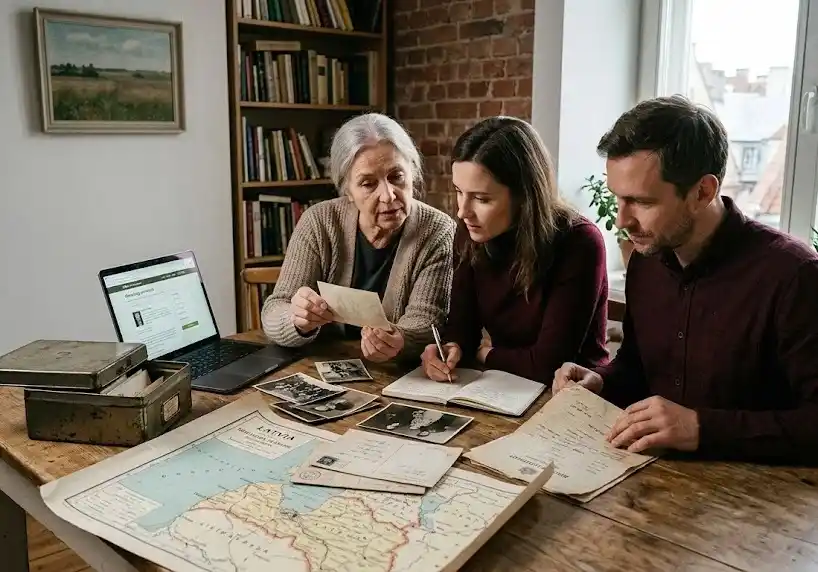




 English [EN]