
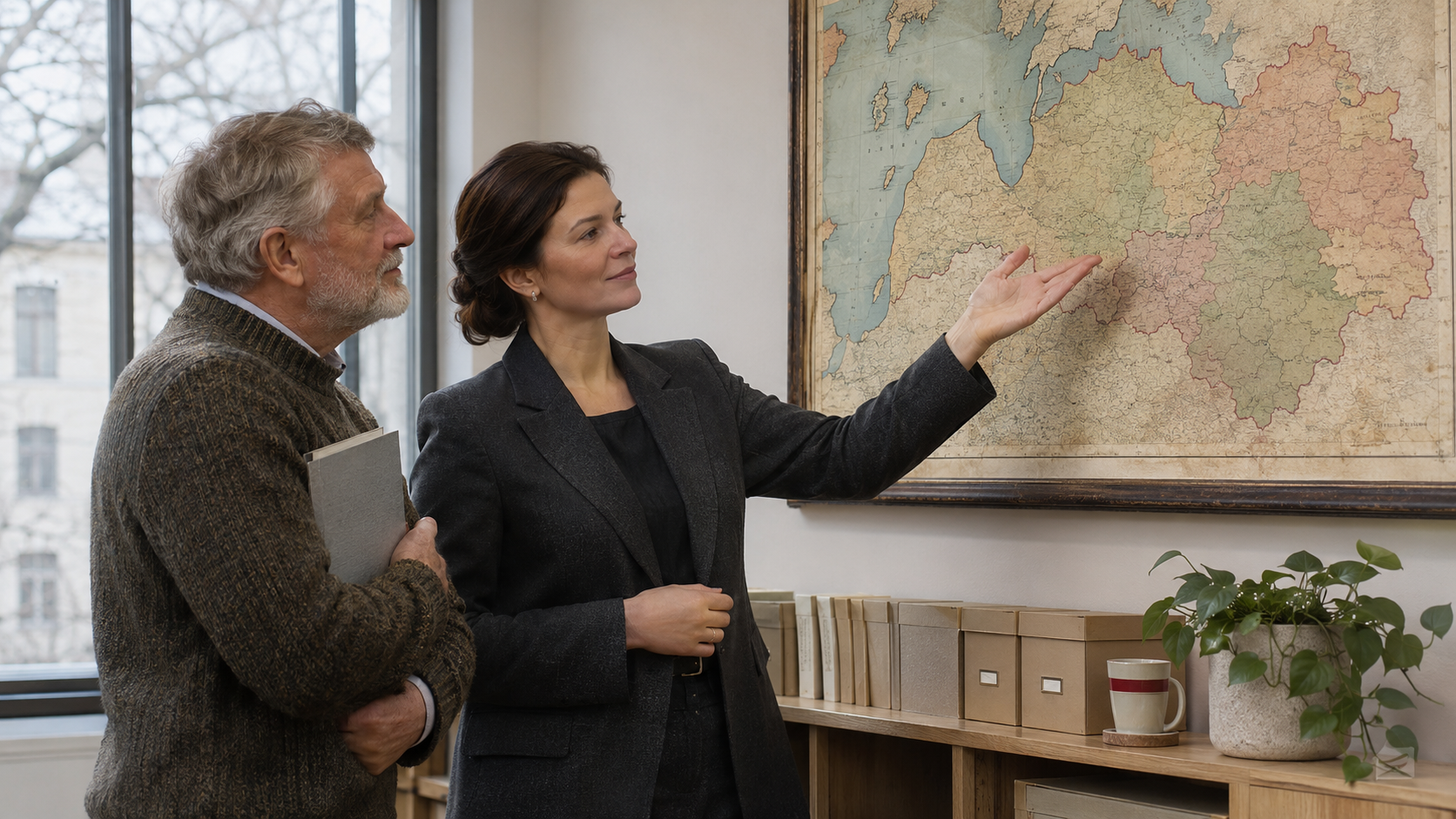
The Latvia 1935 census and the interwar house registers are two of the most useful sources for tracing a family that lived in independent Latvia between the world wars. The census recorded each person on an individual card. These cards often show birth details, nationality, citizenship and occupation. House registers tracked who lived at a specific address over time. Used together, they can place an ancestor at a known address in the years before 1940. That matters for genealogy and, in some cases, for documenting Latvian citizenship by descent.
This guide explains what these records are, where digitised images may be found, how to search them when no name index exists, and where their limits lie.
What Was the 1935 Latvian Census?
The 1935 census was the fourth population census of the Republic of Latvia. It followed the censuses of 1920, 1925 and 1930. The state statistical office published the results in Latvian and French, and those volumes are still used for demographic research.
For family historians, the published statistics matter less than the individual records gathered during the count. The original enumeration material is generally linked to the Latvian State Historical Archives (LVVA), part of the National Archives of Latvia. Because the census was taken only five years before the Soviet occupation of 1940, it is often the closest full snapshot of a household before the war broke up many families.
What Information Do 1935 Census Personal Cards Contain?
The 1935 census used personal cards, usually one per person, grouped by household and place of residence. The exact layout can vary, and handwriting quality differs from one enumerator to the next. Cards often record:
- full name, and sometimes a previous surname for married women
- sex, date of birth and place of birth
- relationship to the head of household and marital status
- nationality (ethnic origin), recorded separately from citizenship
- citizenship at the time of the census
- religion and native language
- literacy, education and occupation
- place of residence, often down to street and house number in towns
The citizenship field is the one that draws most interest from people looking at Latvian citizenship by descent documents. It shows what the person or enumerator stated in 1935. It is not a certificate of citizenship in itself.
Where to Find the Latvia 1935 Census Online (FamilySearch, LVVA)
Much of the search for Latvian ancestry records online starts with FamilySearch. It hosts a collection of digitised 1935 census images drawn from LVVA holdings. Access conditions can vary by collection. Some images may be viewable at home after signing in, while others may only be available at a FamilySearch center or affiliate library.
The National Archives of Latvia also provides access to digitised material through its own online systems, and some collections are available only on site or by request. Searchability is the main practical difference between sources. Some sets are partly indexed by name, while others can only be browsed by volume, meaning by location and year. Researchers should expect to do at least some page-by-page browsing for the 1935 census.
How to Search Unindexed 1935 Census Images Step by Step
When no name index covers your ancestor’s locality, a structured approach saves a lot of time. A typical workflow looks like this:
- Establish where the family lived in 1935: town, city district, or rural parish (pagasts). Family letters, emigration papers and later documents often give clues.
- Check the administrative name of that place in 1935, which may differ from today’s name or from the name used in US records.
- Find the image set for that locality and year in the digitised collection.
- Browse the first images of the volume. They often show how the cards are arranged, for example by street, village or farmstead.
- Narrow down to the street, house or farm, then read each card in the household.
- Write down the collection title, volume, image number and card details so the record can be found again or requested from the archive.
Patience matters here. Card order is not always strictly alphabetical or numerical, and a household can be split across consecutive images.
Latvian House Registers (Mājas Grāmatas): What They Show About a Household
House registers, known in Latvian as mājas grāmatas and often called house books, were kept for residential buildings. They recorded the people registered at that address. Entries typically show the resident’s name, birth date, nationality, identity document details, date of arrival and date of departure. Sometimes they also show the previous or next address.
For Latvian house registers genealogy, the main value is movement over time. A census card shows one moment in 1935. A house book can show when a family moved in, when a son left for military service, or when a relative arrived from the countryside. In many cases these registers fill gaps between the census years and help confirm that two records relate to the same person.
How to Locate Riga and Provincial House Registers by Address
House books are organised by building, so the address is usually the key to finding them. In Riga, this can be harder than expected. Many streets were renamed during the Soviet period and again after 1991, and some buildings were renumbered or demolished. Interwar city address books, old maps and addresses quoted in other family documents can help match a historical address to the right register.
Outside Riga, house registers may be arranged by town, parish or individual farmstead. Rural farms were often known by a farm name rather than a street address, so knowing that name can be decisive. Survival is uneven across the country. Some buildings have registers covering decades, while others have none for the interwar years.
Other Interwar Census Sources: 1920, 1925, 1930 and the 1941 Census
The 1920, 1925 and 1930 censuses can extend a family timeline backwards. How much individual-level material survives, and how much of it is digitised, varies by year and locality. Earlier census records can show a household before a marriage, a move to Riga or the death of a parent.
A count was also carried out in 1941, after Latvian independence had ended. Researchers sometimes use it to trace relatives who stayed in the country. Because it postdates 17 June 1940, it describes a different period and should be read in that context rather than as an interwar record.
1935 Census Cards of Latvian Jews at Yad Vashem
For Jewish families, the 1935 census is often one of the last full records of people who were later murdered in the Holocaust. Copies of 1935 census cards for Jewish residents of Latvia are held at Yad Vashem in Jerusalem, where they are used to document pre-war Jewish life and to identify victims.
These copies can help when the original volume is hard to search or when a researcher only knows a name and a town. Where a document is needed for an official purpose, the copy held in Latvia may still be the relevant one. Researchers should confirm which version an authority expects.
Name, Address and Nationality Problems in Interwar Records
Names are the most common obstacle when working out how to find Latvian ancestors. Latvian adds grammatical endings to names, and women’s surnames take a different form from men’s. The same person may also appear in German, Russian, Yiddish or Polish spellings in different records. US immigration and naturalisation papers often show yet another, anglicised form.
Nationality and citizenship were recorded as separate facts. A person listed as Russian, German, Jewish or Polish by nationality could be a Latvian citizen, and a person listed as Latvian by nationality could, in some cases, hold another citizenship. Some residents were recorded as foreign citizens or as having no citizenship. Careful researchers read each field on its own terms and do not infer citizenship from ethnicity.
Address inconsistencies are also common. A family may give a farm name on one record and a parish name on another, or a Riga street may appear under an older name.
Can 1935 Census Data Support Proof of Latvian Citizenship on June 17, 1940?
It can, in some situations. For applications under the route for Latvian exiles and their descendants, the Office of Citizenship and Migration Affairs (OCMA, or PMLP) lists three types of proof that the applicant or an ancestor was a Latvian citizen on 17 June 1940:
- civil registration documents, such as a birth or marriage certificate or extract, issued by the Civil Registry Department
- documents from the 1935 census, tax administration or military service matters, issued by the State Historical Archives
- a pre-war Latvian citizen’s passport
A few practical points follow from this. OCMA refers to documents issued by the archives. A screenshot or printout of an online image is therefore not the same as an archive-issued document. A card from 1935 also shows the situation at that time, and the authorities may look at the whole file to see whether the picture is consistent with 17 June 1940. The Embassy of Latvia in the US currently describes proof mainly in terms of the pre-war passport and civil documents. Because OCMA decides these cases, its list is the controlling reference, but applicants may want to confirm their documents with OCMA directly.
Proof of an ancestor’s citizenship is only one part of the Latvian citizenship by descent requirements. An application also depends on the family link to that ancestor, the circumstances and dates of leaving Latvia, any differences between records, and how the authorities assess the file. A 1935 census card can be a strong piece of evidence, but it does not guarantee a particular outcome.
Frequently Asked Questions
Is the Latvian 1935 census searchable by name?
Only partly. Some digitised 1935 census records have name indexes, often created by volunteers or genealogy projects, but many volumes can only be browsed by location and year. If your ancestor’s town or parish is not indexed, you will usually need to identify the 1935 locality first and then read the cards page by page. Knowing the street, village or farm name can shorten the search considerably.
Can I submit a FamilySearch image of a census card as proof of citizenship?
In most cases an online image works better as a research lead than as an official document. OCMA describes 1935 census documents issued by the State Historical Archives as acceptable proof for the exile route. Applicants typically use the online image to locate the exact record and then obtain an archive-issued document. Requirements can change, so checking the current position with OCMA before relying on any specific document is sensible.
What if my ancestor does not appear in the 1935 census?
A missing card does not necessarily mean the person was absent from Latvia. Cards can be misfiled, damaged, recorded under a different spelling, or listed at an address you have not yet checked. House registers, earlier censuses and other interwar records may help locate the person. For citizenship purposes, other categories of proof, such as civil registration documents or a pre-war passport, may be relevant depending on what survives.
Do house registers prove Latvian citizenship?
House registers are not among the three categories of proof that OCMA lists for the exile route. They can still be valuable supporting evidence. They can confirm an address, show who lived together, record identity document details, and help explain moves or name changes. In many cases they also help researchers find the census card or civil record that can then serve as proof.
My ancestor’s card lists a non-Latvian nationality. Does that rule out citizenship?
Not by itself. Interwar records listed nationality, meaning ethnic origin, separately from citizenship. Many Latvian citizens were recorded as Russian, German, Jewish, Polish or another nationality. The citizenship field, together with other documents, is what usually matters. How the authorities assess a particular case can depend on the whole set of records and the applicant’s individual circumstances.

 English [EN]
