
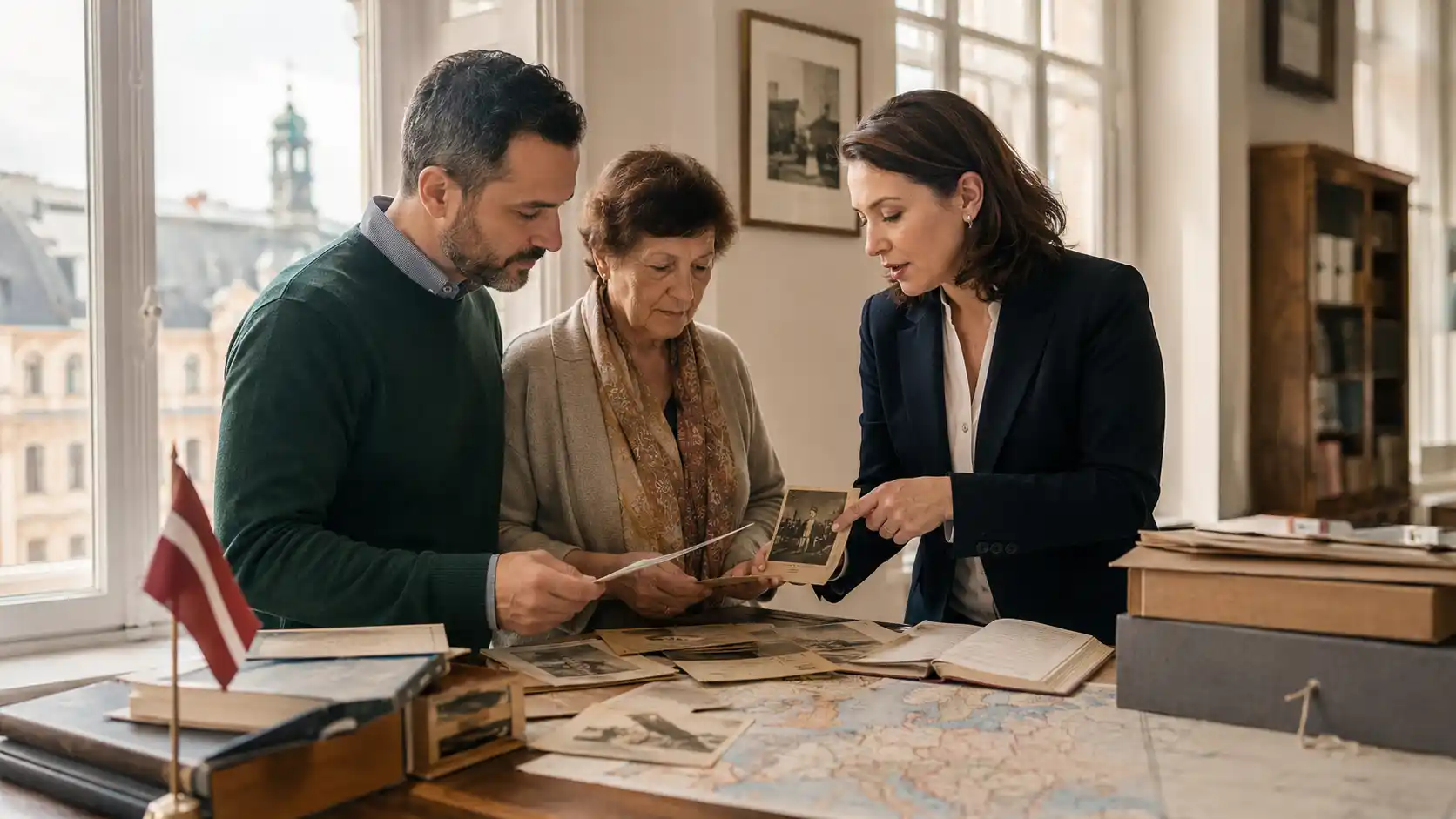
For many Brazilian families, a connection to Latvia began several generations ago, when a parent, grandparent, or great-grandparent left Europe and established a new life in Brazil. Over time, family names may have changed, documents may have been lost, and details about an ancestor’s legal status may have become unclear. Today, descendants who discover Latvian roots often ask whether that family history could provide a legal basis for citizenship. Latvian citizenship by descent for Brazilians may be possible in certain circumstances, but Latvian ancestry alone does not automatically establish a right to citizenship.
Eligibility depends on the specific history of the family and the legal status of the Latvian ancestor. Important factors can include whether the ancestor was legally recognised as a Latvian citizen, when they left Latvia, what happened to their citizenship after emigration, and whether the relationship between the ancestor and the Brazilian applicant can be demonstrated through official records. This is why two people with apparently similar Latvian family backgrounds may receive different legal assessments. Understanding the historical timeline and establishing a documented family connection are therefore essential first steps before preparing an application.
Can Brazilians Qualify for Latvian Citizenship by Descent?
The short answer to the question can Brazilians get Latvian citizenship by descent is that some may qualify, depending on the legal circumstances of their family. Latvian citizenship law provides routes through which descendants of certain Latvian citizens and Latvian exiles may be recognised or registered as citizens. However, the correct route cannot normally be determined simply by establishing that a relative was born or lived in Latvia. The ancestor’s citizenship status, the relevant historical period, and the applicant’s direct family connection must all be considered.
For Brazilian applicants, this distinction is particularly important because migration from Latvia to Brazil occurred during different historical periods. Some families left before the establishment of the Republic of Latvia, others emigrated during Latvia’s independence between the world wars, and others left because of occupation, war, deportation, or exile. These circumstances may have different consequences under Latvian citizenship legislation. As a result, assessing Latvian citizenship eligibility for Brazilians usually begins with reconstructing the ancestor’s history rather than immediately collecting documents for submission.
The legal concept of Latvian citizenship by descent should therefore be understood as more than proving ethnic or cultural ancestry. An applicant generally needs official evidence showing both the relevant citizenship basis and an uninterrupted documentary family line connecting the applicant to the qualifying ancestor. Brazilian birth and marriage certificates may establish later generations, while Latvian civil, population, passport, citizenship, or archival records may be necessary to establish the earlier part of the family history. Determining which documents matter depends on the legal route applicable to the individual case.
Which Latvian Ancestors May Create a Citizenship Claim?
A Latvian ancestor may be found relatively close to the applicant — for example, a parent — or several generations back. For this reason, Latvian citizenship for Brazilian descendants should not be assessed solely according to how many generations separate the applicant from Latvia. A grandparent or, in some circumstances, a great-grandparent may also be relevant. What matters is whether the ancestor falls within an applicable category under Latvian citizenship law and whether the applicant can prove the family relationship through reliable documentary evidence.
Latvian Parent
Having a Latvian parent can provide a strong starting point, but the parent’s actual legal status must still be established. A birth certificate showing that a parent was born in Latvia does not necessarily prove that the parent was a Latvian citizen. Place of birth, ethnicity, residence, and citizenship are separate legal concepts. The relevant records therefore need to establish whether the parent held Latvian citizenship and whether that status can create a citizenship right for the applicant under the rules applicable to the family’s circumstances.
For a Brazilian whose parent was recognised as a Latvian citizen, the documentary chain may be relatively short. Nevertheless, authorities may still require civil-status records confirming the relationship between parent and child, together with supporting citizenship documentation. Changes in names, marriages, naturalisation in Brazil, or inconsistencies between Latvian and Brazilian documents can also require additional evidence. The objective is not simply to show that the family has Latvian roots, but to establish a legally documented connection between the applicant and a person whose citizenship status can support the claim.
Latvian Grandparent
A Latvian grandparent is another common starting point for Brazilian families investigating their ancestry. Latvian citizenship through grandparents Brazil cases require careful attention to both the grandparent’s legal history and the documents connecting each generation. This usually means establishing the relevant status of the grandparent and then demonstrating the family line from grandparent to parent and from parent to applicant. Missing or inconsistent records at either stage can affect how straightforward the assessment will be.
The fact that an applicant’s parent never obtained Latvian citizenship does not, by itself, establish whether the applicant can or cannot qualify. The appropriate analysis depends on the citizenship route involved and the historical circumstances of the Latvian ancestor. For that reason, families should avoid assuming that citizenship must always have been formally obtained by every generation before the next descendant can be considered. Instead, the complete family history and documentary chain should be reviewed together under the applicable Latvian rules.
Latvian Great-Grandparent
A great-grandparent may also be relevant when assessing Latvian citizenship for Brazilian descendants, particularly in families whose connection to Latvia dates back several generations. However, having a Latvian-born great-grandparent does not automatically create a citizenship right. The first question is whether that person held the legal status required under the applicable provisions of Latvian citizenship law. The second is whether the applicant can establish a complete documentary chain connecting the great-grandparent to the grandparent, the parent, and finally the applicant.
This can make great-grandparent cases more document-intensive than claims involving a parent or grandparent. Brazilian civil records may need to be matched with older Latvian documents, while marriages, surname changes, translations, or differences in spelling can create additional issues that must be resolved. In some families, records held at home provide useful clues but are not sufficient on their own to establish citizenship status. A historical passport, birth record, residence document, or other family document may help identify the ancestor, but official records may still be necessary before the legal basis of the claim can be determined.
For this reason, Latvian citizenship Brazilian descendants cases involving a great-grandparent should usually begin with research rather than assumptions about eligibility. The number of generations is only one element of the assessment. The ancestor’s legal status, the historical period in which they lived in or left Latvia, and the continuity of the documented family line can be equally important. Once these elements have been established, it becomes easier to determine whether the family history corresponds to a recognised citizenship route and what additional evidence may be required.
When Did Your Latvian Ancestor Leave for Brazil?
The date and circumstances of emigration can play an important role in determining the correct legal pathway. Latvia’s twentieth-century history included independence, occupation, war, exile, and major population movements, meaning that apparently similar stories of migration to Brazil may have very different legal implications. A family whose ancestor left Latvia during the interwar period may need to be assessed differently from a family whose ancestor fled during or after the Second World War. This historical context is one reason why Latvian citizenship by descent Brazil cases cannot be evaluated simply by confirming that an ancestor once lived in Latvia.
One particularly important historical reference point is the June 17, 1940 citizenship cutoff. When reviewing a potential claim, it may be necessary to determine whether the ancestor was a Latvian citizen on the relevant historical date and what happened to the family during the occupation period. The departure date can provide important context, but it should not be considered in isolation. Citizenship status, the reason for departure, the destination, and subsequent events may all need to be reconstructed from available records.
Earlier emigration requires particularly careful analysis. If an ancestor left Latvia before 1940, this fact alone does not provide a complete answer about the descendant’s current eligibility. It becomes necessary to establish when the departure occurred, whether the ancestor had acquired Latvian citizenship, and whether later events affected that status. For Brazilian families whose relatives arrived in South America many decades ago, passenger lists, immigration files, naturalisation records, passports, and Latvian archival material may help reconstruct this timeline.
The reason for leaving can also be relevant. Some Latvian families migrated voluntarily in search of economic opportunities, while others were displaced by war, occupation, persecution, or exile. Latvian law contains specific provisions relating to certain Latvian exiles and their descendants, so the historical circumstances should be documented as accurately as possible. Family stories are often valuable starting points, but an application ultimately needs to be supported by records capable of demonstrating the facts relevant to the particular legal route.
Was Your Ancestor Actually a Latvian Citizen?
One of the most important distinctions in any citizenship-by-descent assessment is the difference between Latvian ancestry and Latvian citizenship. An ancestor may have been born in territory that is now Latvia, spoken Latvian, identified as Latvian, or lived there for many years without those facts alone establishing the citizenship status required for a descendant’s application. Therefore, Latvian citizenship eligibility for Brazilians often depends on finding evidence that clarifies the ancestor’s legal status during the relevant historical period.
Useful evidence may exist in Latvian population registers, citizenship files, passport records, civil registers, archival collections, or other official sources. When a Brazilian family does not possess sufficient documentation, it may be necessary to request Latvian archive records. Archival research can sometimes establish details that have disappeared from family memory, including an ancestor’s residence, date and place of birth, citizenship documentation, or other information needed to distinguish between ancestry and legally relevant citizenship status.
This verification should generally take place before assuming that a family qualifies. A document showing a Latvian place of birth can be valuable evidence of identity and origin, but it does not necessarily answer the citizenship question. Conversely, the absence of an old Latvian passport in the family’s possession does not necessarily mean that citizenship cannot be demonstrated. The purpose of the research is to build a reliable historical record from official sources and then assess that evidence under the appropriate provisions of Latvian citizenship law.
Common Eligibility Scenarios for Brazilian Families
Brazilian families with Latvian ancestry often share similar migration histories, but small differences in those histories can lead to different legal assessments. One applicant may descend from a Latvian citizen who emigrated before the Second World War, while another may have an ancestor who left because of occupation, war, or exile. In other cases, the Latvian connection may extend through several generations and the family may have only limited information about when the ancestor left Europe or what citizenship they held at the time. These distinctions are important when considering Latvian citizenship by descent for Brazilians, because eligibility is determined by the relevant legal circumstances rather than ancestry alone.
A common scenario involves a parent or grandparent whose Latvian citizenship can be established through official records. Another may involve a more distant ancestor whose status first needs to be reconstructed through archival research. Some Brazilian descendants also discover that their ancestor became a Brazilian citizen after arriving in the country, raising additional questions about whether and when Latvian citizenship may have been affected. For this reason, Latvian citizenship for Brazilians should be assessed by looking at the entire historical sequence: the ancestor’s status in Latvia, departure and migration, later citizenship events, and the documentary family line connecting that person to the applicant.
The same principle applies when several relatives from one Brazilian family are considering citizenship. The existence of a common Latvian ancestor can provide the same historical starting point, but each applicant still needs to establish their own connection to that ancestor. Differences in parentage, civil records, names, dates, or documentation can affect what evidence is required. A previous successful application by another family member may therefore be useful background, but it should not automatically be treated as proof that every relative will qualify under exactly the same circumstances.
What Brazilian Records Can Help Establish the Family Line?
Once a potentially relevant Latvian ancestor has been identified, the next task is usually to document the connection between that person and the applicant. Brazilian civil records can play a central role in this process. Birth certificates can establish parent-child relationships, marriage certificates can explain surname changes, and death records may provide additional identifying information about earlier generations. Immigration and naturalisation files can also help reconstruct when the Latvian ancestor arrived in Brazil and what happened after settlement. Together with Latvian evidence, these records can create the documentary chain required to assess Latvian citizenship for Brazilian descendants.
Applicants should think of the process as connecting generations rather than finding one document that proves the entire case. If the relevant ancestor is a great-grandparent, for example, records may be required to connect the great-grandparent to the grandparent, the grandparent to the parent, and the parent to the applicant. Understanding how to prove Latvian descent can therefore help families identify gaps before an application is prepared. Historical immigration documents, passenger records, old passports, and family papers can provide useful supporting information, but official civil and archival records are generally particularly important for establishing identities and relationships.
Brazilian documents intended for use in a Latvian citizenship procedure may also need to satisfy formal requirements before they can be accepted. Depending on the document and procedure, this can involve obtaining the appropriate version of a civil record and dealing with authentication and translation. Applicants should therefore check the applicable apostille and translation requirements before preparing the final submission. Completing these formalities too early, before determining which records are actually necessary, can create unnecessary work and expense.
The objective is to create a consistent evidentiary chain linking the Brazilian applicant to the relevant Latvian ancestor. If one generation is missing from that chain, additional research may be necessary. This is especially common in older cases where records were created in different jurisdictions, family members used different versions of their names, or documents were lost over time. Identifying these issues during the initial assessment makes it easier to determine whether they can be resolved through Brazilian civil registries, Latvian archives, or other official sources.
What If Names or Dates Differ Between Latvian and Brazilian Records?
Differences between Latvian and Brazilian records are not unusual in families whose ancestors emigrated many decades ago. A Latvian first name may have been adapted to Portuguese, a surname may have acquired a different spelling, or clerks may have recorded names phonetically when Brazilian documents were created. Dates and places of birth can also vary between records because of transcription errors, calendar differences, incomplete information, or mistakes made during immigration and civil registration. Such discrepancies do not necessarily prevent a Latvian citizenship by descent Brazil case from proceeding, but they should not simply be ignored.
The important question is whether the available evidence can demonstrate that differently recorded names or details refer to the same person. This may require comparing dates, parents’ names, spouses, places of origin, immigration information, and other identifying details across several documents. In some situations, additional civil records or archival evidence may explain the discrepancy. In others, a Brazilian record may need to be corrected or supplemented before it can form part of a clear documentary chain. The appropriate solution depends on the nature and significance of the inconsistency.
Applicants should therefore avoid changing documents or beginning formal correction procedures without first understanding whether a discrepancy is legally material. A minor spelling variation may require a different response from a conflicting birth date or a substantial change in surname. The purpose of reviewing the records together is to determine whether the family line remains identifiable and whether additional evidence is needed. For Latvian citizenship Brazilian descendants, a consistent documentary narrative is often more important than expecting every historical record created in two different countries and languages to contain perfectly identical information.
What If Your Ancestor Became a Brazilian Citizen?
The acquisition of Brazilian citizenship can be an important part of the historical assessment. If a Latvian ancestor naturalised after arriving in Brazil, applicants should establish when this occurred and what citizenship status the ancestor held beforehand. Naturalisation should not automatically be treated as proof that a descendant qualifies or does not qualify. Instead, its significance depends on the applicable legal route, the historical period, and the circumstances in which the ancestor’s Latvian citizenship may have been retained or lost. Understanding the possible loss of Latvian citizenship and its impact on descendants can therefore be an important part of reconstructing the family’s legal history.
For Latvian citizenship Brazilian descendants, Brazilian naturalisation records can provide valuable evidence because they may show the date of naturalisation, previous nationality, birthplace, residence, or other identifying information. These details can then be compared with Latvian archival and citizenship records. The objective is to establish a chronological history rather than draw conclusions from the fact of Brazilian naturalisation alone. Where the ancestor’s status changed at some point after emigration, the timing of that change may become particularly relevant to the legal assessment.
Can You Apply While Living in Brazil?
Living in Brazil does not prevent a person from beginning an assessment of a potential citizenship-by-descent case. Applicants can start by identifying the relevant Latvian ancestor, gathering available family records, and determining which evidence may need to be obtained from Latvia. For people researching Latvian citizenship for Brazilians, much of the initial work involves reconstructing the family history and establishing the legal basis of the claim before the formal application stage.
This is particularly useful because records may be located in both countries. Brazilian documents can establish the family line after migration, while Latvian records may be necessary to confirm the ancestor’s identity and citizenship status. The procedural route and document requirements will depend on the individual circumstances, so applicants should determine their potential eligibility before spending significant time obtaining, translating, authenticating, or correcting documents. A well-organised preliminary review can identify missing evidence and make the later application process more efficient.
How to Check Whether Your Family May Qualify
A useful starting point is to identify the closest relevant Latvian ancestor and reconstruct that person’s history as accurately as possible. Applicants should determine where and when the ancestor was born, whether Latvian citizenship can be established, when and why the person left Latvia, and whether Brazilian naturalisation occurred later. The next step is to establish the family relationship from that ancestor through each generation to the applicant. This approach provides a more reliable basis for evaluating Latvian citizenship eligibility for Brazilians than relying only on surnames, family stories, or another relative’s citizenship outcome.
Once the historical timeline and family chain have been assembled, the evidence can be compared with the applicable Latvian citizenship route. Missing Latvian records may require archival research, while inconsistencies in Brazilian documents may need further supporting evidence. A professional assessment before filing can help identify these issues, determine which records are actually relevant, and clarify whether the documented family history may provide a legal basis for citizenship.
Conclusion
For Brazilian families with Latvian roots, citizenship by descent may provide a legal pathway to reconnect with Latvia, but ancestry is only the beginning of the assessment. Latvian citizenship by descent for Brazilians depends on the relevant ancestor’s citizenship status, migration history, historical circumstances, and the applicant’s ability to establish a documented family relationship. Whether the Latvian connection comes through a parent, grandparent, or great-grandparent, the complete family history should be considered rather than focusing on a single surname, birthplace, or document.
Applicants considering Latvian citizenship for Brazilian descendants should therefore begin by reconstructing the ancestor’s history and reviewing Latvian and Brazilian evidence together. Establishing when the ancestor left Latvia, whether citizenship can be documented, what happened after migration, and how each generation is connected can provide a clearer understanding of the potential legal pathway. Where the family history is complex or records are missing, archival research and a professional legal assessment can help determine what additional evidence may be required before an application is prepared.
Frequently Asked Questions
Can Brazilians get Latvian citizenship by descent?
Potentially. Whether a Brazilian applicant qualifies depends on the relevant Latvian ancestor, that person’s citizenship status and historical circumstances, and the applicant’s documented family relationship. Can Brazilians get Latvian citizenship by descent therefore cannot be answered from ancestry alone.
Can I qualify for Latvian citizenship if my grandfather or grandmother was Latvian?
Potentially. A Latvian grandparent may provide a relevant basis for assessment, but the grandparent’s citizenship status and the family chain connecting that person to the applicant must still be established.
Can a Brazilian qualify through a Latvian great-grandparent?
A great-grandparent may be relevant in some family histories, but the relationship alone does not establish eligibility. The ancestor’s legal status and the documentary chain through each subsequent generation must be reviewed.
Does my parent need to obtain Latvian citizenship before I apply?
Not necessarily. Whether a parent must first obtain Latvian citizenship depends on the legal pathway applicable to the family. In some cases, descendants may be able to establish their own eligibility through the qualifying Latvian ancestor, provided that the required family connection and citizenship history can be documented.
Is Latvian ancestry alone enough to qualify for citizenship?
No. Latvian ancestry may provide the starting point for research, but citizenship eligibility requires an assessment of the relevant ancestor’s legal status and supporting documentary evidence.
What if my Latvian ancestor emigrated to Brazil before 1940?
Early emigration can be relevant, particularly when determining the ancestor’s citizenship history around important historical dates. The departure date should be considered together with citizenship status and subsequent events rather than treated as an automatic eligibility test.
What if my Latvian ancestor became a Brazilian citizen?
Brazilian naturalisation may be relevant to the assessment. Its significance depends on when it occurred, the ancestor’s previous citizenship status, and the legal route being considered.
What Brazilian documents can help prove my family connection to a Latvian ancestor?
Birth and marriage certificates, death records, immigration documents, naturalisation files, and records relating to name changes may help establish the family chain. The documents required will depend on the individual case.
What if names or birth dates differ between Brazilian and Latvian records?
Differences do not necessarily prevent a case from proceeding. The records should be compared to determine whether other identifying information can establish that they relate to the same person and whether additional evidence or corrections are necessary.
Can I apply for Latvian citizenship while living in Brazil?
Yes, the process can generally be initiated while living in Brazil. Applicants can collect Brazilian civil records, obtain relevant Latvian archival documents, and prepare the required documentation without relocating to Latvia. The exact submission procedure will depend on the citizenship route and the applicant’s circumstances.
Do I need to speak Latvian to qualify for citizenship by descent?
Language requirements depend on the legal basis under which citizenship is claimed. Applicants should determine which citizenship route applies to their family before assuming that a Latvian-language requirement will or will not apply.
Do I need to live in Latvia to apply for citizenship by descent?
Living in Latvia is not necessarily required to begin a citizenship-by-descent case. Brazilian applicants can research their ancestry and prepare documentation while residing in Brazil. The exact procedural requirements depend on the legal basis of the application.
Can Brazilians keep Brazilian citizenship after obtaining Latvian citizenship?
The possibility of retaining Brazilian citizenship depends on the legal basis for acquiring or registering Latvian citizenship and the applicable rules on multiple nationality. Applicants should review the relevant Latvia dual citizenship rules before assuming that both citizenships can be retained in every case.


 English [EN]