
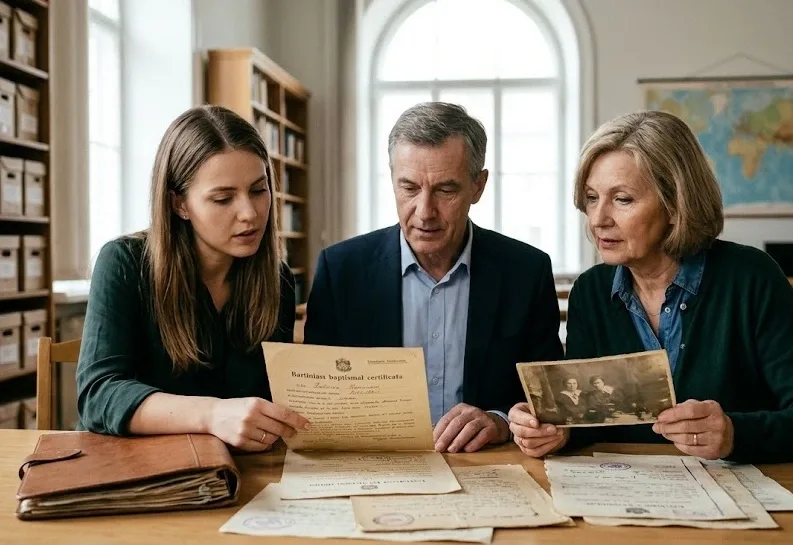
For many U.S.-based applicants, Latvian citizenship by descent is not only a question of family history. It is also a document-based legal process. Even when a person has a Latvian parent, grandparent, or great-grandparent, the application usually depends on whether the family line can be proven with acceptable records.
This guide explains what documents are needed for Latvian citizenship by descent when the applicant’s family records are mainly in the United States. It focuses on U.S. civil records, including birth certificates, marriage certificates, naturalization records, and name change documents. These records may be necessary to connect the applicant to a Latvian ancestor and to explain changes in surnames, citizenship status, or personal identity across generations.
The exact document set can vary depending on the application category, the ancestor’s history, and the position of the Latvian authorities reviewing the file. However, most U.S. cases follow the same basic logic: the applicant must prove identity, prove each generation in the family chain, and support the ancestor’s legal connection to Latvia.
Why U.S. Civil Records Matter in Latvian Citizenship by Descent Cases
U.S. civil records for Latvian citizenship by descent are important because they often create the documentary bridge between the modern applicant and the Latvian ancestor. Latvian archive records may show that the ancestor was born in Latvia, lived there, or held Latvian citizenship before the relevant historical period. U.S. records usually show how that ancestor connects to the applicant.
In many cases, the Latvian side of the file and the U.S. side of the file serve different purposes. Latvian records may help prove the ancestor’s Latvian status, while U.S. birth, marriage, and naturalization documents help prove descent, identity, and continuity of names.
This is especially important for families that emigrated to the United States during or after major historical disruptions. Names may have been transliterated, shortened, Americanized, misspelled, or changed through marriage. A Latvian surname in one document may appear in a different form in a U.S. birth certificate, census record, passenger record, marriage certificate, or naturalization file. A strong application usually explains these differences through official records rather than leaving them unresolved.
The Core Document Logic: Identity, Lineage, and Latvian Connection
A Latvian citizenship by descent document checklist usually has three main layers. The first layer proves the applicant’s current identity. The second layer proves the family relationship from the applicant back to the Latvian ancestor. The third layer supports the ancestor’s connection to Latvia and, where relevant, to Latvian citizenship or exile status.
U.S. civil records mostly belong to the first and second layers. They show who the applicant is, who their parents are, who their grandparents were, and how surnames changed over time. Without these records, even strong Latvian archive evidence may not be enough, because the authorities still need to see that the applicant is legally connected to the qualifying ancestor.
This is why the question is not simply whether the family has Latvian roots. The more practical question is how to prove Latvian descent with U.S. records in a way that is clear, consistent, and legally usable.
Birth Certificate for Latvian Citizenship by Descent
A birth certificate for Latvian citizenship by descent is usually one of the most important records in the file. The applicant’s own birth certificate helps establish identity and parentage. If the application is based on a parent, grandparent, or great-grandparent, birth certificates from each generation may be needed to prove the uninterrupted family line.
For U.S. applicants, long-form birth certificates are generally more useful than short-form certificates. A long-form record usually includes the names of the parents and may include their places of birth, ages, or other identifying information. This can be important when the certificate is being used to prove the link between generations.
For example, if the applicant is claiming descent through a Latvian-born grandparent, the applicant’s birth certificate may identify the applicant’s parent, and the parent’s birth certificate may identify the Latvian grandparent. Together, these records create the chain of descent. If one certificate lacks parental information, the chain may become weaker and may require additional supporting records.
Birth records should be reviewed carefully for spelling differences. A parent’s name may appear with an Americanized surname, initials, a middle name, or a simplified version of a Latvian name. These differences do not always create a problem, but they should usually be explained through the document set.
Marriage Certificate for Latvian Citizenship by Descent
A marriage certificate for Latvian citizenship by descent often becomes important when surnames changed between generations. In U.S. families, this commonly affects women whose surnames changed after marriage, but marriage records may also clarify broader identity questions in the family line.
Marriage certificates can help explain why a person appears under one surname on a birth certificate and another surname on a later document. For example, a grandmother may be listed under her birth surname in a Latvian record, under her married surname in a U.S. census record, and under a slightly different spelling in a child’s birth certificate. A marriage certificate can help connect those identities.
In some cases, more than one marriage record may be needed. If the relevant person remarried, divorced, or used different surnames at different times, the document file may need to show the full sequence. Divorce decrees may also be relevant if they explain a later surname, custody issue, or family relationship.
U.S. marriage records vary by state and county. Some certificates provide detailed information, while others are brief. When possible, applicants should obtain certified copies that include the full available information rather than decorative or abbreviated versions.
Naturalization Records for Latvian Citizenship by Descent
Naturalization records for Latvian citizenship by descent can play several roles. They may help identify the ancestor, explain a name change, confirm immigration history, or show how the person described their former nationality. However, the legal importance of naturalization records depends on the specific facts of the case.
A US naturalization certificate for Latvian citizenship purposes may be useful if it confirms that the ancestor naturalized in the United States under a particular name. It can also help connect an earlier Latvian or immigrant identity to a later American identity. In some cases, naturalization petitions, declarations of intention, certificates of arrival, or court records may contain more detail than the final certificate alone.
Naturalization records may also show a birthplace, former nationality, date of birth, date of arrival, spouse, children, or prior name. These details can help resolve inconsistencies in other records. For example, if a Latvian ancestor used one surname on a passenger list and a modified surname after becoming a U.S. citizen, the naturalization file may help explain the transition.
At the same time, naturalization records should not be treated as a substitute for every other document. A U.S. naturalization document may support the case, but the applicant may still need birth certificates, marriage certificates, Latvian archive records, and documents proving the relationship between generations.
Name Change Documents for Latvian Citizenship by Descent
Name change documents for Latvian citizenship by descent are important when a person’s name changed for reasons other than a simple marriage surname change. These records can include court orders, naturalization documents, amended birth certificates, adoption records, or other official documents showing a legal change of first name, middle name, or surname.
Name discrepancies are common in Latvian ancestry cases. Latvian, German, Russian, Yiddish, Polish, and English forms of a name may appear across historical records. A surname may lose diacritics, gain an English ending, or be spelled phonetically by U.S. officials. The question is whether the file still makes it clear that the records refer to the same person.
Minor spelling variations may often be explainable within the broader document set. Larger differences usually require stronger evidence. If the ancestor was Jānis Bērziņš in a Latvian record, John Berzins in a U.S. record, and John Burns in a later naturalization file, the application may need a careful paper trail showing that these are not three different people.
A good name-change file does not simply list different names. It explains the sequence. It shows when the name changed, why it changed, and how each version belongs to the same individual in the same family line.
Documents to Prove Latvian Ancestry
Documents to prove Latvian ancestry usually include records from Latvia or historical sources connected to Latvia. U.S. civil records may prove the family chain, but the applicant may also need evidence that the ancestor had the necessary Latvian connection.
Depending on the case, relevant Latvian-side documents may include a pre-war Latvian passport, a Latvian birth certificate, a marriage record, a civil registry extract, archive records, census-related records, military records, tax records, or other documents showing the ancestor’s status in Latvia. In some cases, records from refugee, immigration, or displacement contexts may also help explain the ancestor’s route out of Latvia.
For U.S. applicants, this means the document strategy should not stop at American records. U.S. records can prove descent from a person, but the file must also address why that person qualifies as the relevant Latvian ancestor. The stronger the Latvian-side evidence, the easier it usually is to connect the U.S. family records to the legal basis for the application.
How U.S. Records Prove the Family Chain
The family chain should usually be clear from one generation to the next. The applicant’s birth certificate identifies the parents. The parent’s birth certificate identifies the grandparents. If needed, the grandparent’s birth certificate or marriage certificate identifies the great-grandparents. Marriage records then explain surname changes between those documents.
This chain should be reviewed as a single evidentiary sequence. A document may be valid by itself but weak in context if it does not clearly connect to the next generation. For example, a birth certificate that names only one parent may create a gap if the claim depends on the other parent’s line. A marriage certificate that lacks birth names may be less helpful if the main issue is a surname discrepancy.
Applicants should also check whether dates and places are consistent. A one-year difference in age may be understandable in historical records, but a major difference in date of birth, birthplace, or parent names may require additional evidence. The goal is to avoid leaving unresolved contradictions in the file.
Certified Copies, Apostilles, and Latvian Translation
U.S. civil records used for Latvian citizenship by descent usually need to be issued in a form that can be accepted by Latvian authorities. In many cases, this means certified copies from the relevant state, county, court, or federal authority, not informal photocopies or family scans.
Because U.S. documents are foreign public documents for use in Latvia, they may need apostille authentication from the competent authority in the state or jurisdiction where the document was issued. For many U.S. vital records, this is handled through the Secretary of State of the issuing state. Federal records may follow a different authentication route.
Translation is also a key part of the process. Documents issued in English may need to be translated into Latvian. The translation should usually preserve names, dates, seals, apostille text, and official details accurately. Poor translation can create avoidable problems, especially in cases involving name variants, old place names, or handwritten records.
The apostille and translation sequence should be handled carefully. Requirements can depend on the document type, issuing authority, and submission method. Applicants should avoid assuming that a notarized photocopy is equivalent to a certified original or that a translation alone makes a document legally usable.
Common Problems in U.S. Civil Records
One common problem is the use of short-form birth certificates that do not show parents’ full names. These certificates may be insufficient to prove the family link, even if they are official. A long-form version may be needed to show the necessary parent-child relationship.
Another frequent issue is inconsistent surname spelling. Latvian names were often adapted in the United States, especially when families wanted simpler English spellings. Sometimes the same person appears under several versions of a surname across birth, marriage, death, immigration, and naturalization records.
A third issue is missing marriage records. If a surname changes between generations and there is no marriage certificate or name change document, the file may not clearly explain the identity transition. This can be especially important when the Latvian line passes through a female ancestor.
Naturalization records can also create complications. They may contain useful information, but they may also introduce spelling variants, approximate dates, or simplified nationality descriptions. These records should be checked against Latvian archive evidence rather than treated as automatically decisive.
How to Build a Practical U.S. Document Checklist
A practical U.S. checklist should begin with the applicant’s own certified long-form birth certificate and current identity document. If the applicant is married and the surname has changed, the marriage certificate should be included. If the applicant has had a legal name change, the official name change document should be added.
The next step is to collect the birth certificates for each generation between the applicant and the Latvian ancestor. If surnames changed, marriage certificates and divorce records may be needed to explain those changes. If the ancestor naturalized in the United States, the naturalization certificate or related court file may help connect the Latvian identity to the American identity.
The final step is to compare the U.S. records with the Latvian-side evidence. Names, dates, places, and family relationships should be reviewed together. The file should make the lineage understandable to a reviewer who does not know the family story and is relying only on the documents.
When Additional Records May Be Needed
Additional records may be needed when the main civil documents do not fully prove the family connection. These may include death certificates, adoption records, court orders, probate records, census records, immigration files, passenger records, military records, or Social Security records. These documents are usually supporting evidence rather than the core file, but they can be useful when the primary records are incomplete.
For example, a death certificate may confirm a parent’s names or birthplace. A census record may show a family living together under a particular surname. A passenger record may connect an immigrant ancestor to a specific place of origin. A naturalization petition may list a spouse and children, helping connect the ancestor to later U.S. generations.
The need for supporting records depends on the strength of the main documents. A clean chain of long-form birth and marriage certificates may require fewer extras. A file with missing records, conflicting names, or unclear parentage may require a more detailed evidentiary strategy.
FAQ
What documents are needed for Latvian citizenship by descent?
The documents usually include the applicant’s identity document, birth certificate, records proving each generation in the family line, marriage or divorce records where relevant, name change documents if names changed, and evidence of the Latvian ancestor’s connection to Latvia. U.S. applicants may also need apostilles and Latvian translations for U.S.-issued civil records.
Do I need a birth certificate for Latvian citizenship by descent?
In many cases, yes. A birth certificate is usually needed to prove identity and parentage. If the application is based on a parent, grandparent, or great-grandparent, birth certificates for the relevant generations may be needed to show the family chain.
Are U.S. marriage certificates required for Latvian citizenship by descent?
U.S. marriage certificates may be required when they explain a surname change or help connect one generation to another. They are especially important when the Latvian line passes through a person whose surname changed after marriage.
Can U.S. naturalization records help prove Latvian descent?
U.S. naturalization records can help, especially when they show an ancestor’s former name, birthplace, prior nationality, immigration history, or later American identity. However, they usually support the file rather than replace birth, marriage, and Latvian archive records.
What if my ancestor’s name is spelled differently in U.S. and Latvian records?
Different spellings are common in Latvian descent cases. Minor variations may be explainable, but larger differences may require name change documents, marriage records, naturalization records, or other evidence showing that the records refer to the same person.
Do U.S. documents need apostille authentication for Latvia?
In many cases, U.S.-issued civil records intended for use in Latvia need apostille authentication from the proper authority. The exact process depends on the issuing state or authority and the type of document.
Do U.S. records need to be translated into Latvian?
U.S. documents may need Latvian translation before they are submitted. The translation should accurately reflect the full document, including names, dates, official seals, and apostille text where applicable.



 English [EN]