
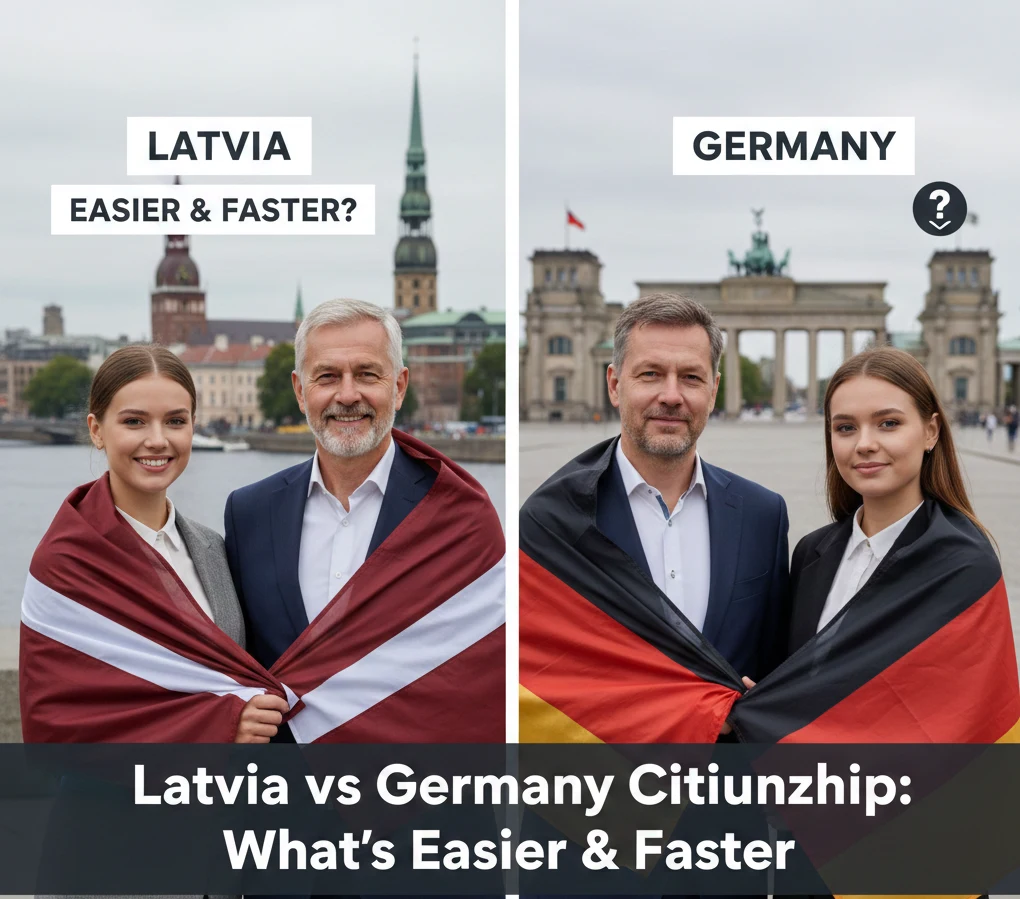
Navigating European migration landscapes makes acquiring secondary travel credentials strategic moves ensuring global mobility. Distinct pathways attract international applicants: heritage-based routes offered by Northern regions versus economic powerhouse tracks from Central Europe. Contrasting Latvia vs Germany unveils fundamentally divergent legal philosophies. Former systems prioritize historical continuity; latter frameworks focus on modern economic integration.
Digital nomads, investors, plus European emigrant descendants find selecting correct jurisdictions critical. Our guide dissects legal frameworks, processing timelines, plus eligibility hurdles helping applicants determine which EU member state offers viable paths toward burgundy booklets.
Overview of Latvian and German Citizenship
Comprehending foundational logic behind jurisdictions clarifies existing requirements.
Latvian Citizenship Explained
Riga views national standing as continuing interwar statehood (1918-1940). Laws skew heavily toward restoration. Systems aim at reintegrating diasporas—ancestors fleeing Soviet occupation. Though naturalization remains possible, legal architectures primarily favor direct bloodline connections dating pre-1940.
German Citizenship Explained
Central Europe recently underwent massive paradigm shifts. Historically restrictive, German citizenship statutes modernized during 2024 attracting skilled labor. Focus moved from strict “blood rights” (jus sanguinis) toward open “residency rights” (jus soli elements), creating accessible naturalization destinations among G7 nations for workers willing to master local tongues.
Key Differences in Citizenship Systems
Differences lie within goals. Riga aims at preserving specific cultural identities, making linguistic exams notoriously strict regarding non-descendants. Conversely, Federal powers aim at bolstering workforces, reducing settlement requirements encouraging integration. One protects history; another builds economic futures.
How to Get Latvian Citizenship
Accessing rights within this nation generally follows two tracks: long-term settlement versus ancestral reclamation.
Main Ways to Obtain Latvian Citizenship
Paths offering least resistance usually involve ancestry. Where doors remain closed, alternatives involve decade-long commitments living within borders. Authorities offer no “Golden Passport” (pure investment schemes); applicants need genuine links.
Citizenship by Naturalization
Without family ties, roads remain long. Applicants must legally inhabit territories five-fold with permanent permits (taking another five annual cycles acquiring temporary ones). Effectively creates decade-long timelines. During such periods, candidates must integrate, pay taxes, plus master local dialects.
Citizenship by Descent
Consider this the “fast track”. Possessing ancestors holding national standing prior to June 1940 who left due to occupation (up to 1990) allows bypassing settlement plus linguistic requirements entirely. “Exile Categories” represent gold standards regarding applicants hailing from US, UK, Israel.
Key Requirements and Eligibility Criteria
Successfully navigating how to obtain Latvian citizenship demands providing archival lineage proof or passing centralized linguistic exams (Level A2/B1). Furthermore, candidates prove legal income sources plus pass loyalty checks.
How to Get German Citizenship
New Federal rules reshaped landscapes, creating formidable competition regarding talent.
How Can You Get German Citizenship
Primary options involve accelerated integration regarding residents plus restoration regarding victims suffering Nazi persecution. Rigid bans on multiple nationalities lifted regarding non-EU citizens, removing barriers facing Americans plus Brits.
German Citizenship by Naturalization
Under 2024 reforms, standard waits dropped from eight annual cycles down to five. Showing “special integration achievements” (C1 proficiency, volunteer work) reduces durations down to three. Game-changers regarding professionals working within Munich or Frankfurt.
How to Claim German Citizenship by Descent
Article 116 (Basic Law) allows descendants deprived of rights between 1933 and 1945 (mainly Jewish refugees) restoring standing. Unlike Northern routes, how to claim German citizenship frequently applies even regarding ancestors naturalizing elsewhere, provided deprivation happened before departure.
Overview of German Citizenship Law
Modernized German citizenship law (StAG) prioritizes democratic values plus economic self-sufficiency. Explicitly disqualifies anyone possessing criminal records related toward hate speech, reflecting commitments toward historical responsibility.
Citizenship Requirements Compared
Holding checklists side-by-side clarifies trade-offs.
Latvian Citizenship Requirements
- Descent: Pre-1940 ancestor proof.
- Settlement: Decade-long stay.
- Linguistics: High proficiency required (fluency).
- Civics: Knowing anthems plus constitutions.
German Citizenship Requirements
- Descent: Proof regarding ancestor’s standing/persecution.
- Settlement: Five annual cycles (or three).
- Self-Sufficiency: Supporting oneself without welfare (Burgergeld).
- Values: Acknowledging free democratic basic orders.
Language, Residence, and Integration Tests
Federal systems appear “easier” regarding integration. Attaining B1 proficiency challenges many, yet resources abound globally. Learning Baltic dialects requires fluency, proving harder due to fewer resources plus archaic complexity. However, descent cases see Riga waive linguistic requirements, whereas German citizenship requirements might imply basic skills regarding discretionary descent categories (StAG 5).
Dual Citizenship Rules
Federal Republics allow dual holding universally. Northern states permit such only regarding citizens via descent (exiles) plus members regarding EU/NATO nations. Exploring how to get Latvian citizenship via integration as non-EU nationals generally demands renouncing previous passports. Berlin wins flexibility here.
Processing Time and Timeline
Bureaucracies act as invisible waiting rooms.
How Long It Takes to Get Latvian Citizenship
Regarding descent cases (Exiles), review periods legally set at 4-12 months, though practical backlogs push timelines toward 14 months. Centralized, relatively efficient digital processes via MIGRIS.
How Long It Takes to Get German Citizenship
While settlement requirements remain short, processing lags. Major cities see applications sitting within queues 18-24 months due toward staffing shortages. Decentralized processing means waits depend entirely upon local Ausländerbehörde.
Which Country Is Faster in Practice
Regarding descent, Northern authorities process faster plus transparently. Regarding naturalization, Central powers require fewer years on ground (5 vs 10), so even with slow processing, documents arrive sooner compared with waiting out Baltic decades.
Difficulty Level: Which Citizenship Is Easier?
“Easier” depends upon starting points.
Legal and Bureaucratic Complexity
How can you get German citizenship relying upon benefits? Impossible. Strict income rules apply. Alternatives prove stricter regarding history plus culture. Failing naming anthem authors fails interviews.
Residence Period Requirements
Berlin wins effortlessly. Five annual cycles represent half durations required by Northern counterparts.
Approval Rates and Practical Challenges
Northern archives remain incredibly thorough; documents possessing single spelling errors halt processes. Federal systems remain rigid on procedure yet predictable. Main challenges within Germany involve finding appointments; Riga demands passing linguistic exams.
Latvian vs German Passport Benefits
Both represent Tier 1 EU credentials, yet subtle power differences exist.
EU Rights and Freedom of Movement
Both grant identical rights living, working, retiring anywhere from Lisbon toward Helsinki. No distinction exists within Single Markets.
Travel Power and Visa-Free Access
Federal documents consistently rank #1 globally, offering access toward roughly 190+ destinations. Baltic credentials rank within top 10, usually around 180+. Differences remain negligible regarding average travelers, mostly involving minor visas regarding parts within Africa/South America.
Living, Working, and Studying in the EU
German credentials might carry slightly more “soft power” regarding business, yet legally, Latvian citizenship holders possess identical hiring priority within France compared toward German nationals.
Which Option Is Better for Different Applicants
Entrepreneurs and Investors
Choose Germany. Larger economies, faster integration regarding skilled workers, plus new dual holding rules make ideal environments building lives within Europe.
Applicants with EU or Baltic Ancestry
Choose Latvia. Fitting specific 1940-1990 exile windows streamlines processes, requires no linguistic tests, guarantees dual holding. Perfect heritage routes.
Long-Term EU Residents
Choose Germany. Already living within EU? Moving toward Berlin capitalizing upon 3-5 year tracks represents strategic shortcuts compared toward decade-long Baltic marathons.
Start Now? Suspecting roots within Northern regions? Verifying eligibility represents step one. Visit https://latviancitizenship.eu/ assessing chances. Clarifying Latvian citizenship eligibility sooner saves bureaucratic effort.
FAQ
Is Latvian citizenship easier to obtain than German?
Descendants finding exile routes easier bypass linguistic/settlement rules. Others find German routes generally faster due toward shorter settlement rules.
Can I have dual citizenship with Latvia or Germany?
Federal laws allow universal holding. Riga permits such specifically regarding “exiles” plus allied nation members (EU/NATO) yet restricts naturalized third-country nationals.
Which citizenship is faster through descent?
Centralized Migration Departments (Riga) typically process exile applications faster (under 12 months) compared toward Federal Office of Administration (taking 24+ months regarding complex restoration cases).
Do both countries require language exams?
Regarding integration, yes. Berlin requires B1 level. Riga demands fluency. However, regarding latvia citizenship via descent (exiles), exams waived.
Which passport is stronger in the EU?
Legally equal. Regarding global visa-free access, Federal documents statistically stronger by small margins.



 English [EN]