
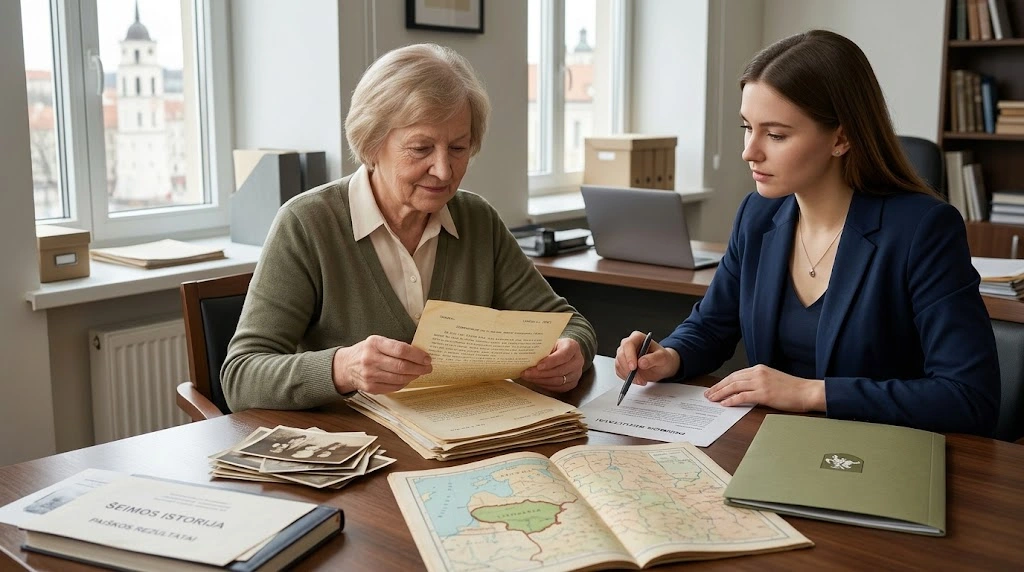
A common question in Latvian citizenship by descent cases is whether a parent must first become formally recognized as a Latvian citizen before their child can rely on the same family line.
The answer is not always yes. A parent already being registered as a Latvian citizen can make the legal position easier to understand, particularly when a child is born after the parent has established Latvian citizenship. However, some descendants may have their own basis for recognition as Latvian citizens even if the previous generation has never completed a separate citizenship procedure.
The distinction is especially important for families in the United States. A Latvian ancestor may have left Europe decades ago, and several generations may have been born in the United States without Latvian passports or entries in Latvia’s population records. That does not necessarily mean the citizenship connection disappeared.
The correct analysis usually depends on the legal basis of the claim, the status of the Latvian ancestor, when each generation was born, whether the family falls within a specific historical citizenship category, and whether the direct family line can be documented.
Does a Parent Need to Become a Latvian Citizen First?
Not necessarily.
For a child born to someone who was already a Latvian citizen at the time of the child’s birth, the position is relatively straightforward. Latvia’s citizenship rules recognize a person as a Latvian citizen when one or both parents were Latvian citizens at the time of birth, subject to the applicable citizenship and dual-citizenship rules. For a child born abroad, registration normally requires evidence of the child’s birth and the parent’s identity and citizenship status.
The situation becomes more complicated when neither the parent nor the child has previously been formally registered as a Latvian citizen.
In certain descent cases involving a person who was a Latvian citizen on June 17, 1940, current guidance from Latvia’s Office of Citizenship and Migration Affairs reflects the principle of continuity of Latvian citizenship. The authority explains that citizenship continued during the occupation period and could pass to subsequent generations. Where a qualifying ancestor was a Latvian citizen on June 17, 1940, the authorities may treat the later generation as having a Latvian citizen parent at the relevant time even though that parent never obtained a Latvian passport or completed a separate registration procedure.
This means that the practical question is often not simply, “Did my parent restore Latvian citizenship first?” Instead, it may be, “Was my parent legally within a line of Latvian citizenship that can be documented under the applicable rules?”
Formal Registration and Legal Citizenship Are Not Always the Same Question
Families often assume that citizenship only exists after a person receives a Latvian passport. That assumption can be misleading in ancestry cases.
A passport is evidence of citizenship, but it does not necessarily determine when the underlying citizenship connection began. Historical descent cases may require Latvia to examine whether citizenship existed through legal continuity even when several generations never requested Latvian documents.
For example, imagine that a Latvian citizen living before the occupation period had a child abroad. That child later had another child in the United States, and neither generation ever requested a Latvian passport. A grandchild researching the family’s status today should not automatically assume that the parent’s failure to register destroyed the family line.
The relevant question is whether the Latvian ancestor and later descendants satisfy the requirements of the applicable citizenship category.
This distinction is one of the most important concepts in understanding Latvian citizenship eligibility for multigenerational families.
When the Parent Was Already a Latvian Citizen at the Child’s Birth
The clearest scenario is when a parent was already recognized as a Latvian citizen when the child was born.
Latvian law provides for citizenship based on having one or both parents who were Latvian citizens at the time of birth. For children born outside Latvia, the Office of Citizenship and Migration Affairs has a specific registration procedure. The required materials generally include an application, the child’s birth record, identification documents for the parent or parents, and the child’s identification document if one exists.
For a U.S.-born child, the American birth certificate is therefore particularly important because it normally establishes the legal parent-child relationship.
A parent does not necessarily need to have been physically living in Latvia when the child was born. Latvian citizenship can continue while a citizen resides abroad, and residence outside Latvia does not by itself cause loss of Latvian citizenship.
In this type of case, the analysis generally focuses on proving that the parent was a Latvian citizen at the relevant date and connecting that parent to the child.
What If the Parent Has Never Registered Latvian Citizenship?
A parent who has never obtained a Latvian passport should not automatically be treated as someone who could never have been a Latvian citizen.
This issue frequently arises in American diaspora families. A grandparent or great-grandparent may have emigrated from Latvia, while the next generation was born in the United States and never interacted with Latvian authorities. Decades later, a child or grandchild discovers the Latvian family history.
Current OCMA guidance concerning descendants of persons who were Latvian citizens on June 17, 1940 is particularly important in these cases. It explains that, under the continuity principle, Latvian citizenship continued during the occupation and was transferred to subsequent generations where the relevant requirements are satisfied. The authority specifically states that if an ancestor was a Latvian citizen on June 17, 1940, it may be presumed that one of the applicant’s parents was a Latvian citizen at the time of the applicant’s birth.
As a result, a child may in some circumstances establish their own Latvian citizenship position without requiring the parent to complete a separate case first.
That does not mean every person with a Latvian ancestor qualifies. The ancestor’s actual citizenship, the applicable legal category, the dates involved, dual-citizenship rules, and documentary evidence all remain relevant.
Does Latvian Citizenship by Descent Pass Automatically to Children?
The word “automatically” should be used carefully.
There is a difference between having a legal basis for Latvian citizenship and having that citizenship formally documented in Latvia’s records.
A child whose parent is a Latvian citizen at birth may have a strong citizenship basis, but registration and supporting documents are still required before Latvian authorities can record the child’s status and issue Latvian identity documents.
Historical descent cases are even more fact-sensitive. Latvian citizenship by descent may extend through a direct family line, but the authorities must be able to establish the legal connection between the applicant and the qualifying Latvian citizen.
Therefore, it is more accurate to say that citizenship may pass through generations under Latvian law than to assume every descendant automatically has a usable Latvian citizenship status without documentation.
Can a Child Claim Latvian Citizenship If the Parent Is Not a Citizen?
Possibly, depending on what “not a citizen” means.
If the parent is genuinely a foreign national with no Latvian citizenship basis and there is no qualifying Latvian citizenship connection further back in the direct line, the child generally cannot create a descent claim merely because the family has Latvian heritage.
But a different analysis may apply if the parent has never been registered as Latvian while potentially belonging to a continuing Latvian citizenship line.
This distinction is critical.
A parent who does not possess a Latvian passport is not necessarily the same as a parent who has no Latvian citizenship connection under the law. The family history and the relevant legal route need to be examined before reaching that conclusion.
Similarly, a person who was merely born in Latvia or lived there is not automatically the same as a Latvian citizen. Descent cases normally require proof of the ancestor’s legal status, not only proof that the ancestor came from Latvian territory.
Latvian Citizenship Through Grandparents
Latvian citizenship through grandparents is common among U.S.-based families because the Latvian-born or Latvian-citizen generation may now be two generations removed from the applicant.
The parent does not necessarily have to complete a separate citizenship procedure simply because the claim runs through a grandparent. What matters is whether the applicant can establish the direct line and meet the rules of the relevant citizenship category.
A typical documentary chain might connect:
- the Latvian grandparent to the applicant’s parent;
- the applicant’s parent to the applicant;
- the qualifying ancestor to Latvian citizenship records.
Marriage certificates and name-change records may also be necessary where surnames differ between generations.
The fact that the parent never held a Latvian passport may therefore be less important than whether the parent’s place in the family line can be legally and documentarily established.
What About Latvian Citizenship by Descent Through Great-Grandparents?
Claims involving a great-grandparent require even greater care.
Latvian citizenship by descent through great grandparents may be possible in certain circumstances, but eligibility cannot be determined simply by counting generations. The legal category and historical facts matter.
For example, descendants of Latvian exiles are subject to specific statutory rules. The Citizenship Law contains provisions concerning Latvian citizens who left Latvia during the occupation period and their descendants, including a date-related rule for certain descendants born by October 1, 2014. Other cases may instead be assessed under citizenship-continuity principles.
This is one reason a great-grandparent case should not be reduced to a simple “three-generation rule.”
Two people with Latvian great-grandparents may have different outcomes because their ancestors left Latvia at different times, had different citizenship histories, or fall under different legal provisions.
What If the Child Was Born Before the Parent Established Latvian Citizenship?
This is one of the most important distinctions for families planning a citizenship case.
If the child was born after the parent was already a Latvian citizen, the child can generally rely on the rule concerning a Latvian citizen parent at the time of birth.
If the child was born before the parent’s citizenship was formally established, the result depends on why the parent later became recognized as Latvian.
Where the parent’s case confirms citizenship that legally continued through the family line, the absence of an earlier passport may not necessarily prevent the child from establishing citizenship.
By contrast, where the parent actually acquires Latvian citizenship later through a route that does not establish earlier citizenship continuity, the child should not automatically be treated as having had a Latvian citizen parent at birth.
There are also procedures under which children under a specified age may acquire citizenship together with a qualifying adult in certain cases. Current OCMA guidance concerning descendants of pre-1940 Latvian citizens states that children under age 15 may acquire Latvian citizenship together with an adult under that procedure.
The child’s age and the parent’s precise legal basis therefore matter.
Why the June 17, 1940 Citizenship Status Matters
For many Latvian-American families, June 17, 1940 is a central date.
Evidence that a direct ancestor belonged to Latvia’s citizen community on that date can be highly important in citizenship-continuity cases. OCMA identifies several forms of evidence that may establish this status, including Latvian civil-status records, historical census or military records, and pre-war Latvian passports.
Being born in Latvia is not necessarily enough.
An ancestor could have lived in Latvian territory without having Latvian citizenship. Conversely, a Latvian citizen could have been living abroad while retaining Latvian citizenship.
For this reason, citizenship research should distinguish among ancestry, birthplace, residence, ethnicity, and actual citizenship status.
Why the Parent’s Naturalization History Can Matter
For U.S.-based families, American naturalization records frequently become an important part of the historical analysis.
An ancestor may have emigrated from Latvia and later become a U.S. citizen. The date and circumstances of that naturalization can help reconstruct the person’s citizenship history and determine which Latvian citizenship rules may apply.
Useful records may include a certificate of naturalization, petition for naturalization, declaration of intention, alien registration materials, or other immigration and citizenship records.
The existence of U.S. citizenship does not automatically exclude Latvian citizenship. Latvia permits dual citizenship in a number of circumstances, and the United States falls within a category of countries covered by Latvia’s dual-citizenship provisions because it is a NATO member. The specific legal route still needs to be considered.
Naturalization documents can also help resolve spelling variations, addresses, dates of arrival, previous nationality descriptions, and changes in personal names.
Documents Needed to Prove the Parent-Child Citizenship Line
A descent case normally succeeds or fails on documentation rather than family stories alone.
The applicant usually needs to establish two separate elements: that the relevant ancestor had the necessary Latvian citizenship status and that the applicant is directly descended from that person.
For a U.S.-based family, U.S. civil records often form most of the generational chain.
Depending on the family history, relevant evidence may include:
- the applicant’s birth certificate;
- the parent’s birth certificate;
- grandparents’ and great-grandparents’ birth records;
- marriage certificates;
- divorce records where relevant;
- death certificates where they help identify individuals;
- adoption or parentage records;
- legal name-change documents;
- U.S. naturalization records;
- Latvian civil registry records;
- Latvian archival records;
- historical Latvian passports or other evidence of citizenship.
OCMA guidance for descendants of pre-1940 citizens expressly requires documents proving both the ancestor’s connection to the Latvian citizenry and the applicant’s relationship to that ancestor.
Name Changes and Americanized Latvian Names
Name discrepancies are common in Latvian-American family histories.
An ancestor named Jānis in Latvian records may appear as Janis, John, Johann, or another variant in U.S. records. Latvian diacritical marks may disappear. Surnames may be shortened or Americanized, and women may have different surnames after marriage.
These differences do not necessarily prevent a citizenship claim, but the documentary chain should explain why records with different names concern the same person.
Marriage certificates, court name-change orders, naturalization records, passenger records, and other official documents may help bridge these differences.
Latvian authorities may also require personal names to be rendered according to Latvian-language rules when the person is entered in Latvian records.
Apostilles, Legalization and Latvian Translations
Foreign documents used in a Latvian citizenship case may need authentication and translation.
The exact requirement depends on the country that issued the document and the method by which it is submitted. OCMA states that foreign birth, marriage, and name-change documents used in relevant citizenship procedures generally need to be legalized as required by law and translated into Latvian, subject to exceptions for certain countries and submission methods.
For documents issued in the United States, applicants should verify the current requirements for the particular document before preparing the final submission.
It is generally better to establish which records are actually needed before ordering multiple certified copies, apostilles, or translations.
What If the Parent Has a Latvian Non-Citizen Passport?
A Latvian non-citizen passport requires a different analysis.
A Latvian non-citizen is not a Latvian citizen. The non-citizen passport is an identity and travel document issued to persons who hold Latvia’s specific non-citizen status. OCMA describes this passport separately from a Latvian citizen passport and separately from a stateless person’s travel document.
The status developed in connection with certain former USSR citizens residing in Latvia who were not citizens of Latvia or another state. Latvian law also treats a Latvian non-citizen and a stateless person as distinct legal categories.
Therefore, a relative’s Latvian non-citizen passport should not be treated as proof that the relative was a Latvian citizen.
It also does not automatically establish Latvian citizenship by descent eligibility for a child or grandchild.
However, the document may still be useful in family-history research because it can establish identity, residence, status, and other information that may lead to earlier records. The family may have another ancestor who was a Latvian citizen, or historical documents may reveal a different citizenship basis.
The legal meaning of the Latvian non-citizen passport therefore depends on the individual’s status and the broader citizenship history of the family.
What If Important Family Documents Are Missing?
Missing documents do not always end the research process.
Many Latvian-American families do not possess an ancestor’s original birth certificate or pre-war passport. Historical records may instead need to be located through Latvian archives, civil registries, U.S. immigration files, naturalization records, or state and local vital-record offices.
The objective is to build a consistent evidentiary chain.
If one record is unavailable, another record may sometimes establish the same fact. A historical census entry, Latvian registry extract, archive statement, or citizenship document may be more useful than a family-held document whose legal significance is unclear.
Applicants should also distinguish between evidence proving Latvian ancestry and evidence proving Latvian citizenship. The two are related but not identical.
Common Mistakes When Assessing a Child’s Eligibility
One common mistake is assuming that the parent must obtain a Latvian passport before anyone in the next generation can proceed. That may be unnecessary where the child has an independent basis under citizenship-continuity rules.
The opposite mistake is assuming that every child of a person with Latvian ancestry automatically qualifies. Latvian heritage alone does not establish citizenship.
Another frequent problem is focusing only on the nearest parent while ignoring the citizenship status of the earlier Latvian ancestor. The legal analysis may depend on a grandparent or great-grandparent’s citizenship and historical circumstances.
Families also sometimes treat a Latvian birth record as conclusive proof of citizenship. A birth record can be important evidence, but citizenship and birthplace are separate legal facts.
Finally, inconsistencies in names, dates, marriages, or naturalization records should be addressed rather than ignored. A clear documentary chain is particularly important when several generations separate the applicant from the qualifying ancestor.
How to Assess Whether a Parent Must Establish Citizenship First
A useful starting point is to identify the precise basis of the family’s potential claim.
First, determine who the qualifying Latvian ancestor is and whether there is evidence that the person was actually a Latvian citizen.
Next, identify which Latvian citizenship category may apply. A claim involving a pre-1940 citizen, an exile and descendant, a Latvian or Liv, or a person born to a Latvian citizen parent may involve different rules.
Then establish the direct line from that person to the child.
The dates of birth of the parent and child should be compared with the citizenship history of the family. This helps determine whether the child was born to someone who was already a Latvian citizen as a matter of law or whether the child’s position depends on another route.
Only after these questions are answered can it be determined whether obtaining formal recognition for the parent first is necessary, useful, or potentially unnecessary.
Frequently Asked Questions
Can a child claim Latvian citizenship if the parent is not currently a Latvian citizen?
Possibly. If the parent has no Latvian citizenship basis at all, the child generally cannot create citizenship merely through that parent. However, if the family descends from a qualifying Latvian citizen and citizenship continuity can be established, the child may have an independent basis even though the parent never registered or obtained a Latvian passport.
Does a parent have to receive a Latvian passport before the child can claim citizenship?
Not necessarily. A passport documents citizenship, but historical descent cases can involve citizenship that existed through legal continuity before a passport was issued. The relevant issue is the parent’s legal citizenship status at the appropriate time, not simply whether the parent possessed a Latvian passport.
Can children claim Latvian citizenship by descent through grandparents?
They may be able to. A grandparent can form part of the direct citizenship line where the grandparent was a qualifying Latvian citizen and the applicant can document each generation between the grandparent and the child.
Can a child claim Latvian citizenship through a great-grandparent?
In some cases, yes, but great-grandparent cases require careful analysis of the applicable citizenship category, dates of birth, the ancestor’s citizenship status, and the direct family line. The number of generations alone does not determine eligibility.
Can a child inherit Latvian citizenship after a parent restores citizenship?
The answer depends on when the child was born and what legal basis was used for the parent’s citizenship. A child born after the parent is a Latvian citizen can generally rely on the Latvian-citizen-parent rule. A child born earlier may still have a possible route, but citizenship should not be assumed to arise retroactively in every type of case.
Does a parent’s U.S. citizenship prevent Latvian citizenship by descent?
Not automatically. Latvia permits dual citizenship in several circumstances, including with countries falling within specified categories such as NATO member states. Because the United States is a NATO member, U.S. citizenship can generally coexist with Latvian citizenship under relevant Latvian dual-citizenship provisions, although the exact citizenship route should still be checked.
Does a Latvian non-citizen passport prove that my parent was a Latvian citizen?
No. A Latvian non-citizen passport documents Latvia’s separate non-citizen status and is not a Latvian citizen passport. It may be useful evidence when reconstructing family history, but it does not by itself establish citizenship or a descendant’s right to Latvian citizenship.
What if my parent’s and grandparent’s names are spelled differently in U.S. and Latvian records?
Spelling differences do not necessarily prevent a claim. Latvian names may have been transliterated, Americanized, or changed through marriage or naturalization. Birth records, marriage certificates, naturalization documents, legal name-change records, and other evidence can help connect the different versions.
Does the parent and child need to submit citizenship cases separately?
Not in every situation. Current OCMA guidance for certain descendant cases provides that children under age 15 may acquire Latvian citizenship together with an adult. Older children or applicants relying on another legal category may require a different procedure. The appropriate approach depends on age and the citizenship basis.
Is Latvian ancestry alone enough for a child to qualify?
No. Latvian ancestry is a starting point, but the applicant generally needs to prove the relevant ancestor’s legal status and establish a direct family relationship from that ancestor to the applicant. Birthplace, ethnicity, or family stories alone may not prove citizenship.


 English [EN]