
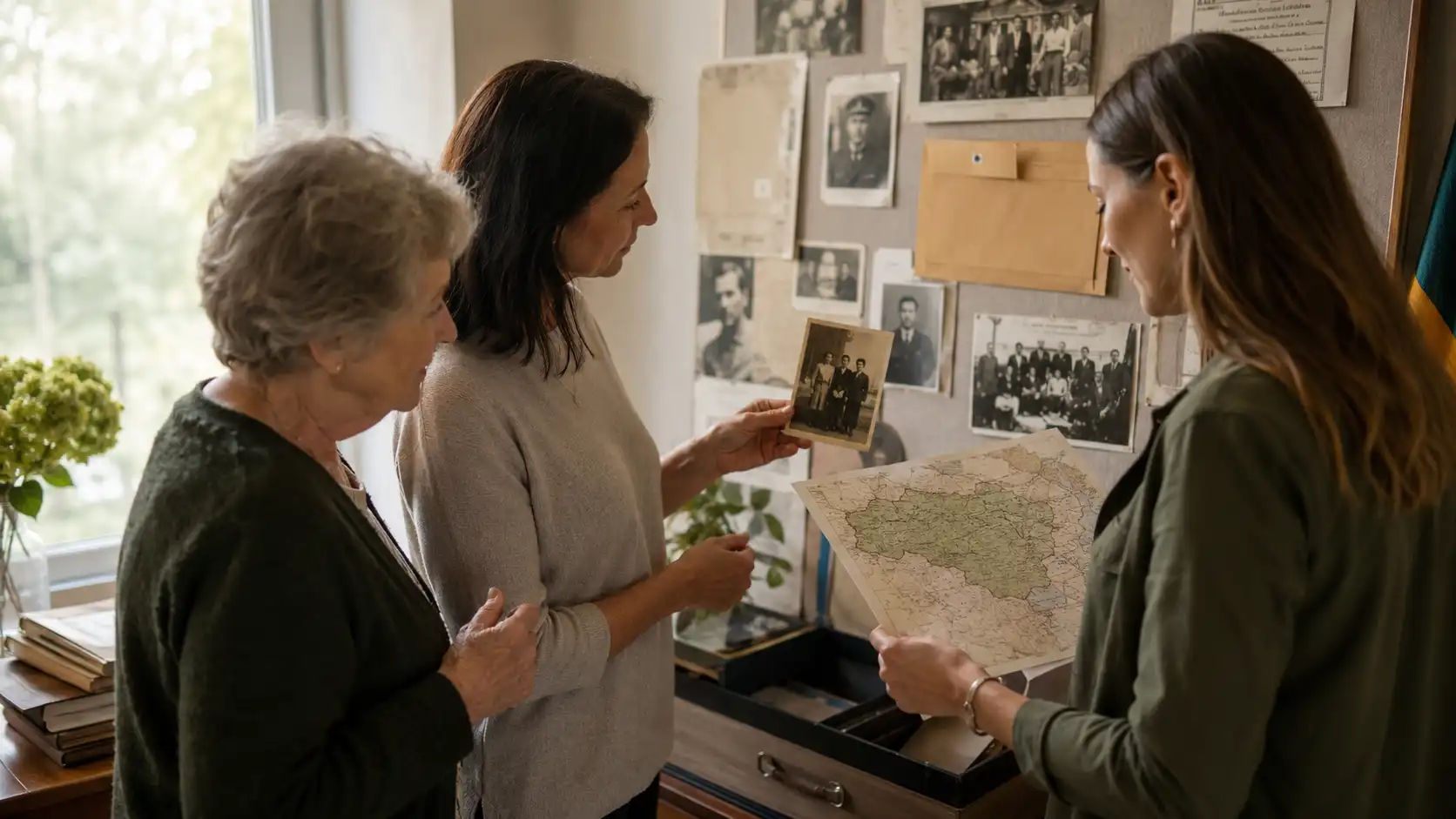
Children may be able to claim Latvian citizenship even when their parent’s case is based on a Latvian great-grandparent. However, the answer depends on more than the number of generations separating the child from the Latvian ancestor.
The relevant factors may include whether the ancestor was a Latvian citizen on June 17, 1940, whether the family qualifies under the rules for Latvian exiles and their descendants, whether the parent was already considered a Latvian citizen when the child was born, the child’s age, the child’s current citizenship, and the quality of the documentary evidence.
Current guidance from Latvia’s Office of Citizenship and Migration Affairs indicates that citizenship continuity may extend through subsequent generations when an ancestor was a Latvian citizen on June 17, 1940. The same guidance provides procedures for children to acquire or register citizenship with an adult applicant in certain circumstances. This means that a distant generation is not necessarily disqualified automatically, but the correct legal basis must be identified for each family member.
The Child’s Eligibility Is Not Determined Only by the Generation
People often ask about the Latvian citizenship by descent generation limit as though Latvia applies a simple rule allowing applications only through a parent, grandparent, or great-grandparent. In practice, the analysis can be more complicated.
A person born in Latvia, or a person with a Latvian-born ancestor, is not automatically eligible merely because of that geographic connection. The applicant usually needs to establish a legally relevant connection to a Latvian citizen or another qualifying citizenship category.
For a parent relying on a great-grandparent, the child may be one additional generation removed from the original Latvian ancestor. The child’s qualifying ancestor could therefore be a great-great-grandparent. That additional generation creates more documentation requirements, but it does not necessarily end the claim.
The central questions are usually whether the original ancestor held Latvian citizenship at the legally relevant time, whether citizenship could continue through the intermediate generations, and whether every parent-child relationship in the direct family line can be proved.
When the Parent Was Already a Latvian Citizen at the Child’s Birth
The clearest situation arises when one parent was a Latvian citizen at the time the child was born.
Under Latvian citizenship rules, a child may be regarded as a Latvian citizen when one or both parents were Latvian citizens at the time of birth. A child born outside Latvia can then be registered using the procedure for children born abroad to Latvian citizens.
In this situation, the historical distance between the child and the original great-grandparent is usually less important. The child’s immediate legal connection is to the Latvian parent rather than directly to the more distant ancestor.
The application generally requires the child’s birth record, identification documents for the parent or parents, and the child’s identification document if one has been issued. The birth record must clearly identify the Latvian parent. Additional evidence may be requested when names, dates, parental details, or civil-status information differ between the child’s record and the Latvian population records.
When the Child Was Born Before the Parent’s Citizenship Was Registered
A more complicated question arises when the child was already born before the parent completed the Latvian citizenship process.
Registration after the child’s birth does not always mean that the parent had no Latvian citizenship status when the child was born. Some citizenship-by-descent procedures recognize an existing status based on citizenship continuity rather than granting citizenship only from the date of the administrative decision.
Current OCMA guidance states that when an ancestor was a Latvian citizen on June 17, 1940, citizenship may be treated as continuing through subsequent generations. It explains that one of the applicant’s parents may be presumed to have been a Latvian citizen at the time of the applicant’s birth. Whether this reasoning applies to a particular parent and child depends on the legal basis, citizenship history, and evidence submitted.
Therefore, the question is not simply whether the parent received a Latvian passport before or after the child was born. A passport is evidence of citizenship, but it is not necessarily the event that created the citizenship status.
The authority may need to determine whether the parent’s citizenship existed through descent at the relevant time and whether that status could pass to the child.
Can a Minor Apply Together With the Parent?
A minor may sometimes be included in or processed alongside the parent’s citizenship case.
Official Latvian guidance states that children under the age of 15 may acquire Latvian citizenship together with an adult under certain descendant procedures. An application for a child under 15 is normally signed by the child’s parent or lawful representative.
Applicants who are 15 or older generally sign their own application. Current descendant procedures provide separate forms for children aged 15 to 18 and children under 15, although the exact documentation and procedural basis may differ.
This age distinction is important. Parents should not assume that all children under 18 can simply be added to the parent’s application in the same manner. A 16-year-old may need to participate directly and sign the relevant forms, while a parent usually acts on behalf of a younger child.
Can Adult Children Inherit Latvian Citizenship After Restoration?
Adult children are usually treated as separate applicants. They generally need their own application, identity documentation, birth record, and evidence connecting them to the relevant Latvian family line.
A parent’s successful citizenship decision can be highly useful evidence. It may establish that the Latvian ancestor was a citizen, confirm part of the family history, and provide an officially accepted connection between the ancestor and the parent.
However, an adult child should not assume that the parent’s approval automatically registers every descendant. The child may still need to prove the parent-child relationship and satisfy any requirements connected to dual citizenship or the applicable citizenship category.
The term “restoration” is commonly used in ancestry cases, but Latvian procedures may involve recognition, registration, acquisition, or restoration depending on the legal circumstances. The legal effect of the parent’s decision should therefore be reviewed rather than inferred from informal terminology.
Is There a Latvian Citizenship by Descent Generation Limit?
Current official guidance concerning descendants of pre-occupation Latvian citizens focuses on direct descent and citizenship continuity rather than stating a universal maximum number of generations.
The guidance explains that citizenship continued to be transferred to subsequent generations when an ancestor was a Latvian citizen on June 17, 1940. This may allow a person to rely on a great-grandparent, great-great-grandparent, or another direct ancestor if the legal conditions and complete documentary chain can be established.
This does not mean that every distant descendant qualifies. Each additional generation increases the possibility of missing certificates, inconsistent names, adoption issues, uncertain paternity, unregistered marriages, or incomplete citizenship records.
Separate rules may also apply to Latvian exiles and their descendants. Official guidance for the exile category refers to descendants born before October 1, 2014, in connection with concurrent citizenship. A person born after that date may need to rely on a different legal basis or receive an individual assessment of their citizenship status.
For US citizens, dual citizenship is generally permitted because the United States is a NATO member. Nevertheless, the applicant’s complete nationality history should still be disclosed, particularly if the applicant also holds citizenship of another country.
Why Documents Matter in Latvian Citizenship by Descent Cases
Latvian citizenship by descent is established through records, not only through family stories, DNA results, online family trees, or the fact that an ancestor was born in territory associated with Latvia.
The documents must usually prove two separate elements. First, they must establish the Latvian ancestor’s qualifying citizenship or historical status. Second, they must establish an uninterrupted family line from that ancestor to the applicant.
A parent may have enough evidence to prove their own connection to a great-grandparent, but the child’s application adds another generational link. The child’s birth certificate must connect the child to the parent, and the parent’s identity must correspond to the identity already established in the Latvian citizenship case.
Even a strong underlying claim may be delayed when the documentary chain contains unexplained discrepancies.
Documents Proving the Ancestor’s Latvian Citizenship
A record showing that a great-grandparent was born in Latvia may be important, but birthplace alone may not prove Latvian citizenship.
Evidence of the ancestor’s status may include a pre-war Latvian passport, Latvian civil-status records, census records, tax files, military conscription records, population records, or archival statements confirming membership in the Latvian community of citizens before the occupation.
Official guidance specifically identifies civil-status registration documents, information from the 1935 Latvian census, tax or military records, and pre-war Latvian passports as possible evidence of citizenship on June 17, 1940.
The appropriate document depends on when and where the ancestor was born, where the ancestor lived, when the ancestor left Latvia, and whether the ancestor later acquired another citizenship.
An archival record may be necessary when the original passport or citizenship document no longer exists. The authority may also evaluate multiple records together when no single document provides a complete answer.
Documents Proving the Family Line to the Child
The family line must normally be shown one generation at a time.
Birth certificates are usually the foundation of the evidence. Each certificate should identify the person’s parents and connect that person to the previous generation. A typical case based on a parent’s great-grandparent may require birth records for the Latvian ancestor’s child, grandchild, great-grandchild, the applying parent, and the parent’s child.
Marriage certificates may be needed when surnames changed between generations. They may also clarify the legal identity of a parent when a birth certificate uses a maiden name or a previous married name.
Death certificates can be relevant when they confirm a person’s full name, date and place of birth, spouse, parents, or residence. They may also be needed to obtain restricted archival or civil records. However, a death certificate containing secondary information may not always replace an unavailable birth or marriage record.
Divorce decrees, adoption records, court orders, delayed birth certificates, and official name-change documents may also be necessary depending on the family history.
Using US Civil Records to Prove Latvian Descent
For US-based families, the documentary chain is often built primarily from state and local civil records.
Long-form birth certificates are generally preferable because abbreviated certificates may omit the parents’ names, parents’ birthplaces, or other information needed to prove descent. The version submitted should usually be a recently issued certified copy rather than an ordinary photocopy or decorative hospital certificate.
Marriage certificates may be issued by a state, county, city, or court, depending on the jurisdiction and date. Applicants should confirm that the document is an official certified record and that it contains sufficient identifying information.
US death certificates may help connect an ancestor’s American identity to their Latvian identity, especially when they list the person’s original birthplace or parents. Because the information was often provided by a relative rather than the deceased person, errors are possible and should be compared with earlier records.
Federal census schedules, passenger manifests, Social Security applications, draft registrations, and church records can provide useful supporting evidence. They may help explain residences, relatives, immigration dates, and name variants. Nevertheless, such records may not be accepted as substitutes for official civil records when a birth or marriage certificate should exist.
Naturalization Records for Latvian Citizenship by Descent
US naturalization records can be central to a Latvian citizenship case.
A naturalization certificate, declaration of intention, petition for naturalization, certificate file, alien registration file, or court naturalization record may show when the ancestor acquired US citizenship. These records may also contain the ancestor’s original name, date and place of birth, arrival details, spouse, children, residence, and former nationality.
The timing may be legally important. If the case depends on proving that the ancestor was a Latvian citizen on June 17, 1940, records showing whether and when another citizenship was acquired may affect the analysis.
Applicants should not rely solely on a family statement that the ancestor “became American.” They should identify the actual naturalization date and obtain the most complete available file. USCIS provides historical immigration and naturalization files through its Genealogy Program, while some court naturalizations and older federal records may be held by the National Archives or local courts.
A naturalization index entry or database screenshot may help locate the record, but the authority may require a certified or otherwise officially issued copy.
Name Changes, Transliteration, and Americanization
Name inconsistencies are common in Latvian-American families and do not necessarily make the family line impossible to prove.
A Latvian surname may have been written without diacritical marks, transliterated from Latvian, Russian, German, or Yiddish, shortened after immigration, or adapted to English pronunciation. A woman’s surname may also appear in different forms before and after marriage.
For example, the same person’s surname may be recorded differently in a Latvian birth record, a passenger manifest, a US marriage certificate, and a naturalization petition. First names may also have English, Latvian, Russian, or German equivalents.
The application should not ignore these differences. The documentary package should demonstrate why the records relate to the same individual. Marriage certificates, court-ordered name changes, naturalization files, amended civil records, and consistent details such as birth date, birthplace, spouse, parents, and address can help connect the identities.
When a discrepancy is substantial, the authority may request additional evidence or an official correction. Affidavits may be useful as supporting explanations, but they are usually stronger when accompanied by contemporaneous records.
Certified Copies, Apostilles, and Latvian Translations
US-issued documents may need to be submitted as certified copies and authenticated for use in Latvia.
The specific authentication route depends on the issuing authority. State and local civil records are generally authenticated by the competent authority of the state that issued them. Federal documents, including certain naturalization-related documents, may follow a federal authentication process.
The Latvian Embassy in the United States indicates that when document copies are sent by mail, copies other than identity-document copies may need to be notarized, with the notarization certified by an apostille from the appropriate Secretary of State. Applicants should verify the current requirements for the particular document and submission method before ordering apostilles.
Documents issued abroad generally must be translated into Latvian under the relevant descendant procedures. An identity document may be exempt from translation, and limited exceptions may apply to certain documents submitted through a diplomatic or consular mission.
Translations, certifications, and apostilles should be prepared in the correct order. Notarizing the wrong document or obtaining an apostille from the wrong authority can result in rejection or the need to repeat the process.
What Happens When Documents Are Missing?
Missing records do not always end a Latvian citizenship case, but the applicant must usually show the relationship through other reliable evidence.
The first step is to determine whether the record is genuinely unavailable or has simply not been located. Records may exist in a different county, parish, archive, court, language, or surname variation.
When a certificate was never created or was destroyed, the applicant may need an official statement confirming that no record was found. Alternative documents can then be evaluated together. These may include church registers, census records, probate files, immigration records, school files, military records, Social Security records, family registers, or archival extracts.
The authority may give different evidentiary weight to different documents. A contemporaneous record created close to the relevant birth or marriage will usually be more persuasive than a later family tree or personal declaration.
When records conflict, the applicant should address the inconsistency directly. Submitting several contradictory documents without explanation can create doubts about the identity of the ancestor or the continuity of the family line.
Common Mistakes to Avoid
One common mistake is assuming that a Latvian birthplace proves Latvian citizenship. The ancestor may have been born before Latvia became independent, may have lived in Latvian territory without becoming a citizen, or may have lost citizenship before the relevant date.
Another mistake is preparing only the parent’s family line and overlooking the additional certificate connecting the child to the parent.
Applicants also frequently rely on short-form US certificates that do not contain enough parental information. Others submit uncertified photocopies, unofficial genealogy printouts, or documents without the required authentication and translation.
Name variations should not be left unexplained. A minor spelling difference may be straightforward, but several changes involving first names, surnames, birth dates, and birthplaces can prevent the authority from confirming that the records refer to the same person.
Finally, families should not assume that every child has the same procedural route. A child born after the parent’s citizenship was established, a child applying simultaneously with the parent, a 16-year-old applying separately, and an adult child may each require a different application strategy.
The Practical Answer for Families Using a Great-Grandparent
Can children claim Latvian citizenship through a great-grandparent? In many cases, they may have a viable path, but the answer must be based on the citizenship history and documents rather than on generation labels alone.
When the parent was a Latvian citizen at the child’s birth, the child may be registered through the parent. When the parent and a young child apply together, the child may be included under the applicable descendant procedure. When the child is older or already an adult, a separate application and independent proof of the family line may be required.
A child whose original Latvian ancestor is a great-great-grandparent is not necessarily excluded merely because another generation has been added. However, the applicant must usually prove every generational connection and establish that the original ancestor had the citizenship status required by the relevant Latvian legal category.
FAQ
Does Latvian citizenship by descent automatically pass to children?
It may pass to a child when one parent was a Latvian citizen at the time of the child’s birth. Registration and supporting documents are still usually required, particularly when the child was born outside Latvia. When the parent’s citizenship is recognized only later, the authority may need to determine whether the parent was legally a citizen at the time of birth.
Can my child inherit Latvian citizenship after I restore mine?
Possibly. A child born after the parent’s Latvian citizenship is established may normally have a direct claim through the parent. A child who was already born may be able to apply with the parent or through a separate descendant procedure. The result depends on the child’s age, the parent’s legal basis, and whether citizenship is recognized as having existed at the time of the child’s birth.
Can minors claim Latvian citizenship by descent?
Yes, minors may apply or be represented in a citizenship procedure. A parent or lawful representative generally signs for a child under 15. Applicants aged 15 or older usually sign their own application. The required forms and supporting documents depend on the citizenship category.
Can great-great-grandchildren claim Latvian citizenship?
They may be able to claim citizenship when they are direct descendants of a qualifying Latvian citizen and can prove the complete family line. Current official guidance refers to citizenship continuing through subsequent generations, but the applicant must still satisfy the relevant citizenship, dual-nationality, and documentary requirements.
Is a Latvian great-grandparent’s birth certificate enough?
Usually not. A birth certificate may prove the ancestor’s birthplace and parentage, but it may not prove that the person was a Latvian citizen on the legally relevant date. Additional Latvian passport, census, civil registry, tax, military, archive, or citizenship records may be needed.
Do I need death certificates for every deceased ancestor?
Not necessarily. Death certificates are useful when they establish identity, family relationships, name variations, or access rights to restricted records. They may not be required for every generation if the family line is already proved by birth and marriage records.
Why are US naturalization records important?
Naturalization records can show when the Latvian ancestor became a US citizen and may identify the ancestor’s original name, birthplace, spouse, children, and immigration history. This information can help determine whether the ancestor had the required Latvian citizenship status and connect Latvian records with US civil records.
What should I do if a surname changed after immigration?
The application should include records connecting the original Latvian name with the later US name. Naturalization petitions, marriage certificates, court orders, amended birth records, and other documents showing consistent birth dates, relatives, or addresses can help explain transliteration, Americanization, or marriage-related surname changes.
Can DNA evidence replace missing civil records?
DNA results may support genealogical research, but they usually do not replace official documents proving legal parentage and citizenship history. The authority will generally expect civil, archival, immigration, or court records establishing each relationship in the direct family line.
Do US documents need an apostille and Latvian translation?
Many US public documents submitted for use in Latvia require authentication or an apostille and translation into Latvian. The correct procedure depends on whether the document was issued by a state, local, or federal authority and how the application is submitted. Requirements should be confirmed before documents are notarized, translated, or authenticated.


 English [EN]